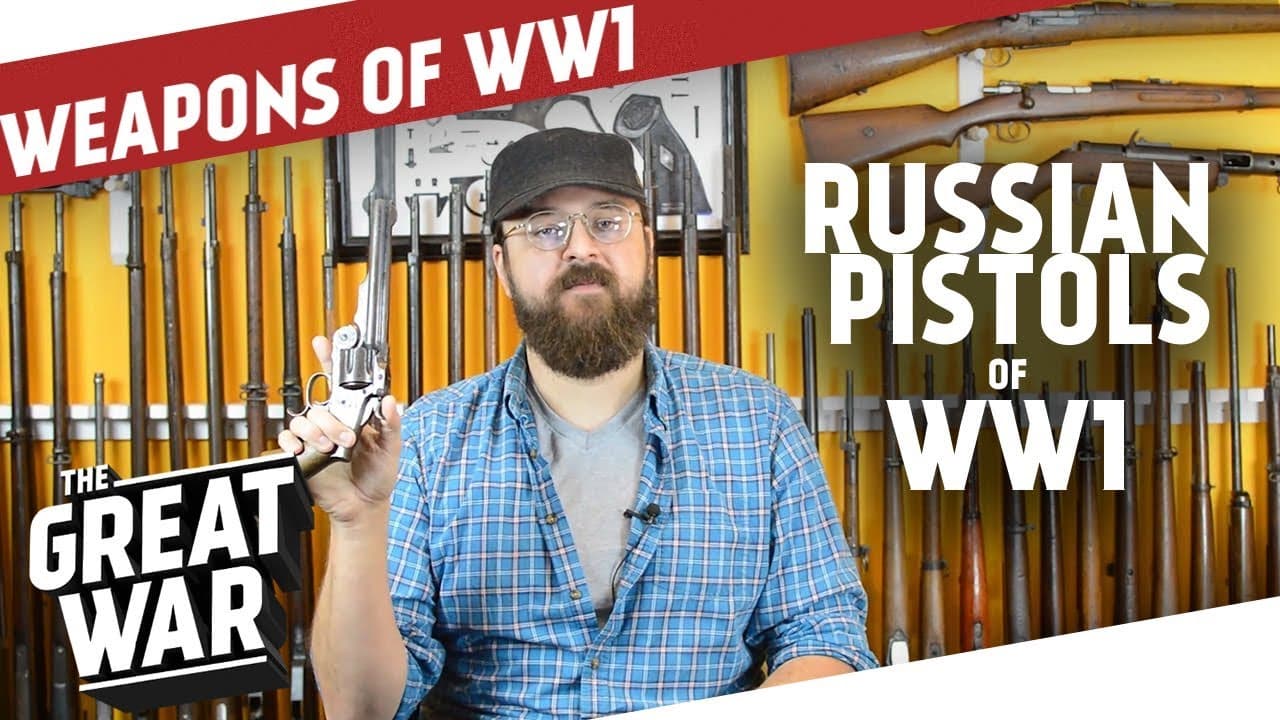
Russian Pistols of World War 1 I THE GREAT WAR Special feat. C&Rsenal
TL;DR
Exploration of Russian pistols used during World War I.
Transcript
i'm indy neidell and this is another great war livestream weapon special today featuring russian weapons from the first world war and my expert guest today who is always my expert for these things is Elias from C and Arsenal if you're not familiar with that channel it's a fantastic channel that of course covers weapons and there's also a series abo... Read More
Key Insights
- The Smith & Wesson No. 3 Russian revolver, adopted in the 1870s, was designed for quick loading on horseback and remained in use through WWI despite its single-action mechanism.
- Russia's economic and production challenges during WWI were significant, yet they managed to field large numbers of troops, sometimes relying on older technology.
- The Nagant M1895 revolver, Russia's primary handgun during WWI, was a double-action revolver with a unique gas-sealing system to prevent gas escape.
- The Nagant M1895 had a heavy trigger pull, often criticized for its mild cartridge and outdated design, yet it remained in service until the 1930s.
- The Ottomans used a unique rimfire Smith & Wesson No. 3 revolver, showcasing the varied and sometimes outdated weaponry employed by different nations during WWI.
- Russia's choice of handguns reflected their focus on reliability over innovation, as semi-automatic technology was still maturing.
- The Ottomans relied on modified or older firearms due to limited production capabilities and resources during WWI.
- The Great War channel collaborates with C&Rsenal to provide in-depth analysis and historical context of WWI firearms.
Install to Summarize YouTube Videos and Get Transcripts
Explore YouTube Video Summarizer or Get YouTube Transcript Extractor
Questions & Answers
Q: What was the primary Russian handgun during WWI?
The primary Russian handgun during World War I was the Nagant M1895 revolver. It was notable for its gas-sealing system, which prevented gas escape between the cylinder and barrel, although it was criticized for its heavy trigger pull and mild cartridge. Despite its outdated design, it remained in service until the 1930s.
Q: Why did Russia continue using older firearms during WWI?
Russia continued using older firearms during World War I due to economic and production challenges. Although they had the capability to produce a significant amount of equipment, their rapid mobilization of large numbers of troops outpaced their production capabilities, forcing them to rely on older technology and existing stockpiles of weapons like the Smith & Wesson No. 3 revolver.
Q: What was unique about the Nagant M1895 revolver?
The Nagant M1895 revolver was unique for its gas-sealing system, which moved the cylinder forward to seal against the barrel, preventing gas escape and increasing muzzle velocity. This design was intended to improve performance, although it resulted in a heavy trigger pull and was considered unnecessary for the mild cartridge it used. The revolver was both single and double action, with the latter being reserved for officers.
Q: How did the Ottomans' choice of firearms reflect their situation during WWI?
The Ottomans' choice of firearms, such as the rimfire Smith & Wesson No. 3, reflected their limited production capabilities and reliance on older or modified weapons. They often adopted firearms from other manufacturers and modified them for their use, as seen with the rimfire adaptation to match their existing ammunition. This approach highlighted the resource constraints and logistical challenges they faced during the war.
Q: What role did C&Rsenal play in the discussion?
C&Rsenal, represented by Elias, played a crucial role in the discussion by providing expert insights into the design, history, and usage of Russian pistols during World War I. Their collaboration with The Great War channel allowed for a detailed exploration of firearms like the Smith & Wesson No. 3 and the Nagant M1895, offering historical context and technical analysis to enhance viewers' understanding of these weapons.
Q: Why is the Nagant M1895's heavy trigger pull significant?
The heavy trigger pull of the Nagant M1895 is significant because it impacted the accuracy and usability of the revolver. A heavy trigger pull can cause the shooter to exert more force, potentially affecting aim and control, especially in stressful situations. This characteristic contributed to the revolver's mixed reputation, as it required more effort to fire accurately compared to other handguns of the time.
Q: How did the episode address misconceptions about Russian WWI firearms?
The episode addressed misconceptions about Russian WWI firearms by providing historical context and technical details that clarified their design and usage. For example, it explained the rationale behind the Nagant M1895's gas-sealing system and addressed the heavy trigger pull's impact on performance. By highlighting these aspects, the discussion aimed to offer a more nuanced understanding of why certain firearms were adopted despite their perceived shortcomings.
Q: What insights did the episode provide about WWI firearm technology?
The episode provided insights into WWI firearm technology by discussing the evolution and limitations of revolver designs, the transition to semi-automatic handguns, and the challenges of ammunition reliability. It highlighted how different countries approached firearm adoption based on their technological capabilities and strategic needs, illustrating the diverse landscape of weaponry during the war and the factors influencing military decisions regarding armaments.
Summary & Key Takeaways
-
Indy Neidell and Elias from C&Rsenal discuss Russian pistols from World War I, focusing on their history, design, and usage. They explore the Smith & Wesson No. 3 and the Nagant M1895, highlighting their features and the reasons behind their adoption.
-
The discussion includes Russia's economic and production challenges during the war, which influenced their reliance on older technology and handguns like the Nagant M1895, known for its gas-sealing system but criticized for its heavy trigger.
-
The episode also touches on Ottoman firearms, particularly a unique rimfire Smith & Wesson No. 3, illustrating the diverse and sometimes outdated weaponry used by different nations during the war.
Read in Other Languages (beta)
Share This Summary 📚
Summarize YouTube Videos and Get Video Transcripts with 1-Click
Try YouTube Summary with ChatGPT & Claude or YouTube Transcript Generator
Explore More Summaries from The Great War 📚


Summarize YouTube Videos and Get Video Transcripts with 1-Click
Try YouTube Summary with ChatGPT & Claude or YouTube Transcript Generator