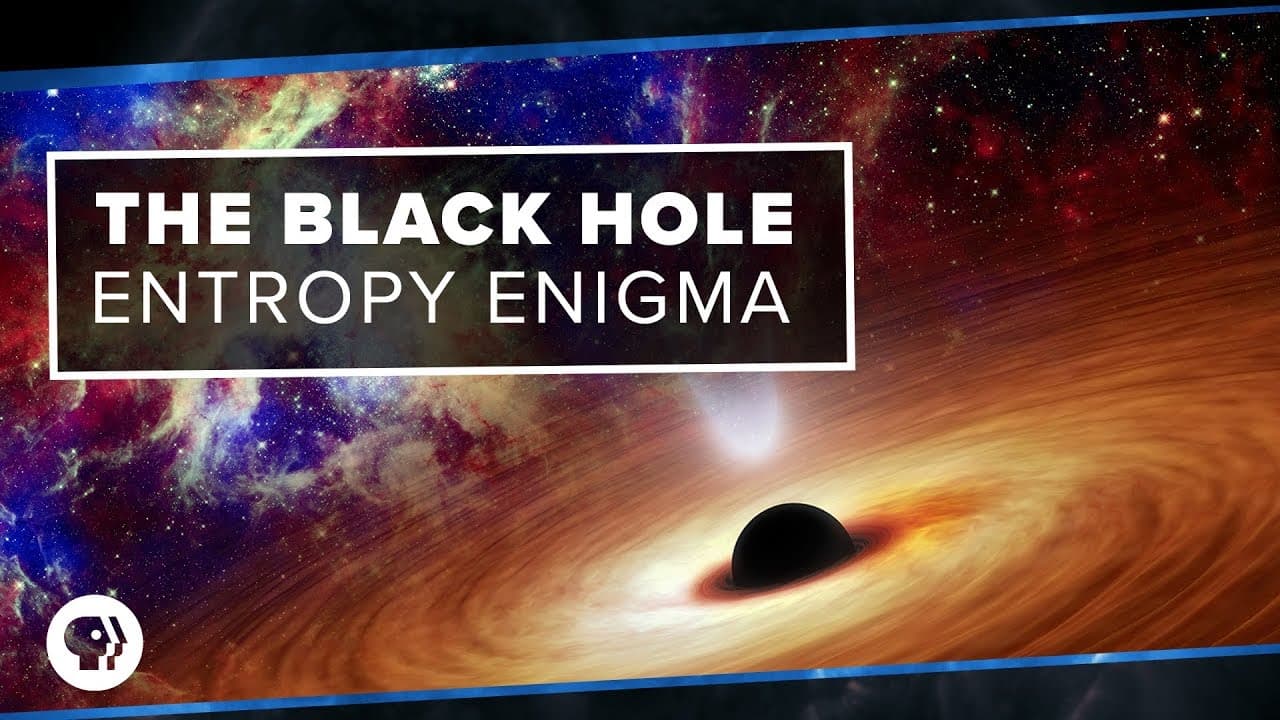
The Black Hole Entropy Enigma
TL;DR
Black holes contain most of the universe's entropy, hinting at a holographic universe.
Transcript
Thanks to Curiosity Stream for supporting PBS Digital Studios Black holes seem like they should have no entropy; but, in fact, they hold most of the entropy in the universe. Let's figure this out. At first it seemed that black holes were so simple they should have no entropy. Well it turns out they contain most of the entropy in the universe...
Key Insights
- Black holes, despite their simplicity, hold most of the universe's entropy, challenging traditional views of thermodynamics and quantum mechanics.
- The No Hair Theorem suggests black holes are defined by mass, spin, and electric charge, losing most other information to the outside universe.
- Jacob Bekenstein connected black holes to thermodynamics, leading to a new understanding of the universe through information theory.
- The black hole information paradox arises from the potential destruction of quantum information as black holes evaporate.
- Gerard 'T Hooft proposed that information could be preserved on a black hole's event horizon, resolving the information paradox.
- Bekenstein discovered that a black hole's entropy is proportional to its surface area, not its volume, using the Boltzmann constant.
- Stephen Hawking's theory of Hawking Radiation confirmed black holes have entropy and temperature, aligning with Bekenstein's findings.
- The concept of the Bekenstein Bound and the Holographic Principle suggests the universe's information is encoded on a 2D surface.
Install to Summarize YouTube Videos and Get Transcripts
Explore YouTube Video Summarizer or Get YouTube Transcript Extractor
Questions & Answers
Q: What is the significance of the No Hair Theorem in black hole physics?
The No Hair Theorem posits that black holes are defined by just three properties: mass, spin, and electric charge. This implies that all other information about the matter that forms a black hole is lost to the outside universe, presenting a challenge to quantum mechanics, which holds that information cannot be destroyed. The theorem is crucial in understanding the black hole information paradox and the nature of entropy in black holes.
Q: How did Jacob Bekenstein relate black holes to thermodynamics?
Jacob Bekenstein connected black holes to thermodynamics by observing that the surface area of a black hole's event horizon is analogous to entropy, which always increases according to the second law of thermodynamics. He proposed that a black hole's entropy is proportional to its surface area, not its volume, leading to the concept of black hole thermodynamics. This insight has profound implications for understanding the informational content of the universe.
Q: What is the black hole information paradox?
The black hole information paradox arises from the conflict between general relativity and quantum mechanics. According to quantum mechanics, information cannot be destroyed, yet when black holes evaporate through Hawking Radiation, it seems as though the information about the particles that fell into the black hole is lost. This paradox challenges our understanding of fundamental physics and has led to various proposed resolutions, including the preservation of information on the event horizon.
Q: How did Gerard 'T Hooft propose to resolve the black hole information paradox?
Gerard 'T Hooft proposed that the information contained by particles falling into a black hole could be preserved on the event horizon. This information could then be imprinted on the outgoing Hawking Radiation, allowing it to escape back into the universe. This idea suggests that the event horizon acts as a storage medium for information, thus resolving the paradox and aligning with the principles of quantum mechanics.
Q: What role does the Boltzmann constant play in Bekenstein's theory?
In Bekenstein's theory, the Boltzmann constant is used to quantify the entropy of a black hole. He estimated the information lost into a black hole as it grows, using an idealized model of elementary particles. The entropy is defined as the information hidden in a system's microscopic configuration multiplied by the Boltzmann constant, showing that black hole entropy is proportional to the surface area of the event horizon.
Q: How did Stephen Hawking's work confirm Bekenstein's findings?
Stephen Hawking's work on Hawking Radiation confirmed Bekenstein's findings by showing that black holes emit radiation as if they have a temperature. Hawking calculated the entropy of a black hole using this temperature and found results consistent with Bekenstein's theory, with black hole entropy being proportional to the surface area of the event horizon. This provided a thermodynamic basis for black hole entropy and supported the idea that black holes contain substantial entropy.
Q: What is the Bekenstein Bound?
The Bekenstein Bound is a concept derived from Bekenstein's work, stating that the maximum amount of information that can be contained within a given volume of space is proportional to the surface area bounding that space. This idea challenges the intuitive notion that information capacity depends on volume and suggests that the universe's informational content is encoded on a 2D surface. The Bekenstein Bound is a key element in the development of the Holographic Principle.
Q: What is the Holographic Principle and its implications?
The Holographic Principle is the idea that the entire 3D volume of the universe is a projection of information encoded on a 2D surface surrounding the universe. This principle emerged from the realization that black hole entropy is proportional to surface area, not volume. It suggests a revolutionary way of understanding space, information, and the universe, with implications for string theory and the nature of reality, proposing that the universe might be a hologram.
Summary & Key Takeaways
-
Black holes, once thought to be simple, actually contain most of the universe's entropy, challenging the second law of thermodynamics. Jacob Bekenstein's insights linked black holes to thermodynamics, suggesting a new way to understand the universe through information theory.
-
Gerard 'T Hooft proposed a resolution to the black hole information paradox by preserving information on the event horizon. Bekenstein discovered that a black hole's entropy is proportional to its surface area, a concept confirmed by Stephen Hawking's work on Hawking Radiation.
-
The Bekenstein Bound and the Holographic Principle suggest that the universe's information is encoded on a 2D surface, leading to a revolutionary understanding of space and information. This idea implies that the universe might be a hologram, with implications for string theory.
Read in Other Languages (beta)
Share This Summary 📚
Summarize YouTube Videos and Get Video Transcripts with 1-Click
Try YouTube Summary with ChatGPT & Claude or YouTube Transcript Generator
Explore More Summaries from PBS Space Time 📚

Summarize YouTube Videos and Get Video Transcripts with 1-Click
Try YouTube Summary with ChatGPT & Claude or YouTube Transcript Generator