Russia's Great Retreat 1915 (WW1 Documentary)
TL;DR
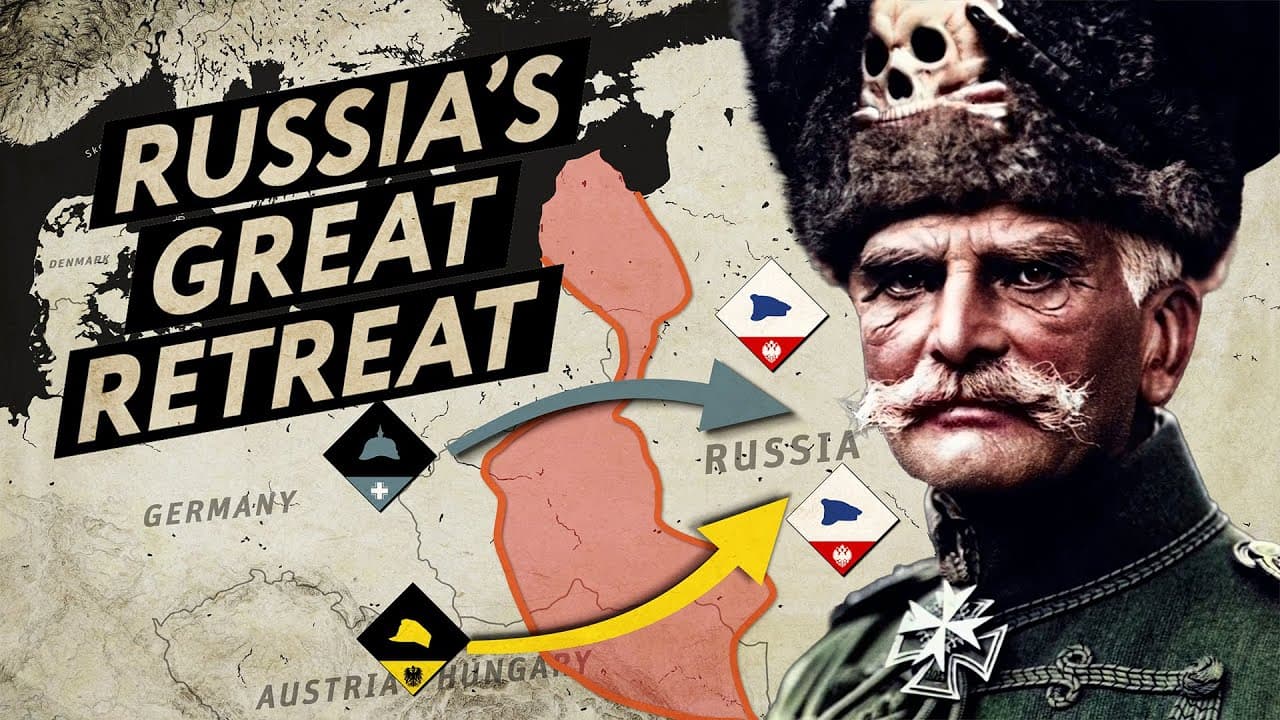
The Central Powers' offensive forced a massive Russian retreat in 1915.
Transcript
By early 1915, the Eastern Front ran on a line that left part of East Prussia and much of Galicia in Russian hands, while Central Powers forces occupied part of Russian Poland. In January, the Germans used poison gas for the first time in history, attacking Russian forces at Bolimov with tear gas. The Germans then attacked at the 2nd Battle of ... Read More
Key Insights
- In early 1915, the Eastern Front saw significant territorial changes with Russia holding parts of East Prussia and Galicia, while Central Powers occupied parts of Russian Poland.
- The Germans introduced poison gas warfare at the Battle of Bolimov, marking a new phase in military tactics.
- The Austro-Hungarian offensive in the Carpathians failed disastrously, leading to the fall of the Przemysl fortress and heavy casualties.
- Russia faced severe shortages in trained personnel and military supplies, exacerbating their strategic challenges on the Eastern Front.
- The Central Powers, led by German General Mackensen, launched a successful offensive in May 1915, breaking through Russian lines and advancing significantly.
- The Russian retreat resulted in massive casualties and territorial losses, with over a million soldiers killed, wounded, or captured.
- Internal tensions within both the Central Powers and Russian commands influenced strategic decisions, leading to mixed results despite military successes.
- The Great Retreat marked a critical moment in WW1, weakening Russia and prompting political and military reforms as internal unrest grew.
Install to Summarize YouTube Videos and Get Transcripts
Explore YouTube Video Summarizer or Get YouTube Transcript Extractor
Questions & Answers
Q: What was the strategic significance of the 1915 Central Powers' offensive on the Eastern Front?
The 1915 Central Powers' offensive was strategically significant as it aimed to relieve pressure on Austria-Hungary and weaken Russia. By breaking through Russian lines, the offensive forced a massive Russian retreat, inflicting heavy casualties and capturing significant territory. This shifted the strategic balance in favor of the Central Powers and exposed Russia's military vulnerabilities.
Q: How did the use of poison gas influence the battles on the Eastern Front in 1915?
The use of poison gas by the Germans at the Battle of Bolimov marked a new phase in warfare, introducing chemical weapons as a tactic. This had a psychological impact on Russian troops and demonstrated the evolving nature of military tactics during WW1. The introduction of gas warfare added a new dimension to the conflict, complicating defensive strategies.
Q: What challenges did Russia face in maintaining its military strength during the Great Retreat?
Russia faced significant challenges in maintaining its military strength during the Great Retreat, including shortages of trained personnel, officers, and critical supplies like rifles and artillery shells. The logistical issues were compounded by internal disagreements among generals about strategic priorities, further weakening Russia's ability to mount an effective defense against the Central Powers' offensive.
Q: What were the outcomes of the Austro-Hungarian offensive in the Carpathians?
The Austro-Hungarian offensive in the Carpathians was a disaster, resulting in heavy casualties and the loss of the Przemysl fortress. The offensive failed to achieve its objectives, highlighting Austria-Hungary's military weaknesses and contributing to the strategic dilemmas faced by the Central Powers. The failure also underscored the challenges of conducting winter campaigns in difficult terrain.
Q: How did internal tensions within the Central Powers affect their military strategy?
Internal tensions within the Central Powers, particularly between German and Austro-Hungarian commanders, affected military strategy by complicating coordination and decision-making. Disagreements over strategic priorities, such as focusing on the Eastern Front versus other theaters, led to strained relations and impacted the effectiveness of their campaigns despite achieving military successes.
Q: What impact did the Great Retreat have on Russia's political and military situation?
The Great Retreat had a profound impact on Russia's political and military situation, leading to calls for reforms and highlighting the weaknesses in Russia's military infrastructure. The retreat exacerbated internal tensions, leading to political unrest and contributing to the eventual formation of the Progressive Block, which demanded changes in governance and military strategy.
Q: How did the Central Powers' victories influence the broader context of World War I?
The Central Powers' victories during the Great Retreat influenced the broader context of World War I by shifting the balance of power on the Eastern Front. These victories weakened Russia, forced it to reconsider its military strategies, and increased the Central Powers' leverage. However, strategic dilemmas and new fronts, such as Italy's entry into the war, complicated their position.
Q: What were the humanitarian consequences of the Great Retreat for civilians?
The humanitarian consequences of the Great Retreat were severe, with millions of civilians displaced as refugees due to the advancing Central Powers. The retreat created a humanitarian crisis, overwhelming Russian authorities and leading to significant suffering. Civilians in occupied territories faced harsh conditions, forced labor, and repressive measures, exacerbating the war's impact on the civilian population.
Summary & Key Takeaways
-
In 1915, the Eastern Front was a focal point of World War I, with Russia initially holding parts of East Prussia and Galicia. However, the Central Powers launched a major offensive, leading to significant Russian territorial losses and casualties.
-
The Central Powers' offensive, led by German General Mackensen, was marked by innovative tactics, including the use of poison gas and overwhelming artillery fire, which forced a massive Russian retreat and reshaped the Eastern Front.
-
The Great Retreat of 1915 was a turning point in the war, exposing Russia's military weaknesses and leading to internal political upheaval. Despite initial successes, the Central Powers faced strategic dilemmas and internal tensions that complicated their military campaigns.
Read in Other Languages (beta)
Share This Summary 📚
Summarize YouTube Videos and Get Video Transcripts with 1-Click
Try YouTube Summary with ChatGPT & Claude or YouTube Transcript Generator
Explore More Summaries from The Great War 📚
Summarize YouTube Videos and Get Video Transcripts with 1-Click
Try YouTube Summary with ChatGPT & Claude or YouTube Transcript Generator