Mechanical Engineering: Crash Course Engineering #3
TL;DR
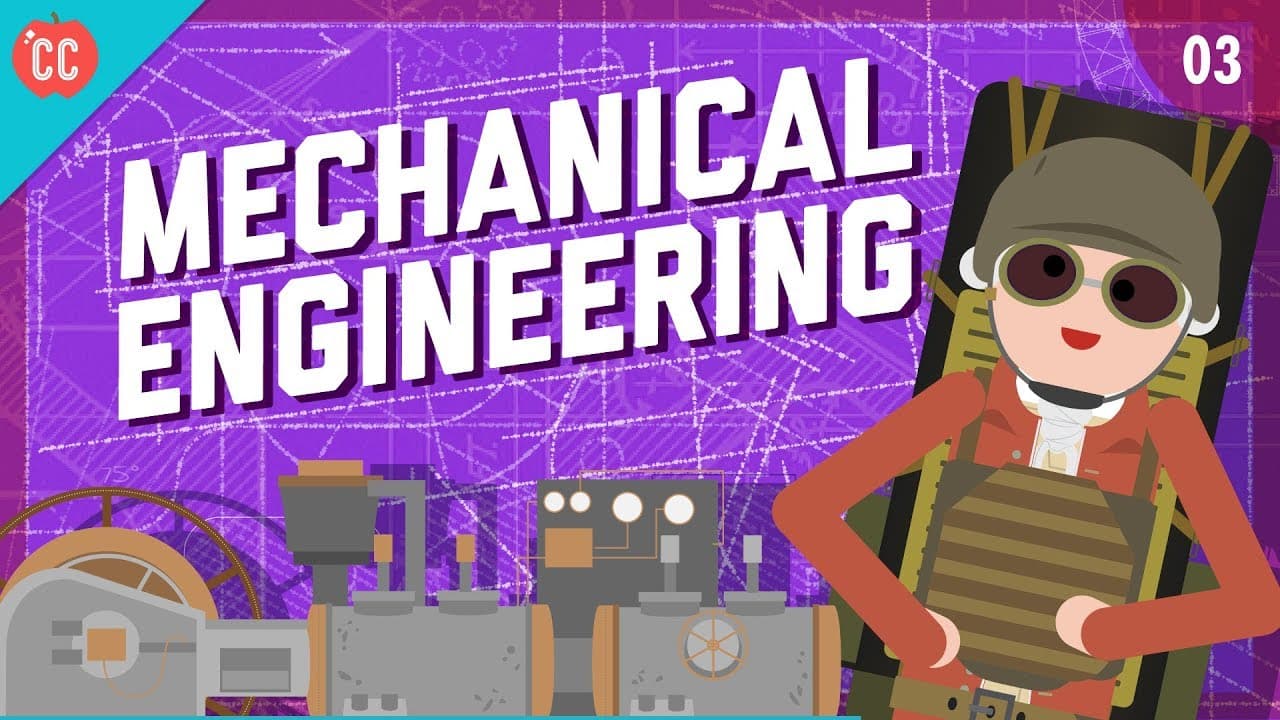
Mechanical engineers revolutionized history with inventions like steam engines and robots.
Transcript
Mechanical engineers have changed the world. You could even say: the course of history. Not just once but countless times. Because they’ve identified problems that were holding humanity back, and they solved them. Things were too big and heavy to move. Travel was too difficult. Distances too far. Our bodies were too weak. If you can think of an inv... Read More
Key Insights
- Mechanical engineering has been pivotal in solving major historical challenges, such as transportation and machinery development, altering the course of human history.
- The evolution of the steam engine, starting with Thomas Newcomen and later improved by James Watt, was crucial in the Industrial Revolution, enhancing productivity and efficiency.
- The development of aircraft, beginning with the Wright brothers' Flyer, was a significant leap in transportation, later leading to advanced jet engines during World War II.
- Robotics has transformed industrial work environments by handling tasks too dangerous or precise for humans, starting with the introduction of Unimate in the 1960s.
- Biomechanics is a cutting-edge field within mechanical engineering, focusing on creating devices like exoskeletons to enhance human capabilities, particularly in military and medical applications.
- Mechanical engineers continue to address modern challenges, such as improving traffic systems and ensuring efficient resource distribution to remote areas.
- The aerospace sector, an offshoot of mechanical engineering, has enabled space exploration, sending satellites and rovers beyond Earth's atmosphere.
- Mechanical engineering integrates various disciplines to develop systems that mimic human functions, enhancing capabilities in fields like healthcare and disaster response.
Install to Summarize YouTube Videos and Get Transcripts
Explore YouTube Video Summarizer or Get YouTube Transcript Extractor
Questions & Answers
Q: What role did mechanical engineering play in the Industrial Revolution?
Mechanical engineering was crucial in the Industrial Revolution, primarily through the development of the steam engine. This innovation, initially designed by Thomas Newcomen and later improved by James Watt, enabled more efficient production processes and transportation, significantly boosting industrial productivity and economic growth.
Q: How did the Wright brothers contribute to mechanical engineering?
The Wright brothers, Wilbur and Orville, were pioneers in aviation, designing the first powered aircraft, the Wright Flyer, in 1903. Their work laid the foundation for modern aerospace engineering, demonstrating the potential of powered flight and leading to significant advancements in aircraft technology.
Q: What impact did robotics have on industrial environments?
Robotics revolutionized industrial environments by automating tasks that were too dangerous, repetitive, or precise for humans. The introduction of the Unimate robot in the 1960s marked the beginning of this transformation, enhancing efficiency and safety in manufacturing processes, particularly in the automotive industry.
Q: In what ways has biomechanics advanced mechanical engineering?
Biomechanics has pushed the boundaries of mechanical engineering by developing technologies that mimic human movement and capabilities. Innovations like exoskeleton suits and robotic limbs are designed to enhance human strength and mobility, offering significant benefits in medical rehabilitation and military applications.
Q: What challenges do mechanical engineers face today?
Today's mechanical engineers tackle challenges such as improving transportation systems, ensuring efficient resource distribution, and developing sustainable technologies. They also focus on advancing robotics and biomechanics to address issues like mobility disorders and enhancing human capabilities in various fields.
Q: How has mechanical engineering influenced space exploration?
Mechanical engineering has been fundamental to space exploration, contributing to the design and development of spacecraft and satellites. The aerospace sector, an extension of mechanical engineering, has enabled missions beyond Earth, including sending rovers to Mars and launching satellites for communication and research.
Q: What are some key historical innovations in mechanical engineering?
Key historical innovations in mechanical engineering include the steam engine, which revolutionized industrial production, and the development of aircraft, starting with the Wright Flyer. These advancements laid the groundwork for modern transportation and industrial processes, showcasing the field's transformative impact.
Q: What future developments are expected in mechanical engineering?
Future developments in mechanical engineering are likely to focus on sustainable technologies, advanced robotics, and enhanced biomechanics. Engineers aim to create more efficient systems for transportation and resource management, while continuing to innovate in fields like aerospace and healthcare, addressing both current and emerging challenges.
Summary & Key Takeaways
-
Mechanical engineering has been instrumental in solving historical challenges, from creating the steam engine to advancing aircraft technology. Engineers like Thomas Newcomen and James Watt played key roles in these developments, which propelled the Industrial Revolution and transformed transportation.
-
The field has expanded to include robotics and biomechanics, with innovations like the Unimate robot and exoskeleton suits enhancing industrial and medical capabilities. These advancements have improved efficiency and safety in various environments, showcasing the versatility of mechanical engineering.
-
Mechanical engineers continue to address contemporary issues, such as traffic management and resource distribution, while contributing to aerospace advancements. Their work ensures ongoing progress in technology, maintaining their pivotal role in shaping the future.
Read in Other Languages (beta)
Share This Summary 📚
Summarize YouTube Videos and Get Video Transcripts with 1-Click
Try YouTube Summary with ChatGPT & Claude or YouTube Transcript Generator
Explore More Summaries from CrashCourse 📚





Summarize YouTube Videos and Get Video Transcripts with 1-Click
Try YouTube Summary with ChatGPT & Claude or YouTube Transcript Generator