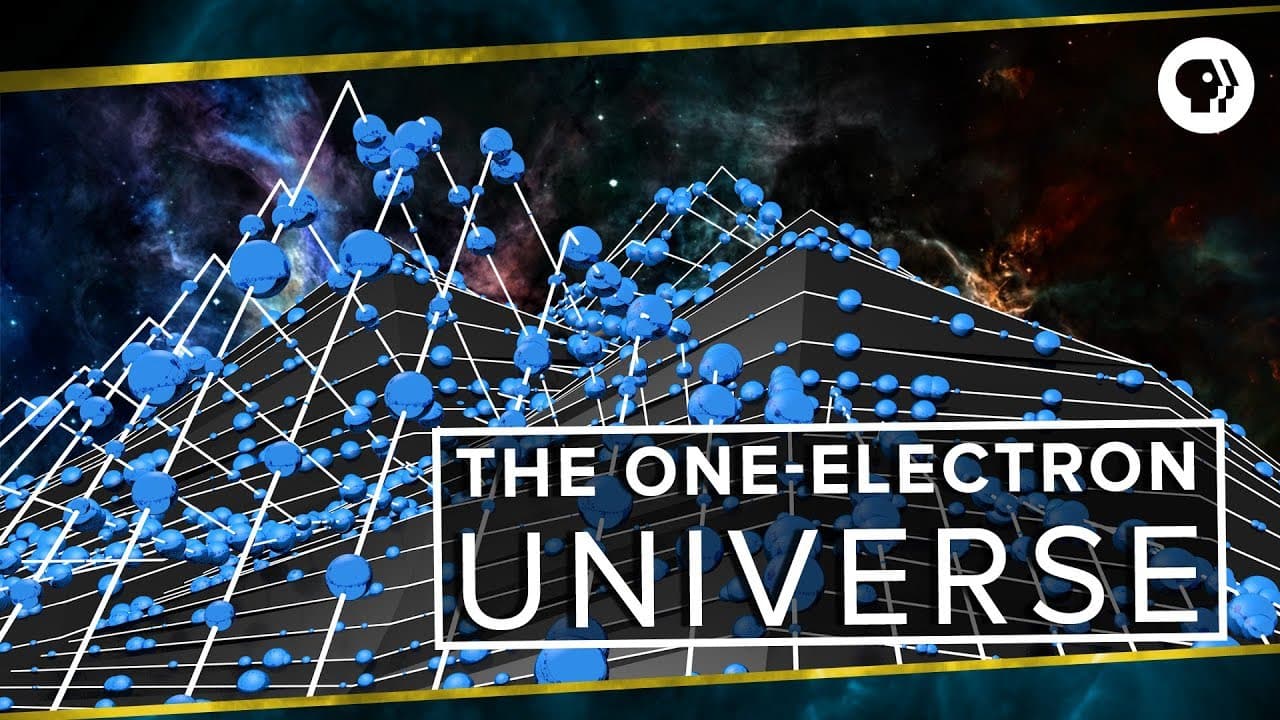
The One-Electron Universe | Space Time
TL;DR
Explores the idea that all electrons are one electron in time.
Transcript
Sometimes, seemingly crazy ideas in physics lead to the most profound advances. For example: the idea that every electron in the universe is really the one same electron.. traveling forwards and backwards in time. In the spring of 1940 the great physicist John Archibald Wheeler had a flash of insight. He picked up the phone and called Richard Feynm... Read More
Key Insights
- John Archibald Wheeler proposed the 'One-Electron Universe' theory, suggesting all electrons are the same electron traveling through time.
- Richard Feynman incorporated the concept of antimatter as time-reversed matter into his Nobel-winning quantum mechanics work.
- The 'One-Electron Universe' theory arose from the observation that all electrons are identical in charge and mass.
- Electrons can be visualized as worldlines in space-time, potentially zigzagging back and forth, creating the illusion of many electrons.
- Antimatter is mathematically equivalent to time-reversed matter, simplifying quantum field theory calculations and reducing Feynman diagrams.
- Wheeler's hypothesis faces challenges, such as the imbalance of electrons and positrons, which he humorously suggested could be hiding in protons.
- Modern physics views electrons as oscillations in a field, making the idea of a single electron with an identifying label problematic.
- The concept poetically suggests that all particles in the universe, including those in our bodies, are the same entity separated by time.
Install to Summarize YouTube Videos and Get Transcripts
Explore YouTube Video Summarizer or Get YouTube Transcript Extractor
Questions & Answers
Q: What is the 'One-Electron Universe' theory?
The 'One-Electron Universe' theory, proposed by John Archibald Wheeler, suggests that all electrons in the universe are actually the same electron traveling back and forth through time. This concept arose from the observation that all electrons have identical properties, such as charge and mass, and was intended to explain this uniformity.
Q: How did Richard Feynman incorporate the concept of antimatter into his work?
Richard Feynman was inspired by the idea of antimatter as time-reversed matter, a concept initially proposed by Ernst Stueckelberg. Feynman incorporated this idea into his path integral formulation and space-time interpretation of quantum mechanics. This approach simplified quantum field theory calculations and played a crucial role in his Nobel Prize-winning work.
Q: What challenges does the 'One-Electron Universe' theory face?
The 'One-Electron Universe' theory faces significant challenges, particularly the imbalance between electrons and positrons. According to the theory, there should be equal numbers of both particles, but this is not observed. Wheeler humorously suggested that positrons might be hiding in protons, but this idea is not taken seriously in the scientific community.
Q: How does the concept of worldlines relate to electrons?
In the context of the 'One-Electron Universe' theory, electrons are visualized as worldlines in space-time rather than point-like particles. These worldlines can zigzag back and forth, creating the appearance of multiple electrons. This perspective aligns with the idea of antimatter as time-reversed matter, offering a unique way to conceptualize particle interactions in quantum mechanics.
Q: What is the significance of CPT transformation in quantum field theory?
CPT transformation is a fundamental symmetry in quantum field theory, involving charge conjugation (C), parity inversion (P), and time reversal (T). This symmetry ensures that if all three transformations are applied simultaneously, a particle returns to its original state. The concept is crucial for understanding the behavior of particles and their antimatter counterparts in quantum mechanics.
Q: Why is the idea of a single electron problematic in modern physics?
In modern physics, electrons are understood as oscillations or waves in a more fundamental electron field, rather than discrete particles with identifying labels. This field-based perspective makes the idea of a single electron traversing time and space problematic, as it contradicts the current understanding of particle physics and quantum field theory.
Q: How does the 'One-Electron Universe' theory contribute to the field of physics?
Despite its challenges, the 'One-Electron Universe' theory has contributed to the field of physics by inspiring new ways of thinking about particle interactions and the nature of antimatter. It played a role in Richard Feynman's development of key concepts in quantum mechanics, ultimately influencing the way physicists approach complex calculations and theoretical models.
Q: What poetic notion does the 'One-Electron Universe' theory suggest?
The 'One-Electron Universe' theory suggests a poetic notion that every particle in the universe, including those in our bodies, is the same entity, separated by time and space. This idea envisions all particles as part of a single thread, weaving back and forth across the cosmos, connecting everything in a continuous, timeless journey.
Summary & Key Takeaways
-
The 'One-Electron Universe' theory, proposed by John Archibald Wheeler, posits that all electrons are the same electron traveling through time. This idea, though not widely accepted, inspired Richard Feynman's work on antimatter and quantum mechanics, leading to significant advances in the field.
-
Electrons are visualized as worldlines in space-time, potentially zigzagging back and forth, creating the illusion of many electrons. This perspective aligns with the concept of antimatter as time-reversed matter, simplifying quantum field theory calculations and reducing the complexity of Feynman diagrams.
-
While Wheeler's hypothesis faces challenges, such as the imbalance of electrons and positrons, it remains a poetic notion. It suggests that all particles, including those in our bodies, are the same entity, separated by time and space, weaving a single thread across the universe.
Read in Other Languages (beta)
Share This Summary 📚
Summarize YouTube Videos and Get Video Transcripts with 1-Click
Try YouTube Summary with ChatGPT & Claude or YouTube Transcript Generator
Explore More Summaries from PBS Space Time 📚
Summarize YouTube Videos and Get Video Transcripts with 1-Click
Try YouTube Summary with ChatGPT & Claude or YouTube Transcript Generator