Lecture 2: Cantor's Theory of Cardinality (Size)
TL;DR
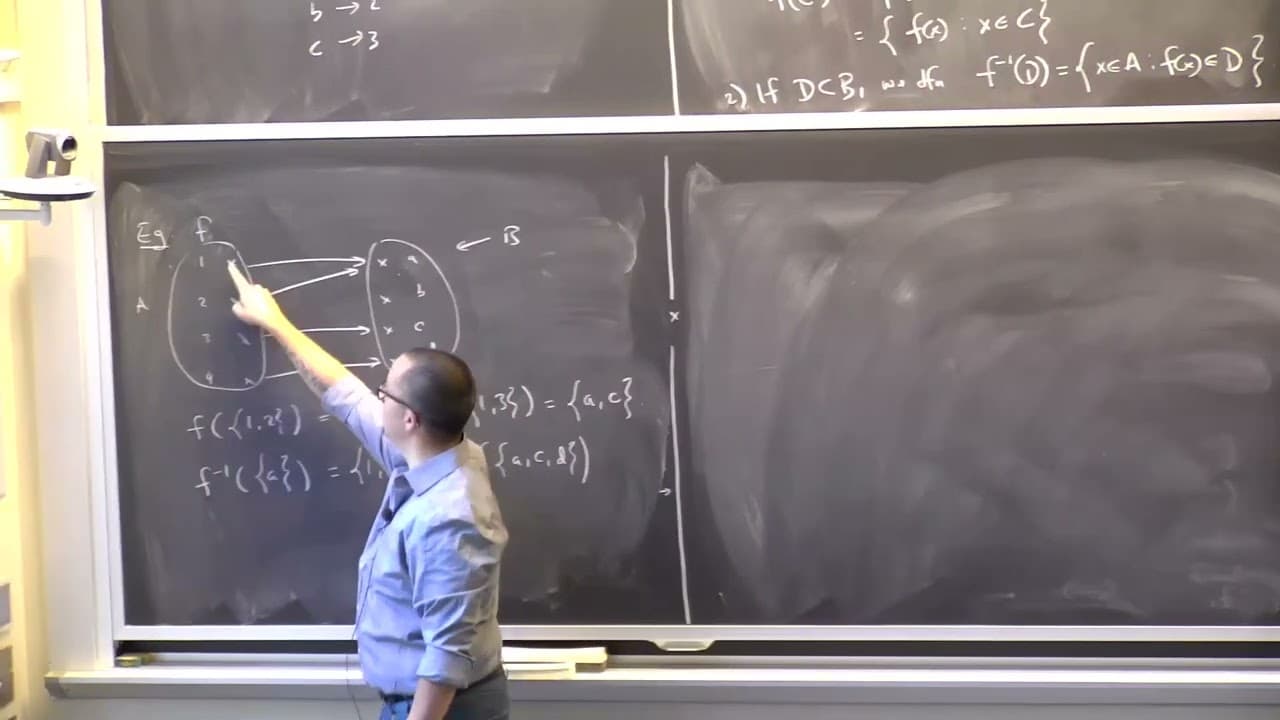
Sets can be compared in terms of their sizes or cardinalities, which can be finite or infinite. Countable sets have the same size as the natural numbers, while uncountable sets have a larger cardinality.
Transcript
[SQUEAKING] [RUSTLING] [CLICKING] CASEY RODRIGUEZ: So last time we spoke about-- we covered sets and induction. This time, I want to ask a question about sets, which turns out is actually quite a deep question. I mean, I didn't come up with it myself. This question is at least 150 years old probably. So the question that I want to ask is if A and B... Read More
Key Insights
- 😫 Cardinality or size can be compared between sets using bijections or bijective functions.
- 😫 Countable sets have the same size as the natural numbers and can be paired off with them.
- 😫 Uncountable sets have a larger cardinality and cannot be paired off with the natural numbers.
- 🌥️ There exists an infinite hierarchy of cardinalities, with each step being larger than the previous one.
Install to Summarize YouTube Videos and Get Transcripts
Explore YouTube Video Summarizer or Get YouTube Transcript Extractor
Questions & Answers
Q: What is the definition of size or cardinality for sets?
Size or cardinality refers to the number of elements or members in a set. Sets can have the same size if there is a bijection or bijective function between them.
Q: What is a countable set?
A countable set has the same size as the natural numbers and can be paired off with them. It can be infinite but still "counted" in some way.
Q: Are all infinite sets countable?
No, not all infinite sets are countable. Uncountable sets have a larger cardinality than the natural numbers and cannot be "counted" in the same way.
Q: What is the continuum hypothesis?
The continuum hypothesis asks whether there exists a set that is larger in size than the natural numbers but smaller than the power set of the natural numbers. This question is independent of standard axiomatic treatments of set theory, making it an open question.
Summary & Key Takeaways
-
Sets can have the same size, or cardinality, if there is a bijection or bijective function between them.
-
Countable sets have the same size as the natural numbers and can be paired off with them.
-
Uncountable sets have a larger cardinality and cannot be paired off with the natural numbers.
Read in Other Languages (beta)
Share This Summary 📚
Summarize YouTube Videos and Get Video Transcripts with 1-Click
Try YouTube Summary with ChatGPT & Claude or YouTube Transcript Generator
Explore More Summaries from MIT OpenCourseWare 📚
Summarize YouTube Videos and Get Video Transcripts with 1-Click
Try YouTube Summary with ChatGPT & Claude or YouTube Transcript Generator