L05.11 Linearity of Expectations
TL;DR
The linearity property of expectation states that when a random variable is transformed using a linear function, the expected value of the transformed variable is equal to the linear function applied to the expected value of the original variable.
Transcript
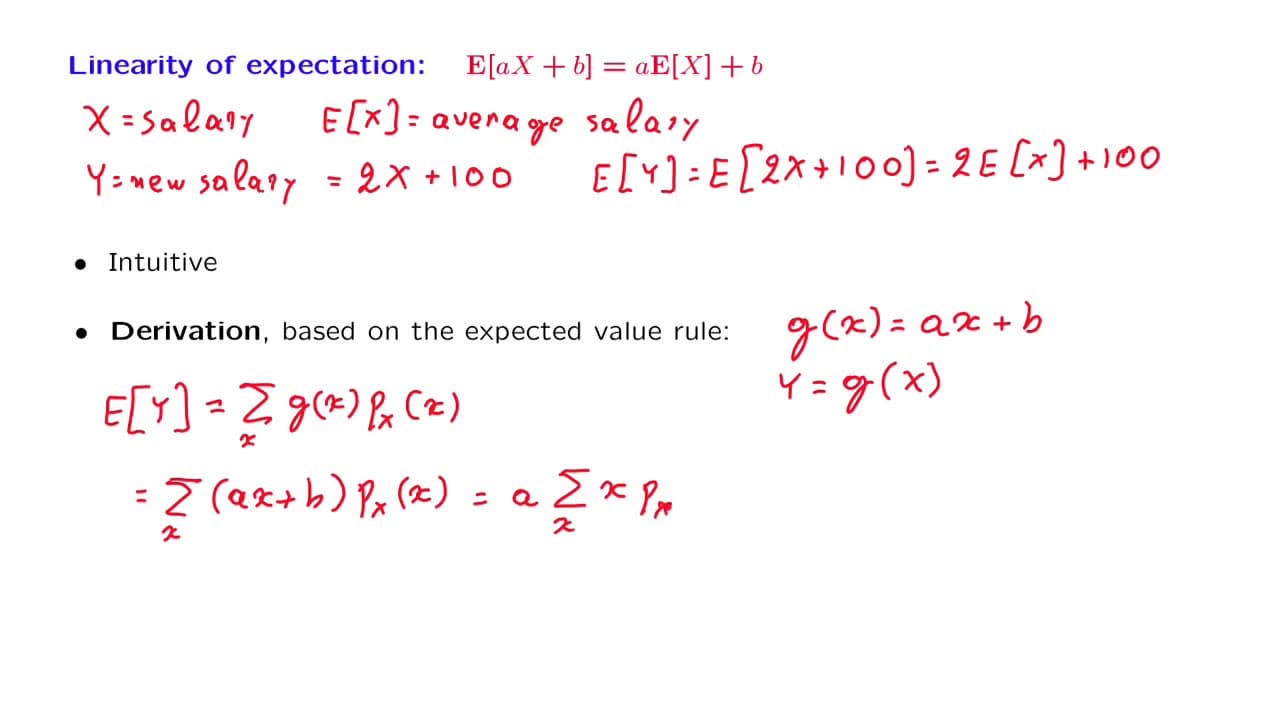
We end this lecture sequence with the most important property of expectations, namely linearity. The idea is pretty simple. Suppose that our random variable, X, is the salary of a random person out of some population. So that we can think of the expected value of X as the average salary within that population. And now suppose that everyone gets a r... Read More
Key Insights
- 🛟 The linearity property of expectation states that the transformation of a random variable using a linear function preserves the linearity in its expected value.
- 🪜 Doubling everyone's salary and adding a constant bonus is an example of a linear transformation on a random variable.
- 🍹 The linearity property can be derived using the expected value rule and separating the linear function into two sums.
Install to Summarize YouTube Videos and Get Transcripts
Explore YouTube Video Summarizer or Get YouTube Transcript Extractor
Questions & Answers
Q: What is the linearity property of expectation?
The linearity property states that when a linear function is applied to a random variable, the expected value of the transformed variable is equal to the same linear function applied to the expected value of the original variable.
Q: How can the linearity property be derived?
The linearity property can be derived using the expected value rule. By separating the linear function into two sums and using the definition of expected value, it can be shown that the expected value of the transformed variable follows a specific formula.
Q: Does the linearity property hold true for non-linear functions?
No, the linearity property is specific to linear functions. For non-linear functions, the expected value of the transformed variable will not be equal to the same function applied to the expected value of the original variable.
Q: Why is the linearity property important in probability and statistics?
The linearity property allows for simplification of calculations involving expected values when linear transformations are applied to random variables. It is a useful property in various applications of probability and statistics.
Summary & Key Takeaways
-
The linearity property of expectation states that when everyone's salary is doubled and an additional $100 is added, the average salary is also doubled and increased by $100.
-
The linearity property can be derived using the expected value rule, separating the linear function into two sums.
-
The linearity property holds true for linear functions but not for non-linear functions.
Read in Other Languages (beta)
Share This Summary 📚
Summarize YouTube Videos and Get Video Transcripts with 1-Click
Try YouTube Summary with ChatGPT & Claude or YouTube Transcript Generator
Explore More Summaries from MIT OpenCourseWare 📚


Summarize YouTube Videos and Get Video Transcripts with 1-Click
Try YouTube Summary with ChatGPT & Claude or YouTube Transcript Generator