Introduction to galvanic/voltaic cells | Chemistry | Khan Academy
TL;DR
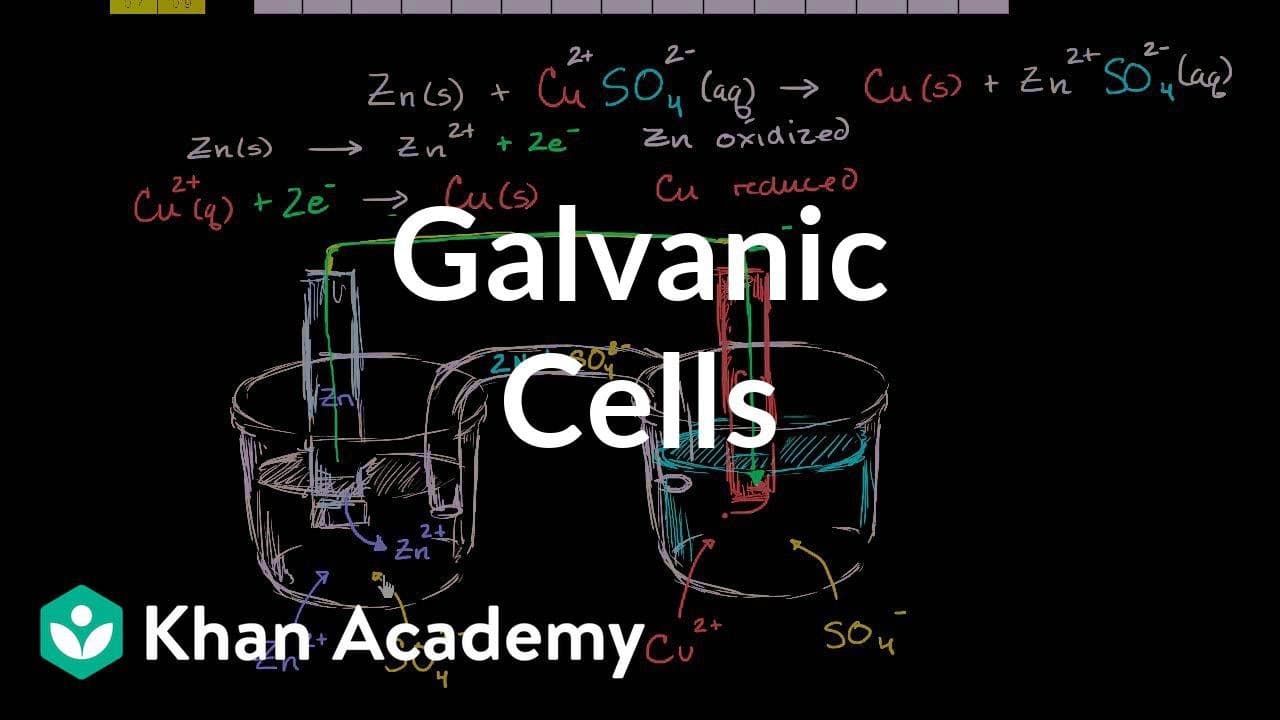
Galvanic cells use redox reactions to separate half reactions and make electrons travel over a wire, creating a current.
Transcript
In the last video, we saw that if you took some solid zinc and stuck it in a solution of copper sulfate, that the zinc will essentially give electrons to the copper. So then you have zinc cations that are in the solution. So essentially, it'll become a solution of zinc sulfate. And the copper, once it gets those two electrons is going to go into it... Read More
Key Insights
- 🗺️ Galvanic cells separate half reactions and make electrons travel over a wire to create a current.
- ❓ Solid zinc provides electrons to copper, which precipitates out of the solution.
- 👻 Conductivity in both metals allows electrons to flow easily.
- ❓ The use of a salt bridge helps maintain balance in the cell by allowing ions to move and neutralize charge.
Install to Summarize YouTube Videos and Get Transcripts
Explore YouTube Video Summarizer or Get YouTube Transcript Extractor
Questions & Answers
Q: How does a galvanic cell separate the half reactions?
A galvanic cell separates the half reactions by connecting the solid zinc and copper with a wire, allowing electrons to flow from the zinc to the copper.
Q: Why is it important to make electrons travel over a wire?
Making electrons travel over a wire creates a current, which can be used to power devices such as motors or lights.
Q: How does the salt bridge help maintain balance in the cell?
The salt bridge, consisting of a salt (such as sodium sulfate) in a gel-like form, allows negative sulfate ions to move from the solution to the salt bridge, while positive sodium ions help neutralize any excess charge.
Q: What happens if the solutions become too positive or negative?
If the solution becomes too positive, the electrons would be less likely to leave the zinc. Similarly, if the solution becomes too negative, the copper ions would capture the electrons. The salt bridge prevents these imbalances, allowing the current to continue flowing.
Summary & Key Takeaways
-
The previous video showed that when solid zinc is placed in copper sulfate solution, the zinc loses electrons and becomes zinc sulfate, while the copper precipitates out.
-
By separating the half reactions and allowing electrons to travel over a wire, a current can be generated, similar to a battery.
-
Galvanic cells use solid zinc, copper, and a salt bridge to maintain a flow of electrons and prevent the solutions from becoming too positive or negative.
Read in Other Languages (beta)
Share This Summary 📚
Summarize YouTube Videos and Get Video Transcripts with 1-Click
Try YouTube Summary with ChatGPT & Claude or YouTube Transcript Generator
Explore More Summaries from Khan Academy 📚






Summarize YouTube Videos and Get Video Transcripts with 1-Click
Try YouTube Summary with ChatGPT & Claude or YouTube Transcript Generator