What Are the Sn2 and E2 Reactions of Bromocyclopentane?
TL;DR
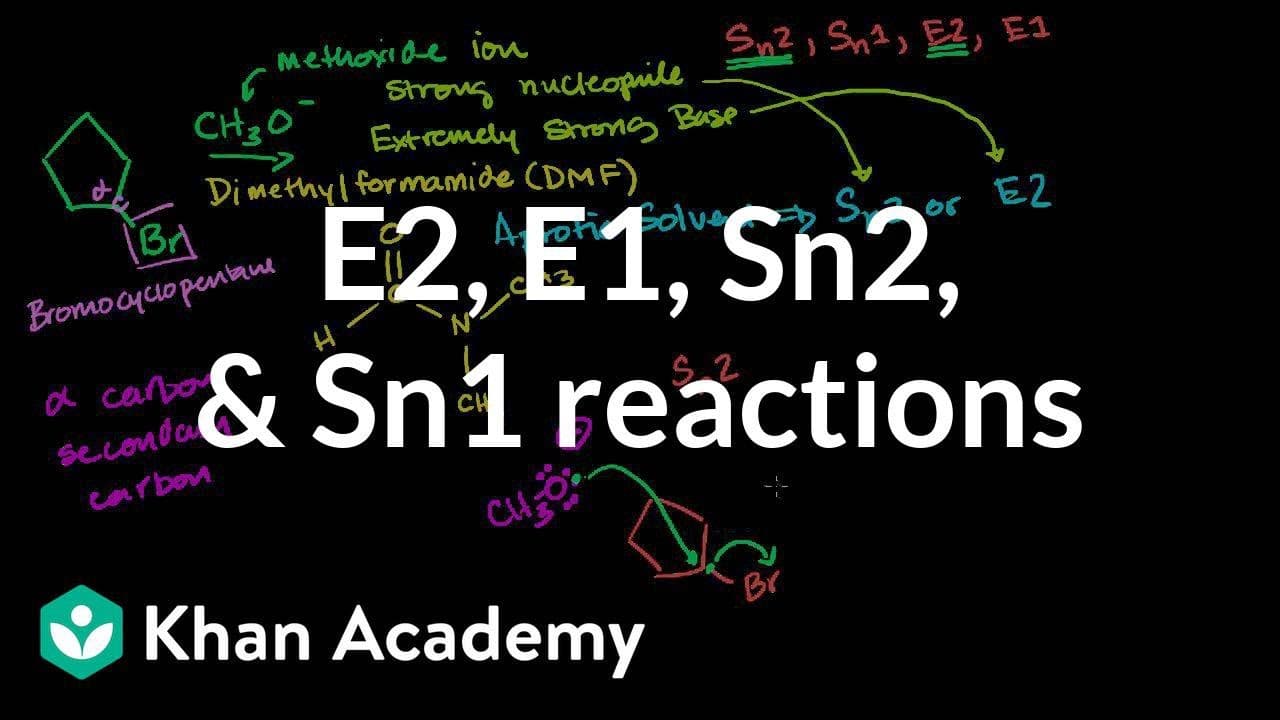
Both Sn2 and E2 reactions are likely to occur with bromocyclopentane in dimethylformamide when reacted with methoxide ion. The aprotic solvent facilitates these mechanisms, while the methoxide acts as a strong nucleophile and base. The secondary carbon structure allows for a mix of products from both reaction pathways.
Transcript
What I want to do in this video is to try to figure out what type of reaction or reactions might occur if we have-- what is this? One, two, three, four, five It's in a cycle. This is bromocyclopentane. If we have some bromocyclopentane dissolved and our solvent is dimethylformamide. Sometimes you'll see that just written as DMF. And I've actually d... Read More
Key Insights
- ❓ The nature of the solvent, whether it is protic or aprotic, can significantly impact the possible reactions.
- ⚾ The strength of the nucleophile/base determines whether an Sn2 or E2 reaction is likely.
- 🖐️ The carbon to which the leaving group is attached plays a role in determining the reaction type.
- 🧑🏭 Environmental factors can favor multiple reactions, resulting in a mix of reaction products.
- ☠️ Sn2 and E2 reactions are both one-step, rate-determining reactions.
- 👊 Sn2 reactions involve a nucleophile attacking the substrate and the leaving group leaving simultaneously.
- 🥺 E2 reactions involve a strong base removing a hydrogen from a beta carbon, leading to the formation of a double bond and the leaving group leaving.
Install to Summarize YouTube Videos and Get Transcripts
Explore YouTube Video Summarizer or Get YouTube Transcript Extractor
Questions & Answers
Q: How does the nature of the solvent affect the reaction possibilities?
The aprotic nature of the dimethylformamide solvent favors Sn2 and E2 reactions. Being aprotic means that it does not have readily available protons, which would hinder the strong nucleophile or base required for Sn2 and E2 reactions.
Q: Is the methoxide ion a strong nucleophile or base?
The methoxide ion is both a strong nucleophile and a strong base. It is a strong nucleophile because it can attack the substrate carbon. It is also a strong base because it can remove a hydrogen from a beta carbon in an E2 reaction.
Q: Why is the carbon with the leaving group considered neutral?
The carbon with the leaving group is a secondary carbon bonded to two other carbons. This makes it neutral in the reaction, allowing for both Sn2 and E2 reactions. A tertiary carbon would favor Sn1 or E1 reactions, while a primary carbon would favor Sn2 exclusively.
Q: Can both Sn2 and E2 reactions occur simultaneously?
Yes, both Sn2 and E2 reactions can occur simultaneously. The environmental factors, such as the aprotic solvent and the strong nucleophile/base, enable both reactions to take place.
Summary & Key Takeaways
-
In the video, the content discusses the reactions that can occur when bromocyclopentane is dissolved in dimethylformamide solvent with methoxide ion.
-
The solvent being aprotic suggests favorability for Sn2 or E2 reactions.
-
The methoxide ion acts as both a strong nucleophile and a strong base, indicating the potential for Sn2 and E2 reactions.
-
The carbon attached to the leaving group is a secondary carbon, making it neutral and allowing for both Sn2 and E2 reactions.
Read in Other Languages (beta)
Share This Summary 📚
Summarize YouTube Videos and Get Video Transcripts with 1-Click
Try YouTube Summary with ChatGPT & Claude or YouTube Transcript Generator
Explore More Summaries from Khan Academy 📚



Summarize YouTube Videos and Get Video Transcripts with 1-Click
Try YouTube Summary with ChatGPT & Claude or YouTube Transcript Generator