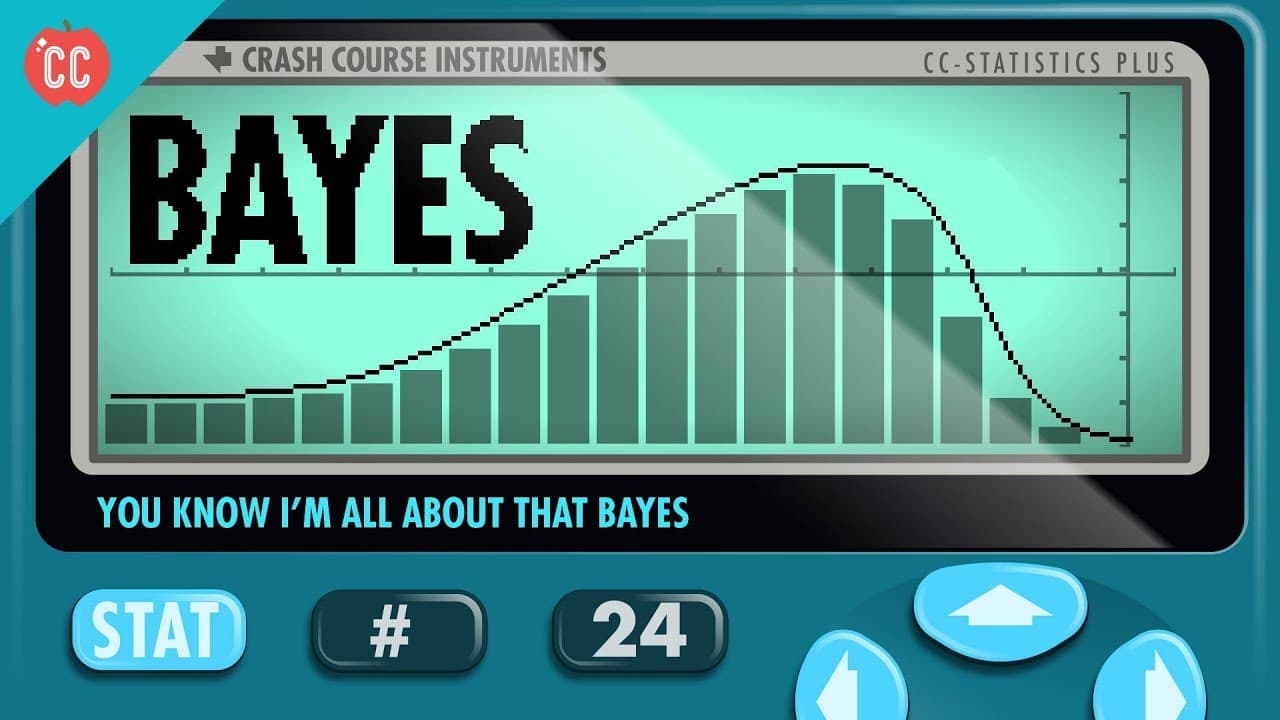
You Know I'm All About that Bayes: Crash Course Statistics #24
TL;DR
Bayesian statistics allow belief updates with new data.
Transcript
Hi, I’m Adriene Hill, and Welcome back to Crash Course, Statistics. We all have ideas about how the world works. And even if we haven’t ever used numbers to describe them, we see different beliefs everywhere we go. From whether it’s healthier to be a vegetarian... to whether school uniforms are a good idea; we all have slightly different “models” o... Read More
Key Insights
- Bayes' Theorem helps calculate conditional probabilities, allowing us to update beliefs based on new information.
- Bayesian statistics are useful for hypothesis testing, as they incorporate prior beliefs and new data to form posterior beliefs.
- Maria's example illustrates Bayesian hypothesis testing by updating her belief about Jordan being a Star Wars fan using Bayes' Factor.
- Bayes' Factor is crucial for comparing hypotheses, allowing adjustments of prior beliefs based on new evidence.
- Subjectivity in Bayesian inference is a criticism, as it relies on personal beliefs, which can vary among individuals.
- Bayesian methods are akin to natural human reasoning, updating beliefs with accumulated evidence over time.
- In scientific studies, Bayes Factor allows others to adjust results based on different prior beliefs, enhancing objectivity.
- Bayesian inference highlights how different initial beliefs can lead to varying conclusions from the same evidence.
Install to Summarize YouTube Videos and Get Transcripts
Explore YouTube Video Summarizer or Get YouTube Transcript Extractor
Questions & Answers
Q: What is Bayes' Theorem and how is it applied?
Bayes' Theorem is a mathematical formula used to calculate the probability of an event based on prior knowledge of related events. It is expressed as the probability of A given B, which equals the probability of B given A times the probability of A, divided by the probability of B. This theorem allows for updating beliefs when new evidence is presented, making it a cornerstone of Bayesian statistics.
Q: How does Bayesian hypothesis testing differ from traditional methods?
Bayesian hypothesis testing differs from traditional methods by incorporating prior beliefs and updating them with new evidence to form posterior beliefs. While traditional statistics often rely on fixed models and parameters, Bayesian methods allow for a dynamic approach, reflecting real-world thinking where beliefs evolve with new information. This makes Bayesian statistics particularly useful for scenarios where prior knowledge is significant.
Q: What is the role of Bayes' Factor in Bayesian analysis?
Bayes' Factor plays a crucial role in Bayesian analysis by comparing the probability of observed data under different hypotheses. It quantifies how much the evidence should change prior beliefs, offering a ratio that indicates the strength of evidence for one hypothesis over another. This allows individuals to adjust their prior beliefs based on new data, even if they initially had different beliefs, enhancing the objectivity of Bayesian inference.
Q: Why is subjectivity a criticism of Bayesian inference?
Subjectivity is a criticism of Bayesian inference because it incorporates personal beliefs into the analysis, which can vary widely among individuals. Unlike traditional statistical methods that aim for objectivity, Bayesian statistics start with prior beliefs that influence the outcome. This subjectivity can lead to different conclusions from the same data if individuals have different initial beliefs, posing challenges for scientific studies that require standardized results.
Q: How do Bayesian methods mirror natural human reasoning?
Bayesian methods mirror natural human reasoning by continuously updating beliefs with new evidence, similar to how people naturally incorporate new information into their understanding of the world. This dynamic approach reflects everyday decision-making processes, where past experiences and new data influence current beliefs and actions. Bayesian inference provides a structured framework for this logical process, aligning statistical analysis with intuitive human thought.
Q: Can Bayesian statistics be objective despite its subjective nature?
Bayesian statistics can achieve a degree of objectivity through the use of Bayes' Factor, which allows individuals to adjust their prior beliefs based on new evidence. While the initial beliefs are subjective, the Bayes' Factor provides a standardized measure of evidence strength, enabling others to apply their beliefs to the same data. This helps reconcile differing initial opinions and supports more objective conclusions, despite the inherent subjectivity of Bayesian methods.
Q: What is an example of Bayesian hypothesis testing in everyday life?
An example of Bayesian hypothesis testing in everyday life is Maria's belief update about Jordan being a Star Wars fan. Initially, she estimates a 60% chance based on general experience. After learning Jordan watched the latest Star Wars movie, she uses Bayes' Theorem to update her belief, increasing the likelihood of him being a fan. This process exemplifies how Bayesian methods allow for evidence-based belief updates in common situations.
Q: How does Bayesian inference handle conflicting evidence?
Bayesian inference handles conflicting evidence by adjusting beliefs based on the strength and amount of new data. When evidence is minimal or ambiguous, prior beliefs have a greater influence. However, as more substantial evidence accumulates, it can overwhelm prior beliefs, leading to significant belief updates. This approach allows for flexibility in accommodating varying levels of evidence, helping reconcile differing conclusions from the same data over time.
Summary & Key Takeaways
-
Bayesian statistics provide a framework for updating beliefs with new data, using Bayes' Theorem to calculate probabilities and form posterior beliefs. This methodology allows for incorporating prior knowledge and new evidence, making it a powerful tool for hypothesis testing.
-
The video explains Bayesian hypothesis testing through relatable examples, such as Maria's belief about Jordan being a Star Wars fan. By applying Bayes' Theorem and Bayes' Factor, Maria adjusts her beliefs based on new information, demonstrating the practical application of Bayesian methods.
-
Critics argue that Bayesian inference introduces subjectivity due to its reliance on personal beliefs. However, the Bayes Factor offers a way to adjust for different prior beliefs, enabling a more objective analysis. Bayesian methods mirror natural human reasoning by continuously updating beliefs with new evidence.
Read in Other Languages (beta)
Share This Summary 📚
Summarize YouTube Videos and Get Video Transcripts with 1-Click
Try YouTube Summary with ChatGPT & Claude or YouTube Transcript Generator
Explore More Summaries from CrashCourse 📚





Summarize YouTube Videos and Get Video Transcripts with 1-Click
Try YouTube Summary with ChatGPT & Claude or YouTube Transcript Generator