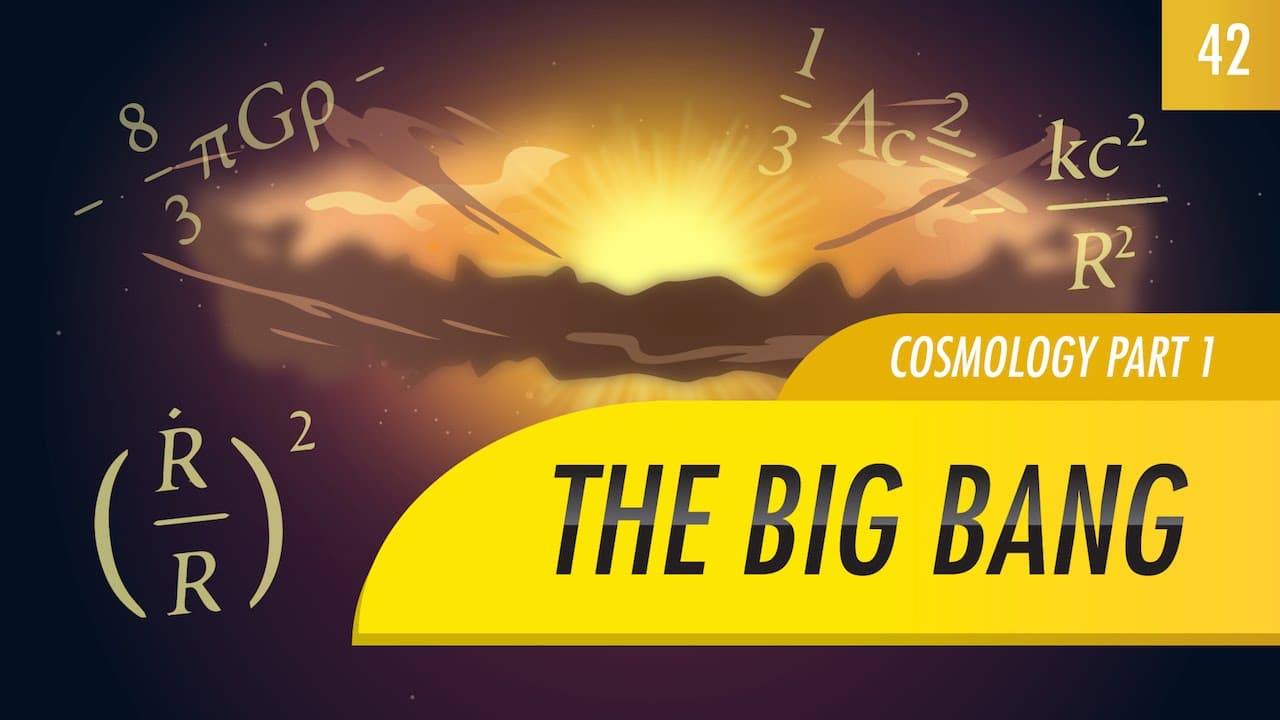
The Big Bang, Cosmology part 1: Crash Course Astronomy #42
TL;DR
The universe is expanding, confirming the Big Bang theory.
Transcript
What is the nature of the Universe? How’s that for a question? For a long time we humans had no idea what was going on in the Universe. To help, we made up stories to either help us explain what we saw, or to make us feel better about what we didn’t understand. But then science came along, and we started to understand more. We could test our ideas,... Read More
Key Insights
- The concept of an expanding universe emerged from observations of redshifted galaxies, indicating they are moving away from us.
- Georges Lemaître and Alexander Friedmann independently concluded that an expanding universe fits Einstein's equations better than a static one.
- Edwin Hubble and Milton Humason's work confirmed that the farther a galaxy is, the faster it moves away, supporting the universe's expansion.
- The Big Bang theory, initially mocked, gained credibility with the discovery of cosmic microwave background radiation.
- The universe's expansion implies it was once a hot, dense state, expanding and cooling over time, forming the cosmos we observe today.
- Lookback time allows astronomers to see distant objects as they were in the past, providing insights into the universe's early state.
- The cosmic microwave background radiation, discovered in 1965, serves as evidence of the universe's hot, dense origins.
- The Big Bang model predicts the abundance of elements in the universe, aligning with observed data, supporting its validity.
Install to Summarize YouTube Videos and Get Transcripts
Explore YouTube Video Summarizer or Get YouTube Transcript Extractor
Questions & Answers
Q: What evidence supports the universe's expansion?
The primary evidence for the universe's expansion comes from the redshift of distant galaxies. Observations show that galaxies farther away are moving faster than those closer to us, suggesting that the universe is expanding. This observation aligns with the predictions made by Georges Lemaître and Alexander Friedmann, who proposed that an expanding universe fits Einstein's equations better than a static one.
Q: How did the Big Bang theory gain credibility?
The Big Bang theory gained credibility through the discovery of the cosmic microwave background radiation in 1965. This radiation is a remnant of the universe's early hot, dense state and provides strong evidence for the Big Bang model. The theory also accurately predicts the abundance of elements in the universe and the large-scale structures observed, further supporting its validity.
Q: What role did Edwin Hubble play in cosmology?
Edwin Hubble played a crucial role in cosmology by providing evidence for the universe's expansion. Alongside Milton Humason, Hubble measured the distances to galaxies and observed their redshifts. He discovered that the farther a galaxy is, the faster it appears to recede from us, confirming the universe's expansion and supporting the Big Bang theory.
Q: What is lookback time, and why is it important?
Lookback time refers to observing distant objects as they were in the past, due to the finite speed of light. This concept is crucial in cosmology because it allows astronomers to study the universe's early state and understand its evolution over time. By observing distant galaxies, we gain insights into the universe's formation and expansion history.
Q: How does the Big Bang theory explain the universe's current state?
The Big Bang theory explains the universe's current state by proposing that it originated from a hot, dense state and has been expanding and cooling over time. This expansion led to the formation of galaxies, stars, and other cosmic structures. Observations of cosmic microwave background radiation and element abundances support this model, aligning with theoretical predictions.
Q: What misconceptions exist about the Big Bang?
A common misconception about the Big Bang is that it was an explosion in space. In reality, the Big Bang represents the expansion of space itself, not an explosion within pre-existing space. The universe is not expanding into anything; rather, space is expanding, carrying galaxies with it. This means the universe has no center or edge, challenging our intuitive understanding.
Q: Why is the cosmic microwave background radiation significant?
The cosmic microwave background radiation is significant because it provides evidence for the Big Bang theory. Discovered in 1965, this radiation is a remnant of the universe's early hot state, predicted by the Big Bang model. Its uniformity and spectrum match theoretical expectations, confirming the universe's expansion from a dense, hot origin and supporting the model's validity.
Q: What predictions does the Big Bang model make about the universe?
The Big Bang model makes several predictions about the universe, including the abundance of light elements like hydrogen and helium, the cosmic microwave background radiation, and the large-scale structure of the cosmos. These predictions align with observations, reinforcing the model's validity. The model also predicts the universe's expansion, supported by redshift observations of distant galaxies.
Summary & Key Takeaways
-
The universe's expansion was first suggested by redshift observations, indicating galaxies are moving away from us. This led to the Big Bang theory, describing the universe's origin from a hot, dense state.
-
Einstein's equations suggested a static universe, but Lemaître and Friedmann proposed an expanding universe, which Hubble confirmed by observing galaxy redshifts and distances.
-
The cosmic microwave background radiation, discovered in 1965, provided crucial evidence for the Big Bang theory, showing the universe's early hot state, aligning with theoretical predictions.
Read in Other Languages (beta)
Share This Summary 📚
Summarize YouTube Videos and Get Video Transcripts with 1-Click
Try YouTube Summary with ChatGPT & Claude or YouTube Transcript Generator
Explore More Summaries from CrashCourse 📚





Summarize YouTube Videos and Get Video Transcripts with 1-Click
Try YouTube Summary with ChatGPT & Claude or YouTube Transcript Generator