Boil Water at Room Temperature! - Hydrostatics
TL;DR
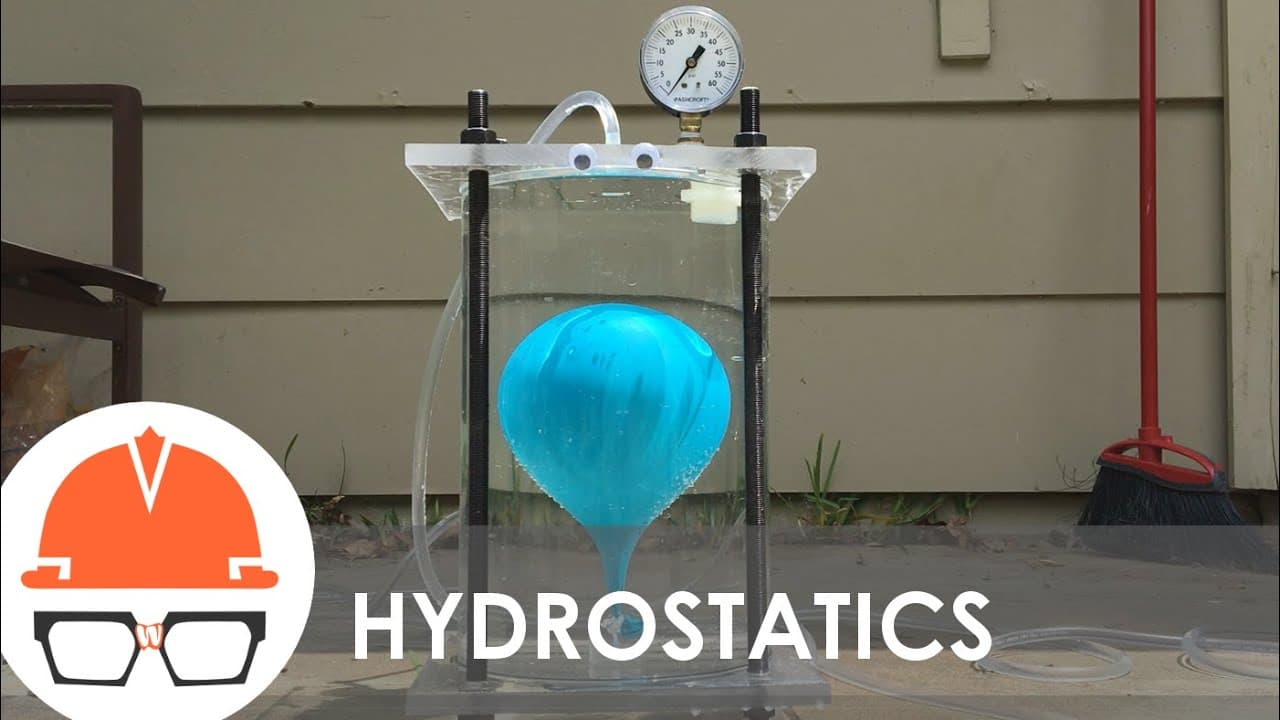
Hydrostatics explains fluid pressure's dependence on depth, not volume.
Transcript
Engineers that work with fluids need a solid understanding of how they behave, and there's one branch of fluid mechanics that plays a role in areas all across our lives. Whether you're designing a water tower for a city, or you just want to understand how those upside-down pet bowls work, you've got to know how to relate the depth and pressure of a... Read More
Key Insights
- Hydrostatics is crucial for understanding fluid behavior, influencing designs from water towers to pet bowls.
- Fluid pressure depends solely on depth, not on the volume or shape of the container holding the fluid.
- Bernoulli's principle indicates that static fluids only have potential and internal energy, impacting pressure calculations.
- Water towers function as physical representations of a city's pressure plane, maintaining consistent water pressure.
- Small water volumes at significant heights can increase pressure due to the relationship between force, area, and height.
- Atmospheric pressure plays a key role in maintaining fluid balance in systems like inverted pet bowls.
- Barometers use the balance between atmospheric pressure and a fluid column to measure pressure, demonstrating hydrostatics.
- Boiling water at room temperature is possible by reducing air pressure, illustrating hydrostatic principles.
Install to Summarize YouTube Videos and Get Transcripts
Explore YouTube Video Summarizer or Get YouTube Transcript Extractor
Questions & Answers
Q: How does hydrostatics influence everyday engineering designs?
Hydrostatics plays a vital role in engineering designs by explaining how fluid pressure depends solely on depth, regardless of the container's volume or shape. This understanding is crucial for designing water distribution systems, like water towers, which maintain consistent pressure. It also helps in creating efficient designs for household items like pet water bowls.
Q: What is the significance of Bernoulli's principle in hydrostatics?
Bernoulli's principle is significant in hydrostatics as it explains that static fluids possess potential and internal energy, impacting the pressure calculations. In static fluids, kinetic energy is absent, so pressure is determined by the fluid's depth and density. This principle helps engineers predict pressure changes in fluid systems, aiding in efficient system designs.
Q: Why do water towers have a consistent height in cities?
Water towers have a consistent height in cities because they represent the pressure plane, an imaginary surface indicating water pressure across locations. The height of the water surface in the tower corresponds to the pressure in the water mains. This uniformity ensures a stable and reliable water supply, maintaining consistent pressure throughout the distribution network.
Q: How can a small volume of water increase pressure in a system?
A small volume of water can increase pressure in a system by being elevated to a significant height. Pressure is the force divided by area, and when a column of water is tall, even if narrow, it exerts considerable pressure at the bottom due to its height. This principle is used in various applications, demonstrating the depth-pressure relationship.
Q: What role does atmospheric pressure play in inverted pet bowls?
Atmospheric pressure plays a crucial role in inverted pet bowls by balancing the fluid system. The pet bowl's design creates a vacuum at the top, resulting in lower pressure than atmospheric pressure. This difference maintains the water level, preventing it from flowing out until air pressure is equalized, showcasing hydrostatic principles.
Q: How does a barometer demonstrate hydrostatic principles?
A barometer demonstrates hydrostatic principles by balancing atmospheric pressure with a column of fluid, typically mercury. The height of the fluid column reflects the atmospheric pressure, providing a measure of pressure changes. This setup illustrates how hydrostatic pressure is influenced by the fluid's depth and density, offering insights into atmospheric conditions.
Q: Is it possible to boil water at room temperature using hydrostatics?
Yes, it is possible to boil water at room temperature using hydrostatics by reducing the air pressure above the water. When atmospheric pressure is lowered, water's boiling point decreases, allowing it to transition to a gas at room temperature. This demonstrates the relationship between pressure and boiling point, highlighting hydrostatic principles.
Q: Why is mercury used in barometers instead of water?
Mercury is used in barometers instead of water because of its higher density, which allows for a shorter column to measure atmospheric pressure. A mercury column is about 13 times shorter than a water column for the same pressure, making barometers more compact and practical. This choice simplifies pressure measurement, adhering to hydrostatic principles.
Summary & Key Takeaways
-
Hydrostatics is a fundamental branch of fluid mechanics, essential for engineers to understand fluid behavior in various applications. Pressure in static fluids depends solely on depth, not the volume or shape of the container. This principle is crucial for designing systems like water towers and pet bowls.
-
Bernoulli's principle explains that static fluids have potential and internal energy, affecting pressure calculations. Water towers serve as physical representations of a city's pressure plane, ensuring consistent water pressure across locations. The relationship between force, area, and height influences fluid pressure.
-
Atmospheric pressure is critical in maintaining fluid balance in systems like inverted pet bowls. Barometers measure pressure by balancing atmospheric pressure with a fluid column. Hydrostatic principles allow boiling water at room temperature by reducing air pressure, showcasing the depth-pressure relationship.
Read in Other Languages (beta)
Share This Summary 📚
Summarize YouTube Videos and Get Video Transcripts with 1-Click
Try YouTube Summary with ChatGPT & Claude or YouTube Transcript Generator
Explore More Summaries from Practical Engineering 📚






Summarize YouTube Videos and Get Video Transcripts with 1-Click
Try YouTube Summary with ChatGPT & Claude or YouTube Transcript Generator