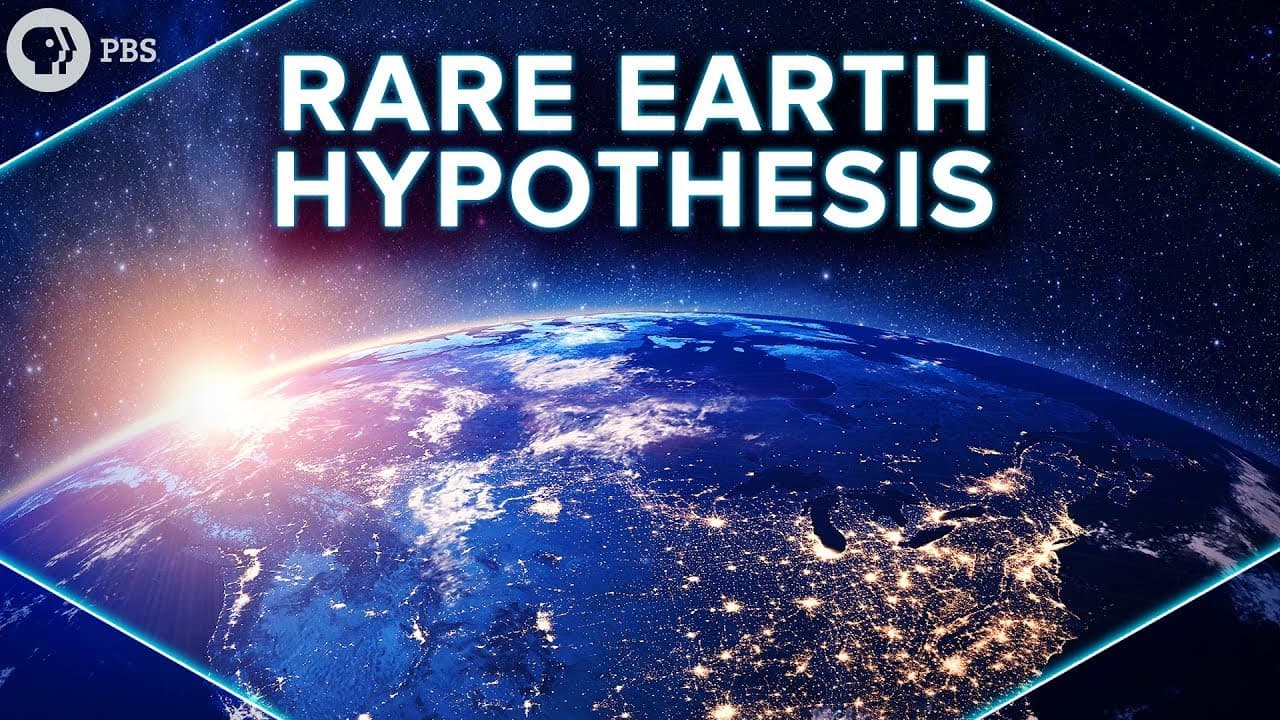
Why We Might Be Alone in the Universe
TL;DR
Earth's uniqueness may explain the absence of alien civilizations.
Transcript
It’s so crazy that I just happen to be in one of the rare places in our universe where I don’t instantly asphyxiate or freeze or vaporize or dehydrate. ... Just lucky I guess. Actually, it turns out that our very privileged perspective on the universe from Earth’s comfortable biosphere may tell us a lot about our reality. And perhaps resolves the F... Read More
Key Insights
- The weak anthropic principle suggests we must find ourselves in a universe capable of supporting intelligent life, which may explain the apparent absence of alien civilizations.
- The Rare Earth hypothesis posits that Earth's unique conditions make it exceptionally capable of supporting intelligent life, possibly explaining the Fermi Paradox.
- Earth's dynamic interior and large moon are critical for life, with tectonic activity and magnetic fields protecting and sustaining life.
- Earth's moon, formed from a massive collision, may have been crucial for life, influencing Earth's rotation and axial tilt, which affect seasons and evolution.
- Jupiter's gravitational influence may have protected Earth from frequent catastrophic impacts, allowing life to evolve over billions of years.
- The evolution of complex life, such as eukaryotic cells, may involve extremely improbable steps, contributing to the rarity of intelligent life.
- The Kepler mission has shown that Earth-like planets are common, but true Earth-like conditions may be rare, explaining the lack of advanced civilizations.
- The weak anthropic principle allows for the possibility that intelligent life is extremely rare, and Earth may be one of the few planets where it has developed.
Install to Summarize YouTube Videos and Get Transcripts
Explore YouTube Video Summarizer or Get YouTube Transcript Extractor
Questions & Answers
Q: What is the weak anthropic principle?
The weak anthropic principle suggests that we must find ourselves in a part of the universe capable of supporting intelligent life. It accounts for observer selection bias, explaining why the universe appears the way it does from our perspective. This principle suggests that intelligent life may be rare, as we are naturally in a life-supporting environment.
Q: What is the Rare Earth hypothesis?
The Rare Earth hypothesis posits that Earth possesses unique qualities that make it exceptionally capable of supporting intelligent life. These include its dynamic interior, large moon, and protective magnetic field. The hypothesis suggests that these conditions are rare, potentially explaining the Fermi Paradox and the apparent absence of alien civilizations.
Q: How does Earth's moon contribute to its ability to support life?
Earth's large moon, formed from a massive collision, may have been crucial for life. It influences Earth's rotation and axial tilt, which affect seasons and evolution. The moon's tidal forces may have played a role in abiogenesis and continuing tectonic activity, making Earth's environment conducive to the development and sustenance of life.
Q: What role does Jupiter play in Earth's ability to support life?
Jupiter acts as a gravitational vacuum cleaner, absorbing debris from the solar system that might otherwise impact Earth. This protection from frequent catastrophic impacts has allowed life on Earth to evolve over billions of years without being wiped out by mass-extinction-level events, contributing to the development of complex life.
Q: Why might intelligent life be rare in the universe?
Intelligent life might be rare due to the combination of unique conditions required for its development, as suggested by the Rare Earth hypothesis. The evolution of complex life involves improbable steps, such as the formation of eukaryotic cells. The weak anthropic principle allows for the possibility that Earth is one of the few planets where these conditions exist.
Q: How does the weak anthropic principle relate to the Fermi Paradox?
The weak anthropic principle relates to the Fermi Paradox by suggesting that our existence in a life-supporting universe may explain the apparent absence of alien civilizations. It implies that intelligent life is rare, and we find ourselves on Earth because it is one of the few environments capable of supporting such life.
Q: What are some unique qualities of Earth that support life?
Unique qualities of Earth that support life include its dynamic interior with tectonic activity, a large moon influencing rotation and axial tilt, a protective magnetic field, and Jupiter's gravitational influence. These factors contribute to Earth's ability to sustain life by providing a stable environment and protecting it from catastrophic events.
Q: What evidence supports the idea that Earth-like planets are common?
The Kepler mission has revealed that Earth-like planets are common, with billions of rocky planets in the habitable zone of stars similar to the Sun. However, true Earth-like conditions, which include specific life-supporting features, may be rare, explaining the lack of advanced civilizations despite the abundance of potential starting points for life.
Summary & Key Takeaways
-
The video explores the weak anthropic principle, suggesting that our existence in a life-supporting universe may explain the apparent absence of alien civilizations. The Rare Earth hypothesis posits that Earth's unique conditions make it exceptionally capable of supporting intelligent life, potentially explaining the Fermi Paradox.
-
Earth's dynamic interior, large moon, and protective magnetic field are highlighted as critical factors for life. The video discusses how these features, along with Jupiter's gravitational influence, may have protected Earth from catastrophic impacts, allowing life to evolve over billions of years.
-
The evolution of complex life, such as eukaryotic cells, may involve extremely improbable steps, contributing to the rarity of intelligent life. The Kepler mission has shown that Earth-like planets are common, but true Earth-like conditions may be rare, explaining the lack of advanced civilizations.
Read in Other Languages (beta)
Share This Summary 📚
Summarize YouTube Videos and Get Video Transcripts with 1-Click
Try YouTube Summary with ChatGPT & Claude or YouTube Transcript Generator
Explore More Summaries from PBS Space Time 📚
Summarize YouTube Videos and Get Video Transcripts with 1-Click
Try YouTube Summary with ChatGPT & Claude or YouTube Transcript Generator