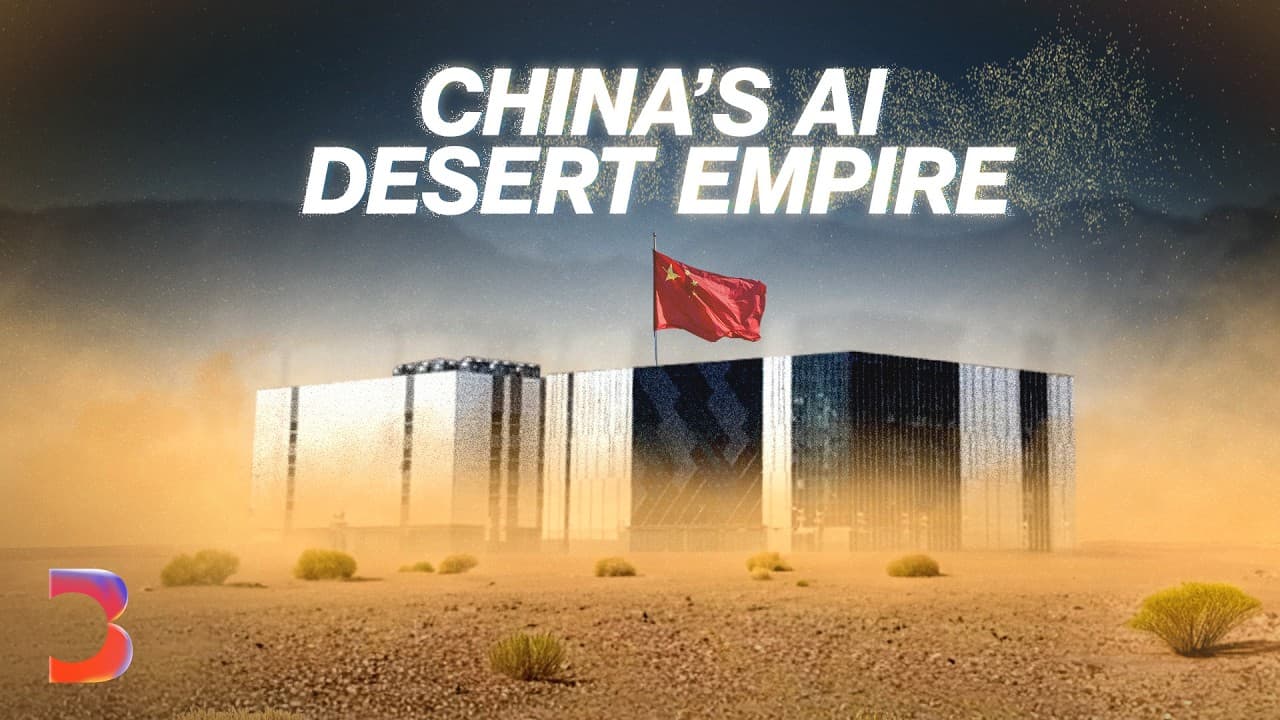
Why Is China Building AI Data Centers in Deserts?
TL;DR
China is constructing AI data centers in the Xinjiang desert, aiming to use over 115,000 Nvidia chips despite a US export ban. These centers are pivotal to China's AI ambitions, challenging US policies. While there is no evidence of chip smuggling, the construction indicates China's determination to advance its AI capabilities.
Transcript
Here in this remote northwestern corner of China, is a town at the center of the country's AI ambitions. We are going to go there to see how the construction going and basically get a better understanding of how these data centers fit in with the overall strategy, for China to build its AI capabilities The Xinjiang region is sensitive. China has be... Read More
Key Insights
- China is building AI data centers in Xinjiang, aiming to use Nvidia chips despite US bans.
- The data centers are crucial for China's goal to lead in AI by 2030.
- US-designed Nvidia chips are banned in China but are still sought after for AI development.
- The US aims to maintain its technological edge by restricting advanced chip exports to China.
- Bloomberg found no evidence of a smuggling network for banned Nvidia chips into China.
- Chinese companies claim they can procure banned chips, challenging US export restrictions.
- China's semiconductor manufacturing lags behind, despite significant investments.
- China aspires to lead globally in AI, not just close the development gap with the US.
Install to Summarize YouTube Videos and Get Transcripts
Explore YouTube Video Summarizer or Get YouTube Transcript Extractor
Questions & Answers
Q: Why is China building AI data centers in the desert?
China is constructing AI data centers in the Xinjiang desert as part of its strategy to become a global leader in AI by 2030. These centers are designed to house advanced computing infrastructure, including Nvidia chips, which are crucial for training AI models. The remote location offers space and resources needed for such large-scale projects.
Q: How is China acquiring Nvidia chips despite US bans?
Although Nvidia chips are banned from export to China by the US, Chinese companies claim they can still procure them. However, Bloomberg's investigation found no evidence of a smuggling network capable of importing these chips in large quantities. The situation remains unclear, with some suggesting that companies might be overstating their capabilities.
Q: What is the significance of Nvidia chips for AI development?
Nvidia chips, particularly the H100 and H200 models, are critical for AI development as they provide the necessary computing power to train large language models. These chips are considered the industry standard for AI applications, and their performance significantly surpasses that of locally designed chips, making them highly sought after in China.
Q: What are the US policies regarding chip exports to China?
The US has imposed export restrictions on advanced semiconductors, including Nvidia chips, to China. These policies aim to maintain the US's technological edge by preventing China from accessing critical hardware that could enhance its AI capabilities. The restrictions focus on chips with potential military applications, seeking to choke China's AI sector.
Q: How does China's semiconductor manufacturing compare globally?
Despite significant investments, China's semiconductor manufacturing still lags behind global leaders. The precision required for advanced chip production is extremely high, and China's capabilities remain several generations behind. This gap makes China reliant on foreign technology, such as Nvidia chips, to advance its AI ambitions.
Q: What challenges does China face in becoming a global AI leader?
China faces several challenges in becoming a global AI leader, including technological gaps in semiconductor manufacturing and restrictions on acquiring advanced chips like Nvidia's. Additionally, geopolitical tensions and export bans from countries like the US complicate China's efforts to secure the necessary hardware for AI development.
Q: What are the implications of China's AI ambitions for global technology competition?
China's AI ambitions intensify global technology competition, particularly with the US. As China seeks to lead in AI, it challenges US dominance in the field, prompting both countries to invest heavily in AI research and development. This competition could influence global AI standards, innovation, and geopolitical dynamics.
Q: How is China's AI development affecting its international relations?
China's AI development affects its international relations by positioning the country as a potential leader in emerging markets and the global south. As China advances its AI capabilities, it seeks to export its technology and infrastructure, potentially increasing its influence and challenging the technological dominance of Western countries.
Summary & Key Takeaways
-
China is constructing massive AI data centers in the Xinjiang desert, aiming to use over 115,000 Nvidia chips despite US export bans. These centers are part of China's strategy to become a global AI leader by 2030. The move challenges US policies, which seek to maintain technological dominance by restricting advanced chip exports.
-
Bloomberg's investigation found no evidence of a smuggling network for the banned Nvidia chips into China. While Chinese companies claim they can procure these chips, the US aims to choke China's AI sector by restricting access to advanced semiconductors. The construction of these centers indicates China's determination to advance its AI capabilities.
-
Despite significant investments in semiconductor manufacturing, China remains behind in chip technology. The US-designed Nvidia chips are critical for AI development, and their restriction poses a barrier to China's AI ambitions. However, China's AI models are exceeding expectations, and the country aspires to be a global AI leader.
Read in Other Languages (beta)
Share This Summary 📚
Summarize YouTube Videos and Get Video Transcripts with 1-Click
Try YouTube Summary with ChatGPT & Claude or YouTube Transcript Generator
Explore More Summaries from Bloomberg Originals 📚





Summarize YouTube Videos and Get Video Transcripts with 1-Click
Try YouTube Summary with ChatGPT & Claude or YouTube Transcript Generator