Economics of Education: Crash Course Economics #23
TL;DR
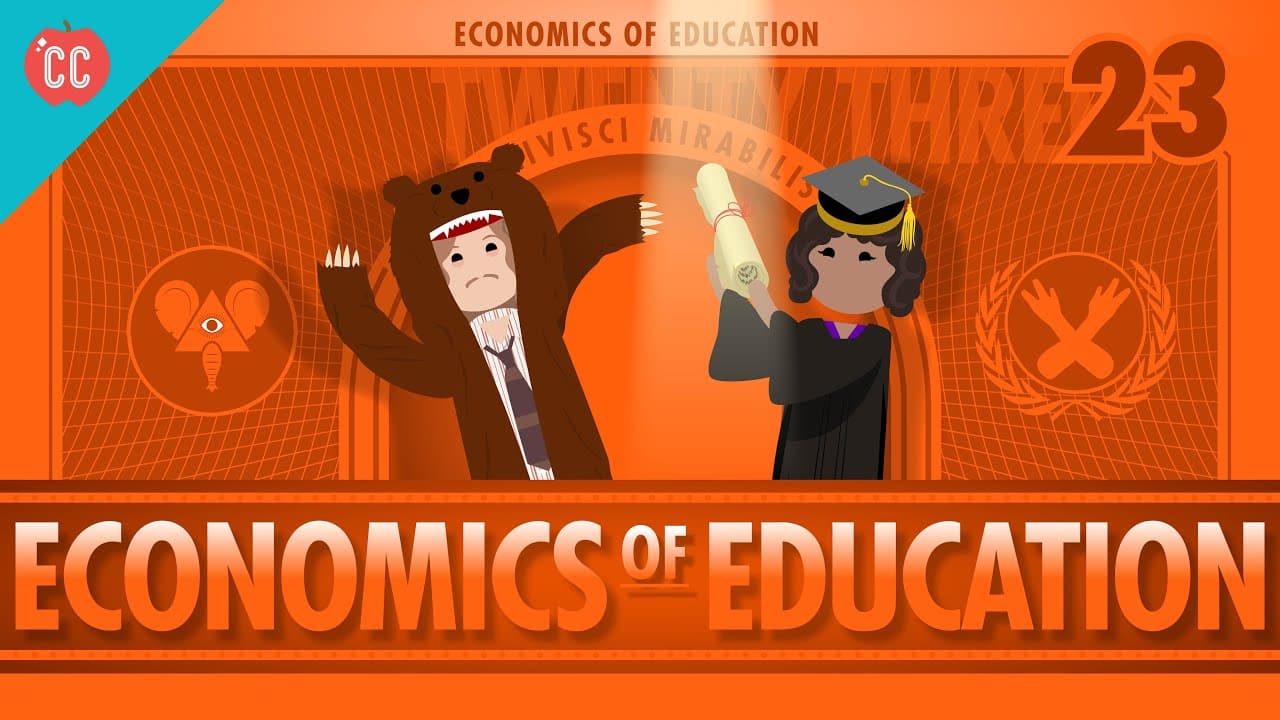
The video explores the costs and benefits of education.
Transcript
Adriene: Welcome to Crash Course Economics, I’m Adriene Hill Jacob: and I’m Jacob Clifford. Some of you might be watching this video in school right now, but even if you’re not, you’ve probably spent a good chunk of your life getting educated. Adriene: Nearly all countries require at least some mandatory schooling and most of those countries provid... Read More
Key Insights
- Education is considered a positive externality, benefiting both individuals and society by increasing productivity and GDP.
- The U.S. education system faces significant challenges, including inequality, with students from low-income families often underperforming.
- There is debate over the best way to improve education, with some advocating for increased funding and others for more competition through charter schools and vouchers.
- College graduates generally earn more than those without degrees, but this is influenced by various factors including socio-economic background.
- Theories explaining higher earnings for college graduates include Human Capital theory and Signalling theory, both of which have supporting evidence.
- The rising cost of college is attributed to multiple factors, including increased administrative costs and amenities, rather than just higher tuition.
- Student debt in the U.S. has reached over 1 trillion dollars, with many students taking out loans to finance their education.
- While college can be a good investment, it depends on factors such as the degree obtained and the cost of education.
Install to Summarize YouTube Videos and Get Transcripts
Explore YouTube Video Summarizer or Get YouTube Transcript Extractor
Questions & Answers
Q: What are the main challenges facing the U.S. education system?
The U.S. education system faces significant challenges, particularly inequality. Students from low-income families often have lower math and reading scores compared to those from higher-income families. Additionally, African American, Latino, and Native American students are more likely to drop out of high school than their White or Asian counterparts.
Q: How do Human Capital and Signalling theories explain higher earnings for college graduates?
Human Capital theory suggests that college teaches skills that help secure higher-income jobs, while Signalling theory posits that a degree signals intelligence and dedication to employers. Both theories are supported by data, as college graduates generally earn more than those without degrees, though the gap is smaller when comparing those with similar education levels.
Q: Why is college considered a good investment despite rising costs?
College is considered a good investment because graduates typically earn more than those without degrees. The 'College Wage Premium' shows that college graduates have higher average incomes and lower unemployment rates. However, the investment's value depends on factors like the degree obtained and the cost of education.
Q: What factors contribute to the rising cost of college in the U.S.?
The rising cost of college in the U.S. is attributed to various factors, including increased administrative expenses, luxurious amenities to attract students, and higher costs of running institutions. Although tuition has increased, the 'sticker price' often doesn't reflect the net cost after discounts and financial aid.
Q: What impact does student debt have on education in the U.S.?
Student debt in the U.S. has exceeded 1 trillion dollars, with many students taking loans to finance their education. This debt burden can impact life choices and financial stability. Despite this, college remains a worthwhile investment for many, provided they complete their degrees and choose cost-effective educational paths.
Q: How does education benefit society as a whole?
Education benefits society by increasing productivity, GDP, and standards of living. It also fosters innovation and creativity, as educated individuals contribute to art, technology, and social progress. A well-educated populace can also address social issues like poverty and inequality, leading to a more equitable society.
Q: What alternatives exist for those who don't attend a four-year college?
Alternatives for those not attending a four-year college include community colleges, vocational training, and apprenticeships. These paths offer specific training and skills for careers such as mechanics, plumbing, and electrical work, which can provide good incomes and are expected to see wage increases as demand grows.
Q: Why is there debate over the best way to improve education in the U.S.?
Debate over improving U.S. education centers on whether to increase funding or introduce more competition. Some advocate for government-funded early education and additional resources for disadvantaged students, while others support charter schools and voucher programs to incentivize schools to improve through competition.
Summary & Key Takeaways
-
The video discusses the economics of education, highlighting the costs and benefits associated with schooling. It emphasizes that education is a positive externality, benefiting both individuals and society. The U.S. education system faces challenges such as inequality, and there are debates over the best ways to improve it.
-
College graduates typically earn more than those without degrees, but this is influenced by factors such as socio-economic background. Theories like Human Capital and Signalling explain why college graduates earn more, with evidence supporting both. Rising college costs are attributed to various factors, including administrative expenses.
-
Student debt in the U.S. has surpassed 1 trillion dollars, with many students relying on loans. While college can be a worthwhile investment, it depends on factors like the degree obtained and the cost. Education is also a tool for reducing poverty and addressing income inequality.
Read in Other Languages (beta)
Share This Summary 📚
Summarize YouTube Videos and Get Video Transcripts with 1-Click
Try YouTube Summary with ChatGPT & Claude or YouTube Transcript Generator
Explore More Summaries from CrashCourse 📚



Summarize YouTube Videos and Get Video Transcripts with 1-Click
Try YouTube Summary with ChatGPT & Claude or YouTube Transcript Generator