How To Detect Faster Than Light Travel
TL;DR
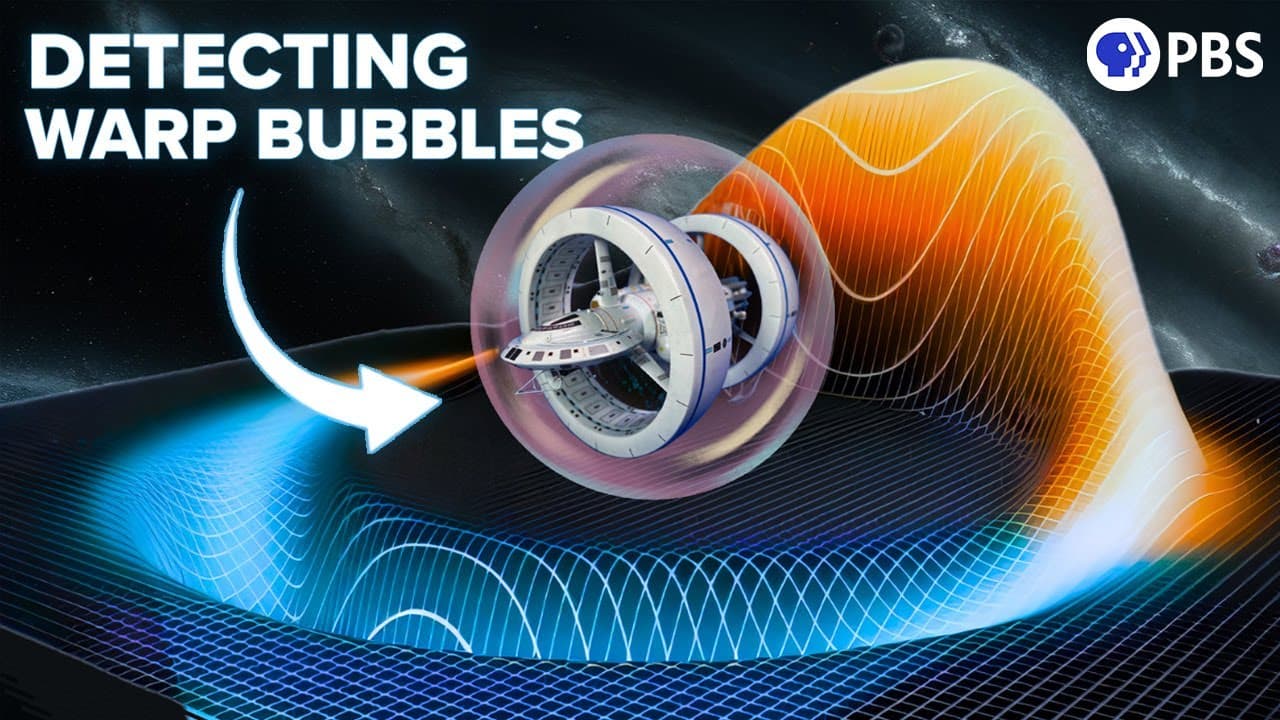
Exploring the possibility of detecting alien warp drives through gravitational waves.
Transcript
Hey Everyone. We have some fun new merch at the merch store, we’ll let you know more at the end of the episode. Warp drives may or may not be possible, but if they are then could a distant alien civilization’s warp fields produce gravitational waves that we could see here on Earth? Well according to a recent study that may be the case. We are e... Read More
Key Insights
- Gravitational wave astronomy is entering a golden era, with advanced detectors like LIGO, Cosmic Explorer, and LISA enhancing our ability to detect cosmic phenomena.
- Warp drives, a staple of science fiction, may produce gravitational waves detectable on Earth if alien civilizations use them for space travel.
- The Alcubierre warp field, a theoretical solution within general relativity, suggests superluminal travel by manipulating spacetime, although it requires exotic matter and immense energy.
- Recent studies explore the potential gravitational wave signatures from the collapse of warp bubbles, which could be detectable by future gravitational wave observatories.
- Simulating warp bubble collapse involves complex numerical relativity calculations, requiring assumptions about unknown equations of state for exotic matter.
- Current detectors like LIGO are not yet sensitive to the high-frequency gravitational waves expected from warp bubble collapse, but future advancements may change this.
- If detected, gravitational waves from warp bubbles would differ from natural sources, potentially accompanied by electromagnetic counterparts, offering a multimessenger event.
- Research into warp drives and gravitational waves expands our understanding of general relativity, even if practical warp travel remains speculative.
Install to Summarize YouTube Videos and Get Transcripts
Explore YouTube Video Summarizer or Get YouTube Transcript Extractor
Questions & Answers
Q: What is the Alcubierre warp field?
The Alcubierre warp field is a theoretical model proposed by physicist Miguel Alcubierre in 1994, which allows for superluminal travel within the framework of general relativity. It proposes a method of faster-than-light travel by expanding space behind a spacecraft and contracting it in front, creating a 'warp bubble' that moves through spacetime. This concept, however, requires exotic matter and immense energy, making it speculative.
Q: How might gravitational waves from warp drives be detected?
Gravitational waves from warp drives might be detected by advanced observatories capable of sensing the unique signatures produced by warp bubble collapses. These waves would differ from those generated by natural phenomena like black hole mergers. Future detectors, with enhanced sensitivity and frequency range, could potentially identify these signals, especially if the collapse occurs within our galaxy, making the waves stronger and more detectable.
Q: Why are warp drives considered speculative?
Warp drives are considered speculative because they require conditions that challenge current physical laws, such as the need for exotic matter with negative mass and enormous energy equivalent to celestial bodies. Additionally, while the Alcubierre warp field is a valid solution in general relativity, practical implementation faces significant theoretical and technological hurdles, including unknown equations of state for sustaining such a warp bubble.
Q: What challenges exist in simulating warp bubble collapse?
Simulating warp bubble collapse involves complex numerical relativity calculations, which require assumptions about the behavior of exotic matter and unknown equations of state. These simulations must account for the evolution of spacetime and mass-energy distributions over time, which is computationally intensive and speculative due to the lack of empirical data on exotic matter and warp dynamics.
Q: What is the significance of detecting gravitational waves from warp drives?
Detecting gravitational waves from warp drives would be significant as it could provide empirical evidence of advanced alien technology and validate aspects of theoretical physics related to superluminal travel. Such a discovery would expand our understanding of general relativity, exotic matter, and the potential for faster-than-light travel, offering insights into the limits and possibilities of our current scientific theories.
Q: What role do gravitational wave detectors like LIGO play in this research?
Gravitational wave detectors like LIGO play a crucial role in this research by providing the technology needed to detect and analyze cosmic phenomena, including potential signals from alien warp drives. LIGO's sensitivity to minute spacetime distortions allows scientists to explore new frontiers in astrophysics, although current detectors are not yet equipped to detect the high-frequency waves expected from warp bubble collapses.
Q: How does the concept of warp drives relate to general relativity?
The concept of warp drives relates to general relativity through the manipulation of spacetime geometry, as described by the Alcubierre warp field. This theoretical model leverages the flexibility of spacetime to allow superluminal travel, consistent with Einstein's equations. However, it challenges current understanding by requiring exotic matter and immense energy, pushing the boundaries of what is considered physically possible within the theory.
Q: What potential outcomes could result from detecting an alien warp drive signal?
Detecting an alien warp drive signal could lead to groundbreaking discoveries in physics and astronomy, confirming the existence of advanced extraterrestrial technology and providing insights into the properties of exotic matter. It could also inspire new technologies and theories in faster-than-light travel and expand our understanding of the universe. Additionally, such a detection could trigger a reevaluation of the limits of general relativity and our current scientific paradigms.
Summary & Key Takeaways
-
The video discusses the potential for detecting gravitational waves from alien warp drives, a concept grounded in theoretical physics and general relativity. It examines the Alcubierre warp field, a theoretical model for faster-than-light travel, and its implications for gravitational wave astronomy.
-
Advanced gravitational wave detectors like LIGO and future projects such as Cosmic Explorer and LISA are enhancing our ability to detect cosmic phenomena, including potential signals from alien warp drives. These detectors could one day identify the unique gravitational wave signatures of warp bubble collapses.
-
While practical warp drives remain speculative, research into their theoretical underpinnings helps expand our understanding of general relativity and cosmic phenomena. Detecting gravitational waves from warp drives could provide insights into exotic matter and the limits of current physical theories.
Read in Other Languages (beta)
Share This Summary 📚
Summarize YouTube Videos and Get Video Transcripts with 1-Click
Try YouTube Summary with ChatGPT & Claude or YouTube Transcript Generator
Explore More Summaries from PBS Space Time 📚



Summarize YouTube Videos and Get Video Transcripts with 1-Click
Try YouTube Summary with ChatGPT & Claude or YouTube Transcript Generator