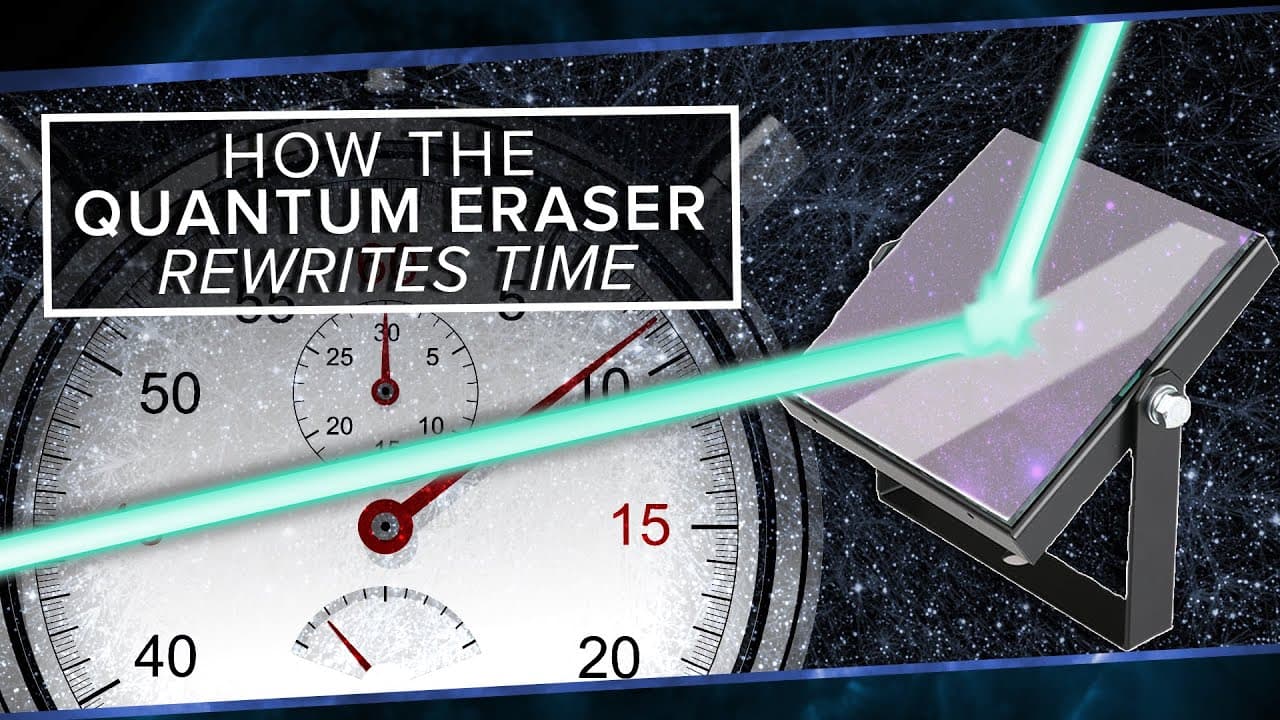
How the Quantum Eraser Rewrites the Past | Space Time | PBS Digital Studios
TL;DR
Quantum Eraser experiment challenges our understanding of causality.
Transcript
[MUSIC PLAYING] This episode is sponsored by Audible. Can reality be adjusted after events have occurred? That's the unsettling implication of the delayed choice quantum eraser experiment. We recently talked about the weird results of the single particle double slit experiment. They imply some startling things about the nature of reality. Today, I ... Read More
Key Insights
- The delayed choice quantum eraser experiment suggests that reality can be altered retroactively, challenging the traditional understanding of causality.
- In the double slit experiment, particles behave like waves, creating interference patterns, unless their path is observed, collapsing the wave function.
- The experiment indicates that knowledge of a particle's path can retroactively influence its behavior, suggesting a complex link between observation and reality.
- Quantum entanglement plays a crucial role in these experiments, allowing particles to influence each other instantaneously across distances.
- The Copenhagen interpretation posits that wave function collapse occurs upon observation, but the experiment challenges this by suggesting retroactive influence.
- Alternative interpretations like the De Broglie-Bohm Pilot Wave Theory propose hidden variables and non-locality to explain quantum phenomena.
- The quantum eraser component of the experiment erases path information, restoring interference patterns and further complicating our understanding of reality.
- Quantum mechanics continues to defy intuitive understanding, prompting ongoing exploration of its implications for the nature of space and time.
Install to Summarize YouTube Videos and Get Transcripts
Explore YouTube Video Summarizer or Get YouTube Transcript Extractor
Questions & Answers
Q: What is the delayed choice quantum eraser experiment?
The delayed choice quantum eraser experiment is an advanced version of the double slit experiment, which suggests that the act of observation can retroactively influence the behavior of particles. By using entangled particles, the experiment demonstrates that knowledge of a particle's path can alter its past behavior, challenging traditional notions of causality.
Q: How does the double slit experiment work?
In the double slit experiment, particles like photons are fired at a barrier with two slits. When unobserved, they create an interference pattern on a screen, behaving like waves. However, when observed, the wave function collapses, and they behave like particles, landing in clumps. This suggests that observation influences their behavior, a key insight into quantum mechanics.
Q: What role does quantum entanglement play in these experiments?
Quantum entanglement is crucial in these experiments, as it allows particles to influence each other instantaneously across distances. In the quantum eraser experiment, entangled particles are used to determine the path of photons, demonstrating that entangled particles can retroactively alter each other's behavior, challenging our understanding of observation and reality.
Q: What is the Copenhagen interpretation?
The Copenhagen interpretation is a widely accepted explanation of quantum mechanics that posits the wave function collapse occurs upon observation, determining a particle's properties. However, the delayed choice quantum eraser experiment challenges this interpretation by suggesting that observation can retroactively influence reality, prompting reconsideration of the wave function's role in defining reality.
Q: What is the significance of the quantum eraser component?
The quantum eraser component involves using beam splitters to erase path information of photons, restoring interference patterns. This suggests that the mere potential for observation influences particle behavior, complicating our understanding of reality. It highlights the intricate relationship between observation, information, and the behavior of particles in quantum mechanics.
Q: How does the De Broglie-Bohm Pilot Wave Theory differ from the Copenhagen interpretation?
The De Broglie-Bohm Pilot Wave Theory posits that particles have hidden variables and follow deterministic paths guided by a pilot wave. Unlike the Copenhagen interpretation, it suggests that wave function collapse involves non-locality and instantaneous changes in properties, offering an alternative explanation for quantum phenomena, including those observed in the delayed choice quantum eraser experiment.
Q: What implications does the experiment have for our understanding of space and time?
The delayed choice quantum eraser experiment suggests that causality may not be as linear as traditionally thought, with observation potentially influencing past events. This challenges our understanding of space and time, prompting further exploration of quantum mechanics and its implications for the fundamental nature of reality, including the potential for retroactive influence on events.
Q: How does the experiment challenge traditional notions of causality?
The experiment challenges traditional notions of causality by suggesting that observation can retroactively alter the behavior of particles. This implies that the future can influence the past, contradicting the conventional understanding of causality as a one-way progression from cause to effect. It raises profound questions about the nature of time and the role of observation in shaping reality.
Summary & Key Takeaways
-
The delayed choice quantum eraser experiment challenges the traditional understanding of causality by suggesting that observation can retroactively alter reality. This experiment builds on the double slit experiment, where particles act like waves unless observed, collapsing the wave function.
-
The experiment utilizes quantum entanglement, allowing particles to influence each other instantaneously. This raises questions about the nature of observation and its role in determining reality, challenging interpretations like the Copenhagen interpretation.
-
The quantum eraser component involves erasing path information, restoring interference patterns, and complicating our understanding of quantum mechanics. These findings prompt further exploration of quantum phenomena and their implications for space and time.
Read in Other Languages (beta)
Share This Summary 📚
Summarize YouTube Videos and Get Video Transcripts with 1-Click
Try YouTube Summary with ChatGPT & Claude or YouTube Transcript Generator
Explore More Summaries from PBS Space Time 📚

Summarize YouTube Videos and Get Video Transcripts with 1-Click
Try YouTube Summary with ChatGPT & Claude or YouTube Transcript Generator