Why Many People May Be “Einstein in the Patent Clerk Days”, François Chollet | AI Podcast Clips
TL;DR
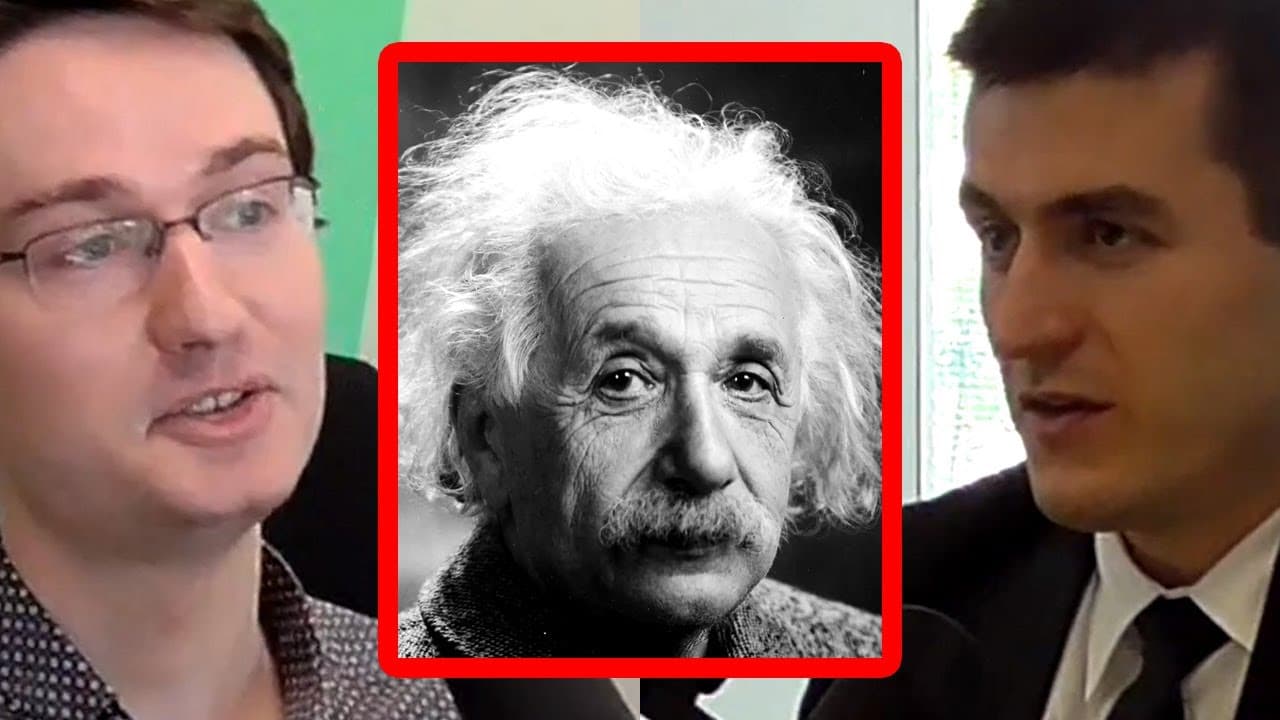
Many people may have genius-level intelligence that remains unexpressed because intelligence emerges when strong problem-solving capabilities meet a significant problem at the right time. François Chollet uses Einstein’s patent-clerk days to argue that brain power alone is not the bottleneck: intelligence depends on an interdependent brain-body-environment system, where improving one component creates another bottleneck. Read on to understand why this challenges the idea of an exponential AI intelligence explosion.
Transcript
so yes winters explosion I'm sure if Mei was the idea but it's the idea that if you were to build general AI problem-solving algorithms well the problem of building such in the eye that itself is a problem that could be solved by your AI and maybe it could be so better than that and what humans can do so you're a I could start tweaking its own algo... Read More
Key Insights
- François Chollet critiques the idea of an AI intelligence explosion, arguing that intelligence is not just a property of the brain but emerges from interactions with the body and environment.
- The concept of exponentially improving AI intelligence is questioned, as intelligence is not isolated like a building's height but involves complex interdependencies.
- Chollet suggests that intelligence is the meeting of problem-solving capabilities with significant problems, not merely the potential intelligence measured by IQ or brain power.
- Many people may have genius-level intelligence but lack opportunities to express it, similar to Einstein's potential remaining untapped if not for the right circumstances.
- The current AI debate involves whether superhuman intelligence can arise simply by scaling up brain-like processing, a notion Chollet challenges.
- Chollet argues that improving one part of an intelligence system leads to new bottlenecks, questioning the feasibility of limitless intelligence growth.
- The discussion reflects broader debates in AI about the limits of human and artificial intelligence, and the role of environment in shaping intelligence.
- Chollet emphasizes that intelligence should be viewed as a holistic system involving brain, body, and environment, rather than isolating one component.
Install to Summarize YouTube Videos and Get Transcripts
Explore YouTube Video Summarizer or Get YouTube Transcript Extractor
Questions & Answers
Q: Why does François Chollet say many people are like Einstein in his patent-clerk days?
Chollet argues that many people may be genius-level smart without having the right problem or opportunity through which to express that intelligence. He says Einstein became Einstein through the meeting of a genius and a big problem at the right time; without that meeting, he might have remained a patent clerk.
Q: What is François Chollet’s main criticism of an AI intelligence explosion?
He rejects the implicit idea that intelligence is an isolated property of a brain that can simply be increased. In his account, intelligence emerges through interactions among a brain, a body, and an environment, so modifying one component cannot by itself produce exponentially increasing intelligence.
Q: What does the AI intelligence-explosion theory propose?
The theory proposes that a general AI could treat the task of building a better AI as another problem to solve. By repeatedly improving its own algorithms, it could become a better version of itself in a recursive process and potentially achieve exponentially increasing intelligence.
Q: Why can’t intelligence be treated like the height of a building?
Chollet says a building’s height can be considered as an isolated property, whereas intelligence cannot. Intelligence depends on the interaction of a brain, an embodied agent, and an environment; without one of those pieces, he argues, intelligence cannot be properly defined.
Q: Why might improving one part of an intelligent system fail to produce an intelligence explosion?
A brain-body-environment system contains many interdependencies. Chollet argues that whenever one part is improved, a new bottleneck arises elsewhere, preventing the capabilities emerging from the whole system from simply exploding exponentially.
Q: Is brain capacity the main limit on what very smart people can achieve?
Chollet does not think the brain or its capabilities are the primary bottleneck for very smart people. He observes that many smart people are not solving major scientific problems, suggesting that achievement also depends on encountering suitable problems and circumstances.
Q: How does Chollet define expressed intelligence?
He describes intelligence as the meeting of great problem-solving capabilities with a great problem. Without a problem that allows those capabilities to be demonstrated, a person is left with only potential intelligence, such as brain capacity or an IQ number.
Q: How does the environment affect intelligence in Chollet’s view?
The environment supplies the problems and tasks with which an agent can become coupled. Intelligence becomes visible when an agent encounters and solves such a problem, so the environment is part of the system that produces expressed intelligence rather than merely a backdrop.
Summary & Key Takeaways
-
François Chollet challenges the notion of AI intelligence explosion, arguing that intelligence is not just a brain property but emerges from interactions within a system involving the body and environment. He suggests that intelligence is the meeting of problem-solving capabilities with significant problems, not just potential intelligence.
-
Chollet questions the feasibility of exponentially improving AI intelligence, noting that intelligence involves complex interdependencies and improving one part of a system leads to new bottlenecks. He argues that many people have genius-level intelligence but lack opportunities to express it, similar to Einstein's potential remaining untapped.
-
The discussion reflects broader debates in AI about the limits of human and artificial intelligence and the role of environment in shaping intelligence. Chollet emphasizes viewing intelligence as a holistic system involving brain, body, and environment, rather than isolating one component.
Read in Other Languages (beta)
Share This Summary 📚
Summarize YouTube Videos and Get Video Transcripts with 1-Click
Try YouTube Summary with ChatGPT & Claude or YouTube Transcript Generator
Explore More Summaries from Lex Fridman 📚



Summarize YouTube Videos and Get Video Transcripts with 1-Click
Try YouTube Summary with ChatGPT & Claude or YouTube Transcript Generator