What Is Pythagoras's Theorem and How to Use It?
TL;DR
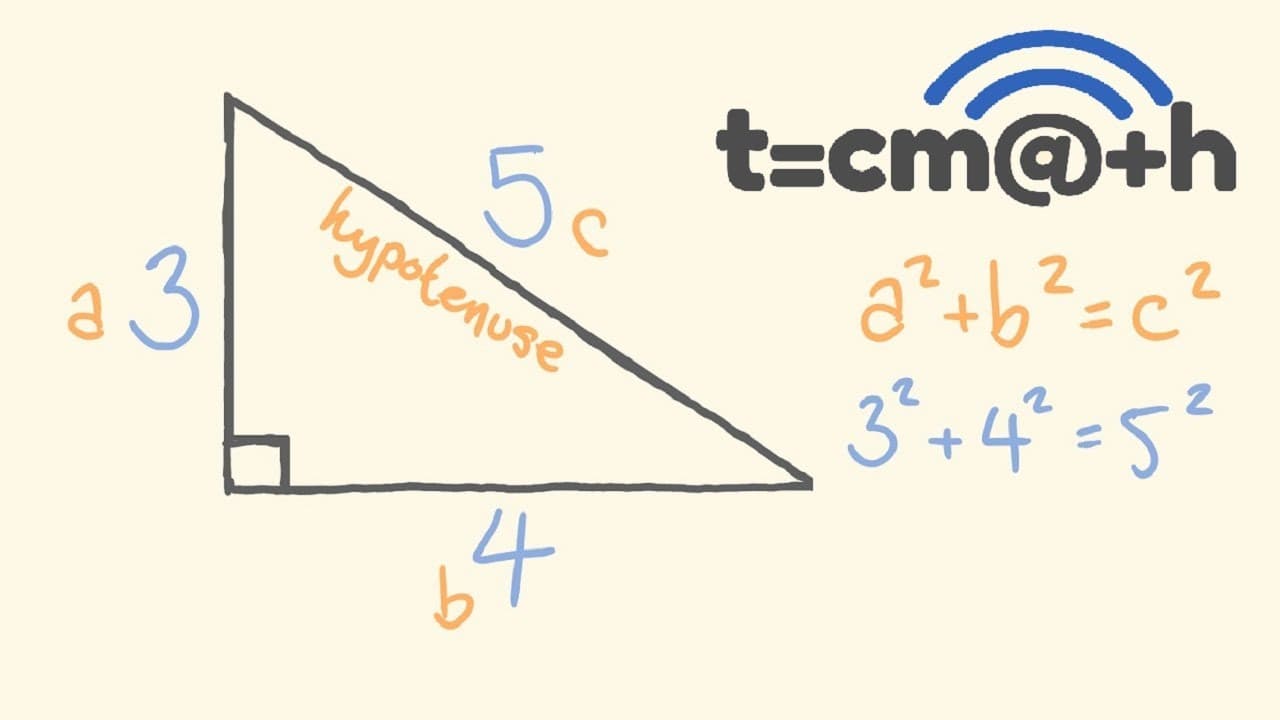
Pythagoras's Theorem allows you to calculate the length of an unknown side in a right triangle, given the lengths of the other two sides. The formula is a² + b² = c², where c is the hypotenuse. It’s a fundamental principle in geometry and can be applied in various mathematical problems.
Transcript
good day welcome to Tech maath Channel what we're going to be having a look at in this video is Pythagoras's Theorem so sit back and enjoy and if you like this video please remember underneath the uh video there there's a little like button please give it a poke uh and first off before I start also a big shout out to my uh very very first patreon y... Read More
Key Insights
- 🔺 Pythagoras's Theorem is applicable only to right angle triangles.
- 🔺 The hypotenuse is the longest side in a right angle triangle.
- ❓ The formula for Pythagoras's Theorem is a^2 + b^2 = c^2.
- 🙃 Pythagoras's Theorem allows us to find an unknown side length if we know the lengths of the other two sides.
- 🫚 The square root is used to solve for the unknown side length.
- 🔺 There are common right angle triangles, such as the Pythagorean Triad, with known side length ratios.
- 🌍 Pythagoras's Theorem is a useful tool in various mathematical and real-world applications.
Install to Summarize YouTube Videos and Get Transcripts
Explore YouTube Video Summarizer or Get YouTube Transcript Extractor
Questions & Answers
Q: What is Pythagoras's Theorem?
Pythagoras's Theorem is a mathematical formula that relates the lengths of the sides of a right angle triangle. It states that the square of the hypotenuse (the side opposite the right angle) is equal to the sum of the squares of the other two sides.
Q: How do you identify the hypotenuse in a right angle triangle?
The hypotenuse is the longest side in a right angle triangle and is directly opposite the right angle. It can be identified by comparing the lengths of the other two sides.
Q: How do you use Pythagoras's Theorem to find an unknown side length?
To find an unknown side length, you need to know the lengths of the other two sides. Substitute these values into the formula a^2 + b^2 = c^2, where a and b are the known sides and c is the unknown side. Solve for c by taking the square root of the sum of the squares.
Q: Are there any common right angle triangles that have known side length ratios?
Yes, one common right angle triangle is the Pythagorean Triad, which consists of sides with lengths in the ratio of 3:4:5. Multiples of this ratio can also form right angle triangles.
Summary & Key Takeaways
-
Pythagoras's Theorem applies to right angle triangles and allows us to find an unknown side length if we know the lengths of the other two sides.
-
The longest side in a right angle triangle is called the hypotenuse.
-
The formula for Pythagoras's Theorem is a^2 + b^2 = c^2, where a and b are the shorter sides and c is the hypotenuse.
Read in Other Languages (beta)
Share This Summary 📚
Summarize YouTube Videos and Get Video Transcripts with 1-Click
Try YouTube Summary with ChatGPT & Claude or YouTube Transcript Generator
Explore More Summaries from tecmath 📚




Summarize YouTube Videos and Get Video Transcripts with 1-Click
Try YouTube Summary with ChatGPT & Claude or YouTube Transcript Generator