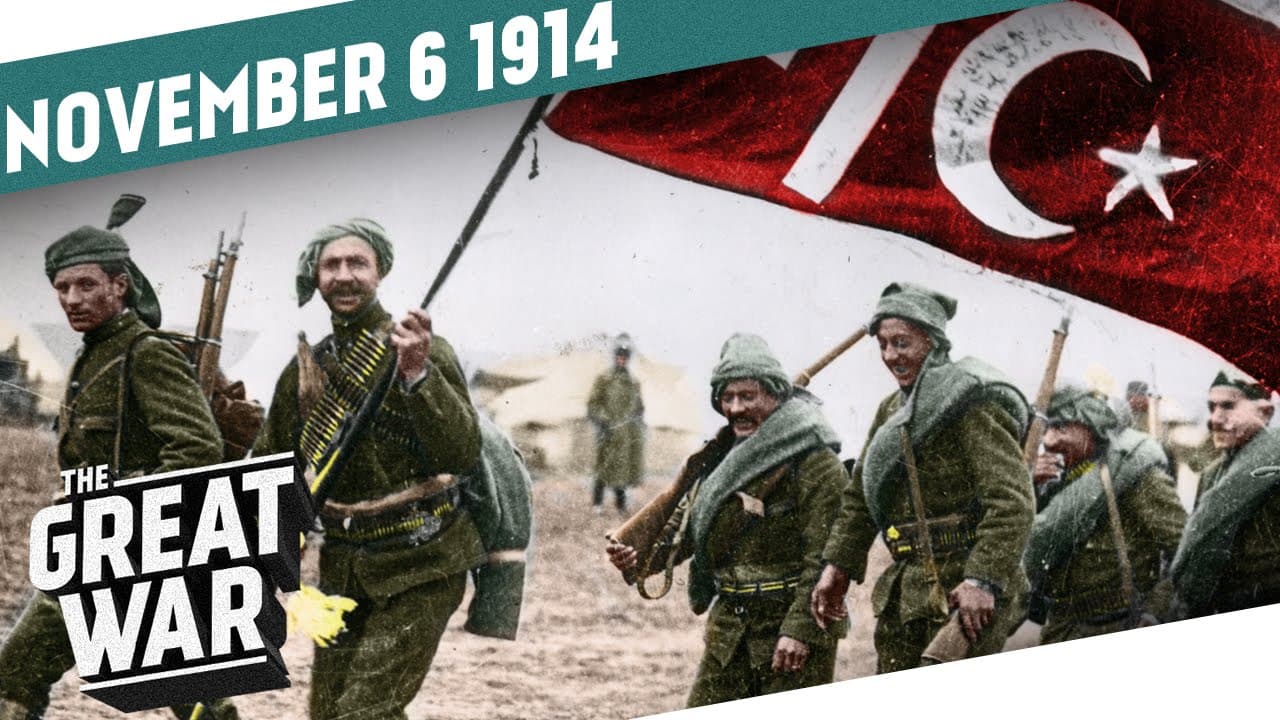
The World at War - The Ottoman Empire Enters The Stage I THE GREAT WAR Week 15
TL;DR
The Ottoman Empire enters WWI, expanding the conflict globally.
Transcript
Three months of war have devastated Europe, and with conflict recently spreading to colonial territory in Africa and the Far East it grew ever larger. It would grow many times larger this week though, and open up huge new theaters of battle, as the Ottoman Empire entered the war. I’m Indy Neidell; welcome to the Great War. Last week we saw the Belg... Read More
Key Insights
- The Ottoman Empire entered World War I, significantly expanding the conflict's geographical scope and introducing new battlefronts.
- Enver Pasha, the Ottoman Minister of War, used strategic deception to involve Turkey in the war, aiming for a nationalist future.
- The Russian declaration of war on the Ottoman Empire followed covert aggression by Turkish forces disguised as Germans.
- The Battle of Coronel highlighted German naval prowess as they sank two British ships off the coast of Chile, despite logistical challenges.
- The stalemate on the Western Front marked the end of maneuver warfare, transitioning to trench warfare that would last until 1918.
- German General von Lettow-Worbeck's guerrilla tactics in East Africa successfully tied down Allied forces, despite being outnumbered.
- The failed British and Indian offensive at Tanga demonstrated the effectiveness of German military strategy and the incompetence of Allied forces.
- The Ottoman entry into the war was driven by a vision of a new Turkish nation, but resulted in significant loss of life and suffering.
Install to Summarize YouTube Videos and Get Transcripts
Explore YouTube Video Summarizer or Get YouTube Transcript Extractor
Questions & Answers
Q: What prompted the Ottoman Empire to enter World War I?
The Ottoman Empire entered World War I primarily due to the actions of Enver Pasha, the Turkish Minister of War. He aimed to establish a new nationalist identity for Turkey and believed that involvement in the war could achieve this goal. Pasha's strategic deception, including disguising German ships as Turkish, led to Russia declaring war on Turkey, thus officially involving the Ottoman Empire in the conflict.
Q: How did the Battle of Coronel impact the naval dynamics of World War I?
The Battle of Coronel, fought off the coast of Chile, demonstrated German naval superiority early in the war. The German East Asia Squadron, under Maximilian von Spee, decisively defeated a British naval squadron, sinking two ships and causing significant British casualties. This victory showcased the global reach of the conflict and highlighted the strategic importance and challenges of naval warfare, despite the logistical constraints faced by the German forces.
Q: What was the significance of the stalemate on the Western Front?
The stalemate on the Western Front marked a significant turning point in World War I as it transitioned from maneuver warfare to trench warfare. This shift resulted in a static and brutal conflict, characterized by entrenched positions and high casualties. The stalemate underscored the challenges of breaking through enemy lines and foreshadowed the prolonged and grueling nature of the war, with both sides unable to secure a decisive victory until 1918.
Q: How did General von Lettow-Worbeck impact the East African campaign?
General von Lettow-Worbeck played a crucial role in the East African campaign by employing effective guerrilla warfare tactics. Despite being consistently outnumbered, his strategic maneuvers tied down tens of thousands of British and colonial troops, preventing them from being deployed to Europe. His ability to maintain a prolonged campaign against superior forces demonstrated the complexity and global nature of World War I, as well as the effectiveness of unconventional military strategies.
Q: What challenges did the Russians face on the Eastern Front?
On the Eastern Front, the Russians faced significant logistical challenges, particularly related to transportation and supply lines. The lack of railways in Western Poland, exacerbated by German destruction during their retreat, hindered Russian advances. This logistical unpreparedness slowed their pursuit of German forces, preventing them from capitalizing on earlier victories and ultimately forcing a halt to their advance due to disrupted supply lines for food and ammunition.
Q: Why did the British offensive at Tanga fail?
The British offensive at Tanga failed due to a combination of factors, including British incompetence and lack of training, as well as the strategic brilliance of German General von Lettow-Worbeck. Despite being outnumbered, the Germans effectively repelled the British and Indian troops, showcasing superior military tactics and highlighting the challenges faced by Allied forces in executing successful operations in unfamiliar and challenging terrains.
Q: What were Enver Pasha's goals for Turkey in the war?
Enver Pasha's goals for Turkey in World War I were centered around establishing a new nationalist identity and future for the country. He envisioned a Turkish nation that was self-reliant and not dependent on the Arab world for guidance. Pasha believed that participating in the war would forge national unity through shared struggle and sacrifice, ultimately contributing to the creation of a modern and independent Turkish state.
Q: How did the Ottoman entry into the war affect the global scope of the conflict?
The Ottoman entry into World War I significantly expanded the global scope of the conflict by introducing new battlefronts in the Middle East, the Caucasus, and the Dardanelles. This involvement drew additional countries into the war, increased the complexity of military operations, and highlighted the war's far-reaching impact beyond Europe. The Ottoman participation also underscored the geopolitical significance of the Middle East and its resources, particularly oil, in the broader context of the war.
Summary & Key Takeaways
-
The Ottoman Empire's entrance into World War I marked a significant expansion of the conflict, opening new battlefronts across the globe. Enver Pasha's strategic deception led to Turkey's involvement, aiming to forge a new nationalist identity. This decision had profound consequences, both for the Ottoman Empire and the broader war dynamics.
-
The war at sea reached South America with the Battle of Coronel, where the German East Asia Squadron achieved a significant victory against the British. Despite logistical challenges, the German forces showcased their naval strength, highlighting the global reach of the conflict and the strategic importance of naval warfare.
-
On the Western Front, the transition to trench warfare marked the end of maneuver battles until 1918. The stalemate underscored the brutal and static nature of the conflict, with both sides suffering heavy casualties. Meanwhile, in East Africa, German General von Lettow-Worbeck's guerrilla tactics effectively tied down Allied forces, demonstrating the strategic complexity of the war.
Read in Other Languages (beta)
Share This Summary 📚
Summarize YouTube Videos and Get Video Transcripts with 1-Click
Try YouTube Summary with ChatGPT & Claude or YouTube Transcript Generator
Explore More Summaries from The Great War 📚
Summarize YouTube Videos and Get Video Transcripts with 1-Click
Try YouTube Summary with ChatGPT & Claude or YouTube Transcript Generator