Fermions Vs. Bosons Explained with Statistical Mechanics!
TL;DR
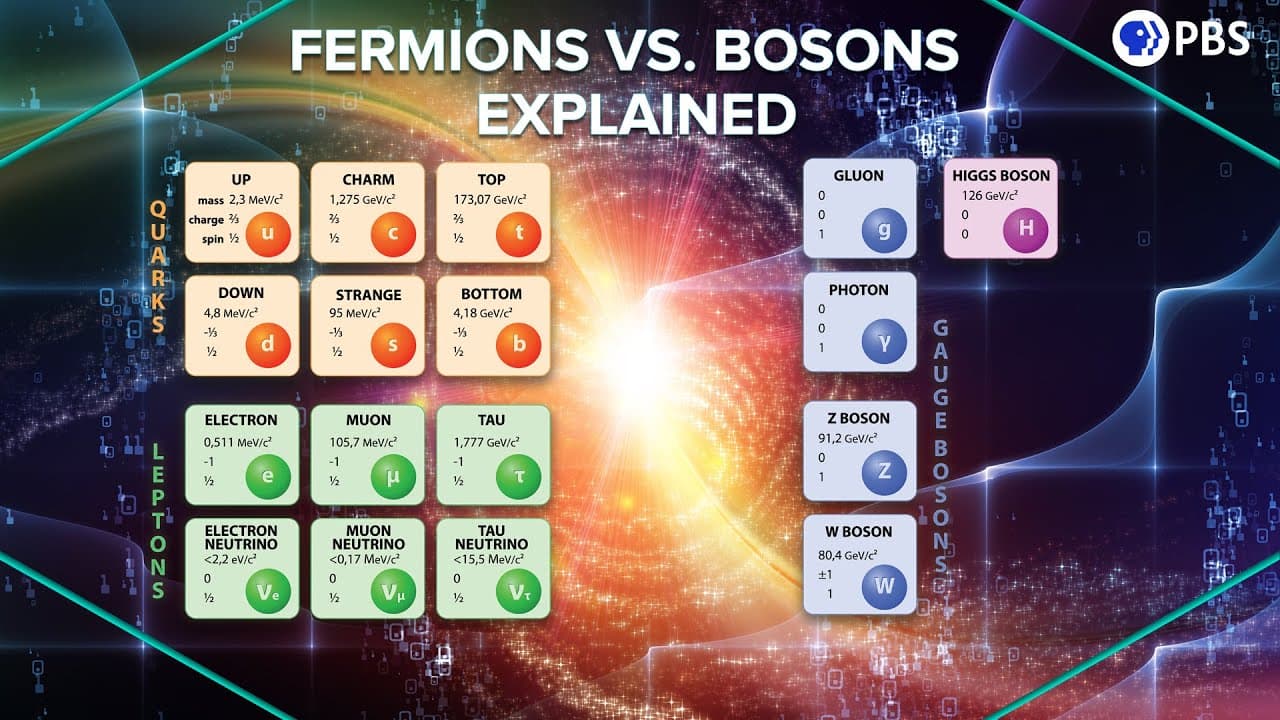
Statistical mechanics explains fermions and bosons using energy distributions.
Transcript
let's say I roll a pair of dice and you get to bet on what number comes up what do you choose well the smart choice is seven because there are more ways for two dice to come up seven than any other number well it turns out that you can apply the same logic to predicting the behavior of the universe so let's see how some of our most powerful tools i... Read More
Key Insights
- Statistical mechanics allows us to predict the behavior of complex systems by analyzing the statistical distribution of particles and their energy states.
- The laws of thermodynamics are derived from the statistical motion and interaction of particles, revealing the hidden order behind observable properties.
- Microstates represent specific configurations of particles, while macrostates represent observable properties like temperature and pressure.
- Entropy measures how close a macrostate is to having maximum microstates, indicating a system's level of disorder.
- Maxwell-Boltzmann statistics describe energy distributions in systems where particles are distinguishable, leading to predictable energy states.
- Bose-Einstein statistics apply to indistinguishable particles, allowing multiple particles to occupy the same energy state, leading to phenomena like superconductivity.
- Fermi-Dirac statistics describe fermions, which cannot share energy states, resulting in unique properties like electron shells in atoms.
- Statistical mechanics helps us understand exotic states of matter and the conditions leading to phenomena like black holes.
Install to Summarize YouTube Videos and Get Transcripts
Explore YouTube Video Summarizer or Get YouTube Transcript Extractor
Questions & Answers
Q: What is the significance of statistical mechanics in physics?
Statistical mechanics is significant because it provides a framework for understanding the behavior of complex systems by analyzing the statistical distribution of particles and their energy states. It bridges the gap between microscopic interactions and macroscopic observable properties, explaining phenomena like thermodynamics and exotic states of matter.
Q: How do microstates and macrostates differ in statistical mechanics?
In statistical mechanics, microstates represent specific configurations of particles, detailing their positions and energy levels. Macrostates, on the other hand, represent the observable properties of a system, such as temperature and pressure. A macrostate can correspond to many microstates, indicating the system's level of disorder or entropy.
Q: What role does entropy play in statistical mechanics?
Entropy in statistical mechanics measures the level of disorder within a system. It quantifies how close a macrostate is to having the maximum number of microstates. Systems naturally evolve towards states of higher entropy, as these states are statistically more probable, leading to the observable laws of thermodynamics.
Q: How do Maxwell-Boltzmann statistics describe energy distributions?
Maxwell-Boltzmann statistics describe energy distributions in systems where particles are distinguishable. They predict the number of particles in each energy state, depending on the system's temperature. This statistical model helps explain the distribution of velocities and energies in gases, leading to predictable macroscopic behaviors.
Q: What distinguishes Bose-Einstein statistics from other statistical models?
Bose-Einstein statistics apply to indistinguishable particles, allowing multiple particles to occupy the same energy state. This results in unique phenomena like Bose-Einstein condensates and superconductivity, which occur at low temperatures. Unlike other models, Bose-Einstein statistics account for the indistinguishability of particles, affecting energy distributions significantly.
Q: Why are fermions restricted by Fermi-Dirac statistics?
Fermions are restricted by Fermi-Dirac statistics because they cannot share energy states, due to their half-integer spin. This restriction leads to the unique properties of fermions, such as the formation of electron shells in atoms. Fermi-Dirac statistics explain the structure of matter and phenomena like white dwarfs and neutron stars.
Q: How does statistical mechanics explain exotic states of matter?
Statistical mechanics explains exotic states of matter by analyzing the statistical distribution of particles and energy states. It predicts behaviors like superconductivity and superfluidity, which arise from unique energy distributions. By understanding these distributions, statistical mechanics reveals the conditions under which these exotic states occur.
Q: What insights does statistical mechanics provide into the universe's structure?
Statistical mechanics provides insights into the universe's structure by explaining how microscopic interactions lead to macroscopic observable properties. It reveals the hidden order behind phenomena like thermodynamics, atomic structures, and cosmic events like black holes, offering a deeper understanding of the fundamental workings of the universe.
Summary & Key Takeaways
-
Statistical mechanics provides insights into the behavior of particles, explaining the laws of thermodynamics through the statistical distribution of microstates and macrostates. By understanding energy distributions, we can predict the behavior of complex systems, including the conditions for exotic states of matter.
-
The behavior of fermions and bosons is explained through different statistical models. Fermions, obeying Fermi-Dirac statistics, cannot share energy states, leading to unique atomic structures. In contrast, bosons follow Bose-Einstein statistics, allowing multiple particles to occupy the same energy state, resulting in phenomena like superconductivity.
-
Statistical mechanics reveals the hidden order behind observable properties by counting microstates and macrostates. This understanding allows us to predict the behavior of particles, leading to insights into the universe's structure, from atomic interactions to the formation of black holes.
Read in Other Languages (beta)
Share This Summary 📚
Summarize YouTube Videos and Get Video Transcripts with 1-Click
Try YouTube Summary with ChatGPT & Claude or YouTube Transcript Generator
Explore More Summaries from PBS Space Time 📚




Summarize YouTube Videos and Get Video Transcripts with 1-Click
Try YouTube Summary with ChatGPT & Claude or YouTube Transcript Generator