L06.3 The Variance of the Bernoulli & The Uniform
TL;DR
This video explains how to calculate the variances of Bernoulli and uniform random variables and explores the relationship between variance and the probability of success.
Transcript
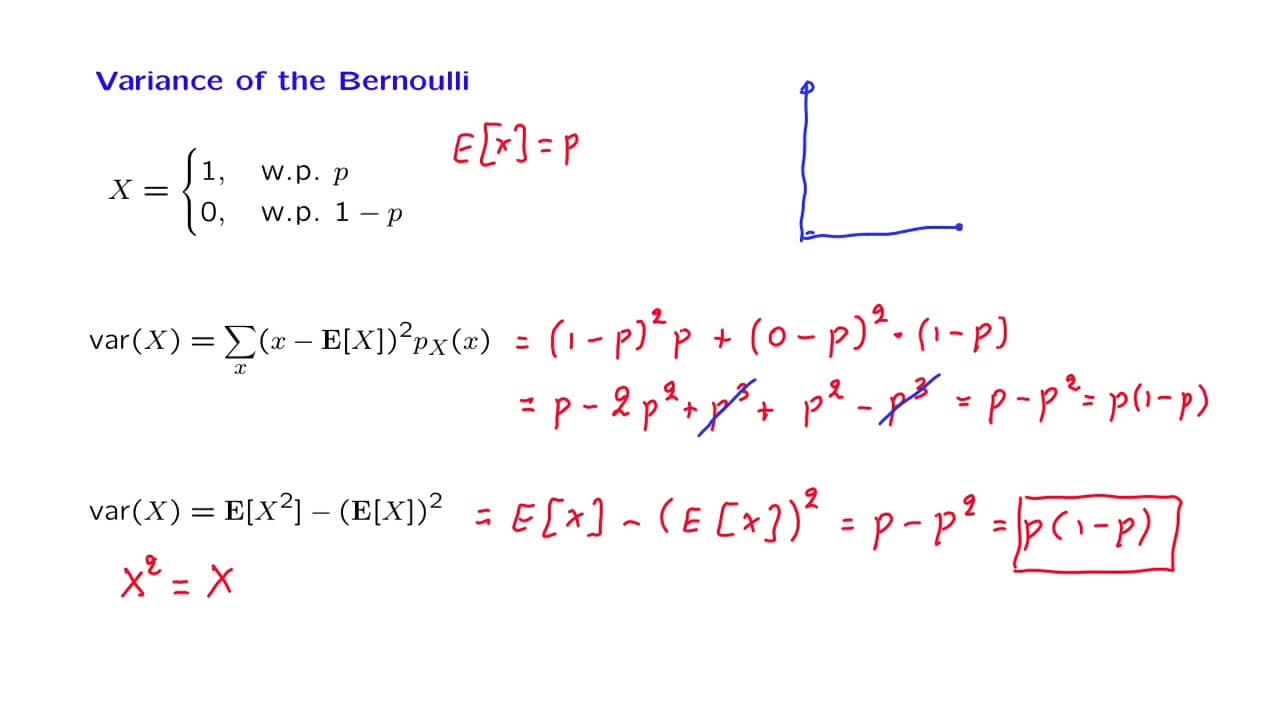
In this segment, we will go through the calculation of the variances of some familiar random variables, starting with the simplest one that we know, which is the Bernoulli random variable. So let X take values 0 or 1, and it takes a value of 1 with probability p. We have already calculated the expected value of X, and we know that it is equal to p.... Read More
Key Insights
- 😘 The variance of a Bernoulli random variable depends on the probability of success, with the highest variance at p=1/2 and the lowest at p=0 or p=1.
- 🪙 The variance of a coin flip is largest when the coin is fair, confirming the intuition that fairness leads to more uncertainty.
- 🥋 The variance of a uniform random variable can be calculated using an alternative formula that involves squared values and the midpoint of the distribution.
- 🪜 Shifting a uniform random variable by adding a constant does not change its variance because adding a constant does not affect the variability of the variable.
Install to Summarize YouTube Videos and Get Transcripts
Explore YouTube Video Summarizer or Get YouTube Transcript Extractor
Questions & Answers
Q: How do you calculate the variance of a Bernoulli random variable?
The variance of a Bernoulli random variable can be calculated using the definition or by subtracting the expected value of X squared from the expected value of X, both of which give the same result of p(1-p).
Q: What is the relationship between the variance of a coin flip and its fairness?
The variance of a coin flip, modeled by a Bernoulli random variable, is highest when the coin is fair (p=1/2) because there is the most uncertainty or randomness in the outcome. The variance is lower when the coin always results in the same outcome (p=0 or p=1).
Q: How is the variance of a uniform random variable calculated?
The variance of a uniform random variable can be calculated using an alternative formula that considers the squared values and the midpoint of the distribution. For a simple case where the range is from 0 to n, the variance is (1/12) * n * (n+2).
Q: How does the variance of a more general uniform random variable relate to the variance of the simple case?
The variance of a general uniform random variable with a range from a to b is the same as the variance of the simple case (n * (n+2)) as long as we make the correspondence that n = b - a. Shifting the PMF of the uniform random variable by adding a constant does not change the variance.
Summary & Key Takeaways
-
The video starts by calculating the variance of a Bernoulli random variable, which represents a binary outcome with probability p.
-
Two methods are presented to calculate the variance: using the definition directly and using the expected value of X minus the expected value of X squared.
-
The variance of a Bernoulli random variable depends on the probability of success, p. It is highest when p=1/2 and lowest when p=0 or p=1.
-
The video also discusses the variance of a uniform random variable, where all possible values are equally likely. The variance is calculated for both a simple case and a more general case.
Read in Other Languages (beta)
Share This Summary 📚
Summarize YouTube Videos and Get Video Transcripts with 1-Click
Try YouTube Summary with ChatGPT & Claude or YouTube Transcript Generator
Explore More Summaries from MIT OpenCourseWare 📚






Summarize YouTube Videos and Get Video Transcripts with 1-Click
Try YouTube Summary with ChatGPT & Claude or YouTube Transcript Generator