19.2.3 Atomic Transactions
TL;DR
Mutual exclusion and semaphores are critical for ensuring shared data consistency and atomic execution of critical sections in multi-process systems.
Transcript
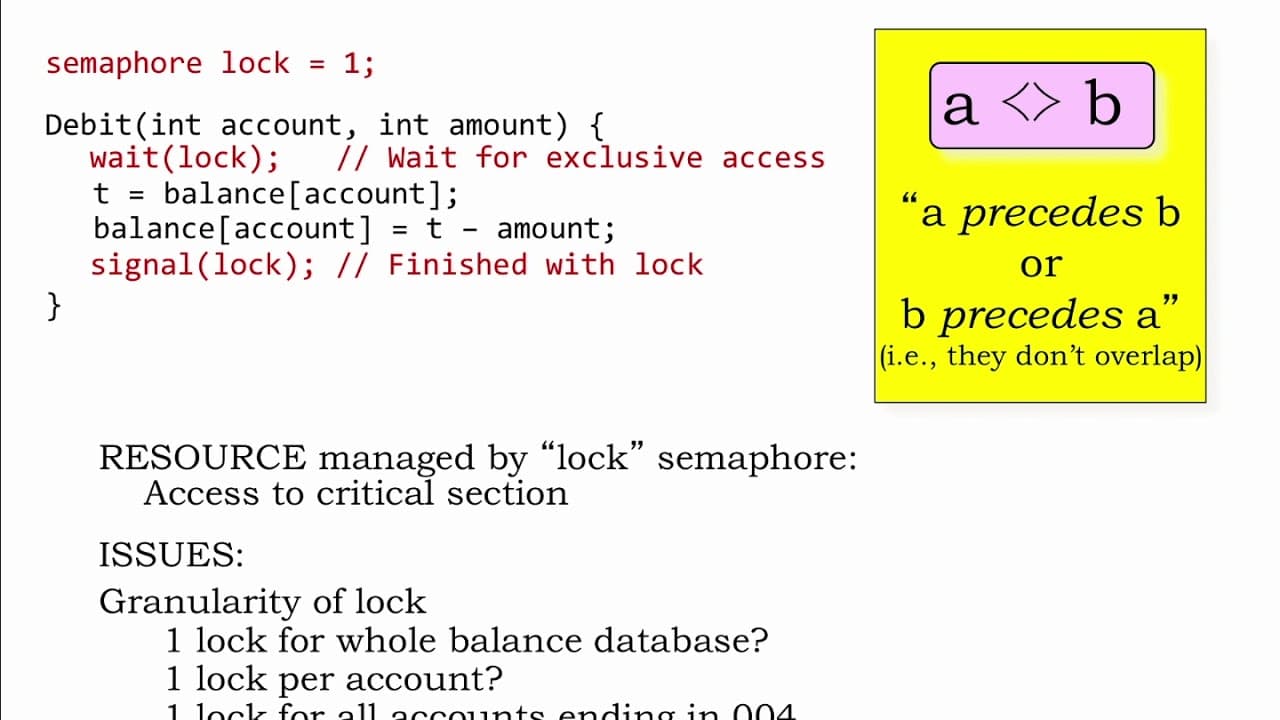
Let's take a moment to look at a different example. Automated teller machines allow bank customers to perform a variety of transactions: deposits, withdrawals, transfers, etc. Let's consider what happens when two customers try to withdraw $50 from the same account at the same time. A portion of the bank's code for a withdrawal transaction is shown ... Read More
Key Insights
- ♿ Shared data accessed by multiple processes requires synchronization to prevent data inconsistencies.
- ⌛ Mutual exclusion ensures that only one process can execute a critical section at a time, maintaining data integrity.
- 🫀 Semaphores are used to enforce mutual exclusion and achieve atomic execution of critical sections.
- ⏰ Lock granularities should be carefully chosen to balance concurrency and efficiency.
- 👻 Per-account locks can optimize a banking system's performance by allowing mostly non-overlapping transactions to occur simultaneously.
- ❓ Database systems offer dedicated functionality for transactions and shared data management.
- 🚦 Semaphores are versatile tools for synchronizing processes, guaranteeing proper execution timing and protecting shared resources.
Install to Summarize YouTube Videos and Get Transcripts
Explore YouTube Video Summarizer or Get YouTube Transcript Extractor
Questions & Answers
Q: What happens when two customers try to withdraw money from the same account simultaneously?
If not properly synchronized, both processes may read an outdated balance and subtract the withdrawal amount, resulting in inconsistent data.
Q: What is a critical section, and why is it important to handle it carefully?
A critical section is a part of code that accesses shared data. It must be executed atomically to guarantee data consistency and prevent conflicts between processes.
Q: How do semaphores ensure mutual exclusion?
Semaphores act as locks that control access to critical sections. By acquiring and releasing the semaphore, processes can enter critical sections one at a time, ensuring mutual exclusion.
Q: Can different locks be used for different shared data in a multi-process system?
Yes, using separate locks for different shared data allows for more concurrency and efficiency. For example, in a banking system, separate locks for each account prevent unnecessary serialization of transactions.
Summary & Key Takeaways
-
When multiple processes try to access shared data simultaneously, careful synchronization is necessary to maintain data integrity.
-
Mutual exclusion ensures that only one process at a time can execute a critical section of code that accesses shared data.
-
Semaphores are used to implement mutual exclusion and atomic execution of critical sections in multi-process systems.
Read in Other Languages (beta)
Share This Summary 📚
Summarize YouTube Videos and Get Video Transcripts with 1-Click
Try YouTube Summary with ChatGPT & Claude or YouTube Transcript Generator
Explore More Summaries from MIT OpenCourseWare 📚


Summarize YouTube Videos and Get Video Transcripts with 1-Click
Try YouTube Summary with ChatGPT & Claude or YouTube Transcript Generator