How Are AI and Robotics Different?
TL;DR
AI and robotics, though often conflated, serve distinct roles. AI excels in processing data and generating responses, while robotics focuses on physical tasks. Together, they can enhance efficiency and accuracy in fields like healthcare and agriculture. However, the journey toward fully autonomous, sentient robots is still unfolding, with significant technological and ethical challenges remaining.
Transcript
basic that sounds like a tricky situation robots have come a long way machines such as Boston Dynamics doglike spot showed the world what The Cutting Edge of advanced robotics looks like but its autonomous self-correcting quadraped can't pick up and use a pen meanwhile software like chat gbt evokes visions of a future where nobody even needs pens y... Read More
Key Insights
- AI is primarily about processing data, understanding language, and generating responses, while robotics involves physical tasks and interactions.
- Robots can increase efficiency and accuracy in sectors like healthcare, agriculture, and transportation by automating mundane tasks.
- The media and science fiction often blur the lines between AI and robotics, leading to misconceptions about their capabilities.
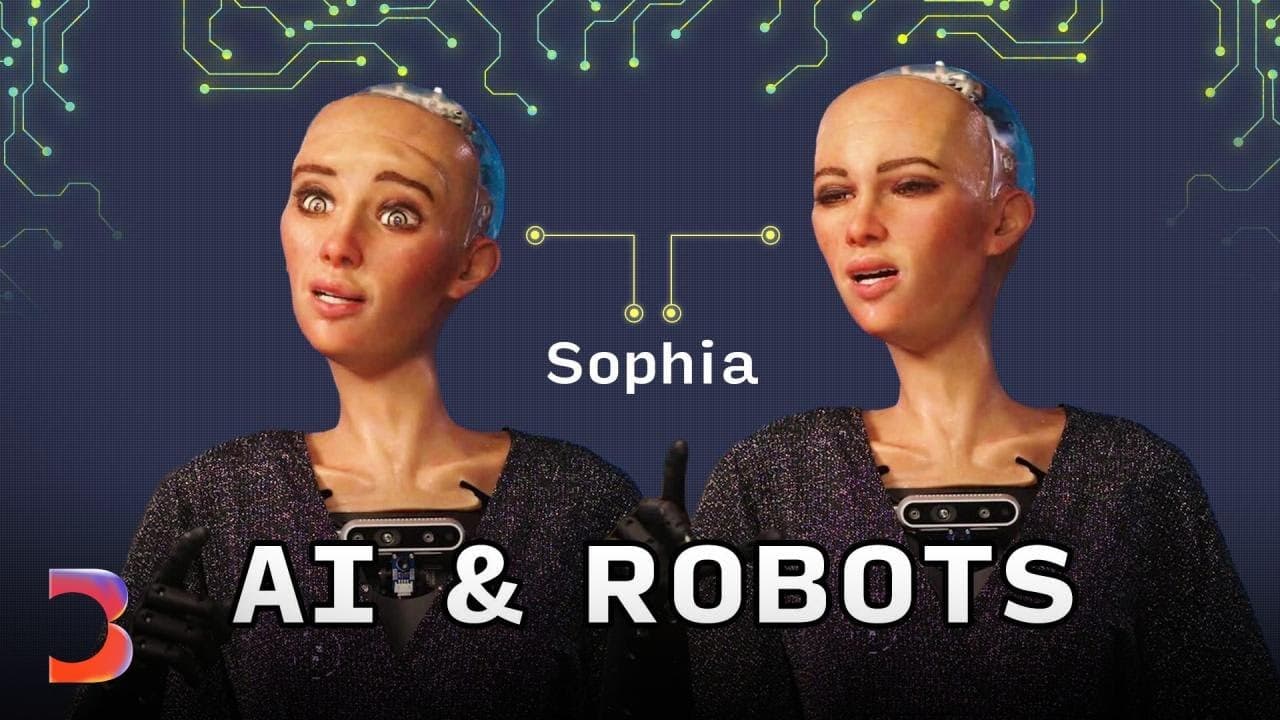
- Sophia, a humanoid robot, uses AI to process visual and audio data, understand natural language, and interact with humans.
- Trust is a central issue in robotics; user acceptance depends on perceiving robots as safe and having good intentions.
- Ethical concerns in robotics include decision-making processes, safety, and the subjective nature of ethics.
- Physical robots are not always necessary for AI advancements; virtual interactions can suffice for many applications.
- The development of sentient robots is still theoretical, with experts predicting significant progress in the next 10-30 years.
Install to Summarize YouTube Videos and Get Transcripts
Explore YouTube Video Summarizer or Get YouTube Transcript Extractor
Questions & Answers
Q: How do AI and robotics differ?
AI is about data processing, understanding language, and generating responses, while robotics focuses on physical tasks and interactions. AI can enhance robotics by providing intelligent decision-making capabilities, but the two serve distinct roles and are not interchangeable.
Q: What are the main applications of robots in various industries?
Robots are used to increase efficiency and accuracy in industries like healthcare, agriculture, and transportation. They automate mundane tasks, freeing up human resources for more complex activities. Robots can assist in surgeries, manage agricultural processes, and optimize logistics and supply chains.
Q: Why do people often confuse AI and robotics?
The confusion arises from media portrayals and science fiction, which often depict AI and robotics as interchangeable or equally advanced. This blurring of lines leads to misconceptions about their capabilities and roles, although they are distinct technologies with different applications.
Q: What is Sophia the robot, and how does she use AI?
Sophia is a humanoid robot that uses AI to process visual and audio data, understand natural language, and interact with humans. She demonstrates how AI can be integrated into robotics to enhance human-robot interactions, serving as a research platform for exploring AI's potential in robotics.
Q: Why is trust important in robotics?
Trust is crucial because user acceptance depends on perceiving robots as safe and having good intentions. A trustworthy system is more likely to be adopted and integrated into daily life. Trust involves ensuring the system is reliable, ethical, and aligned with user expectations and safety standards.
Q: What ethical issues arise in robot training?
Ethical issues include decision-making processes, safety, and the subjective nature of ethics. Robots must be programmed to make ethical decisions, comply with legal standards, and prioritize doing good over harm. The lack of universal ethical standards complicates these considerations.
Q: Are physical robots necessary for AI advancement?
Physical robots are not always necessary for AI advancement. Many AI applications, such as virtual companions and conversational agents, do not require a physical form. However, physical robots are essential for tasks that involve physical interactions and environments, complementing AI's capabilities.
Q: When can we expect fully sentient robots?
Experts predict significant advancements in robot sentience within the next 10-30 years. While AI and robotics are progressing rapidly, achieving full sentience involves overcoming technical and ethical challenges. The timeline is uncertain, but ongoing research continues to push the boundaries of what's possible.
Summary & Key Takeaways
-
AI focuses on data processing and language understanding, while robotics deals with physical tasks and interactions. Together, they can improve efficiency in various fields. However, misconceptions persist due to media portrayals.
-
Sophia, a humanoid robot, exemplifies the integration of AI in robotics, using it for data processing and human interaction. Trust and ethical considerations are crucial in the development and acceptance of such technologies.
-
The path to fully sentient robots is complex, with experts predicting advancements in the coming decades. Ethical concerns and the necessity of physical robots in AI development remain key discussion points.
Read in Other Languages (beta)
Share This Summary 📚
Summarize YouTube Videos and Get Video Transcripts with 1-Click
Try YouTube Summary with ChatGPT & Claude or YouTube Transcript Generator
Explore More Summaries from Bloomberg Originals 📚





Summarize YouTube Videos and Get Video Transcripts with 1-Click
Try YouTube Summary with ChatGPT & Claude or YouTube Transcript Generator