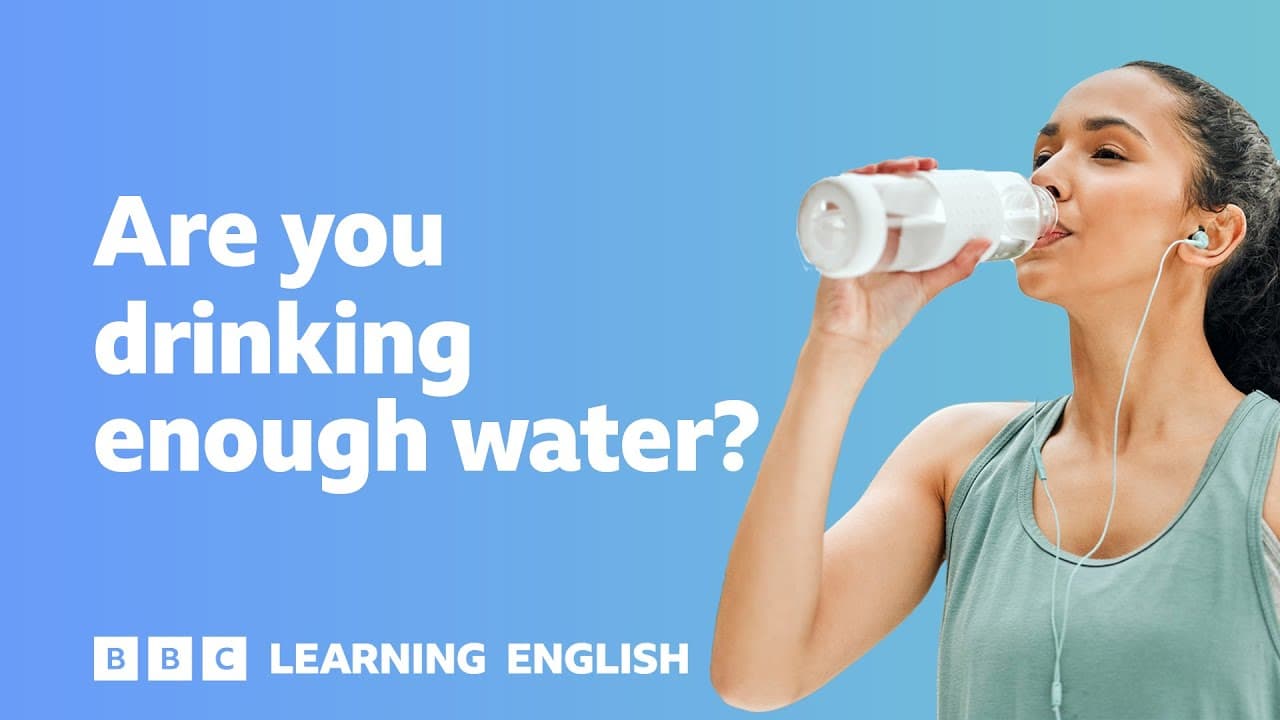
Are you drinking enough water? ⏲️ 6 Minute English
TL;DR
Discusses recommended daily water intake and its health impacts.
Transcript
Hello, this is 6 Minute English from BBC Learning English. I'm Phil, and I'm Beth. Nowadays, I often see people carrying water bottles with them to make sure they drink enough. How much water do you drink a day, Phil? Oh, I don't know. Um, maybe about a litre. OK. And do you know how much water you should drink a day? I think it's probably about tw... Read More
Key Insights
- The common belief is to drink two liters of water daily, but this lacks scientific backing despite global government recommendations.
- Over half the human body is composed of water, with blood consisting of about 90% water.
- Dehydration symptoms include tiredness, headaches, and dry mouth, often mistaken for hunger.
- Water intake needs vary based on individual size and activity, as it replaces water lost through breathing, sweating, and urination.
- The idea of two liters a day has taken grip globally, but it is more of a ballpark figure than a precise requirement.
- Hydration is crucial for blood to transport nutrients to cells and organs effectively.
- Professor John Speakman highlights the lack of scientific evidence supporting the exact two-liter recommendation.
- BBC Learning English provides resources to improve vocabulary related to health and hydration.
Install to Summarize YouTube Videos and Get Transcripts
Explore YouTube Video Summarizer or Get YouTube Transcript Extractor
Questions & Answers
Q: Why is two liters of water a commonly recommended daily intake?
The two-liter daily water intake recommendation is prevalent globally due to widespread governmental advice, despite lacking scientific evidence. This figure has taken grip on public health policies, serving as a general guideline rather than an exact scientific requirement, reflecting a ballpark figure for adequate hydration.
Q: What percentage of the human body and blood is composed of water?
Over half of the human body is composed of water, highlighting its critical role in physiological functions. Specifically, human blood consists of approximately 90% water, emphasizing the importance of maintaining proper hydration for efficient nutrient transport and overall health.
Q: What are common symptoms of dehydration?
Dehydration can manifest through symptoms such as tiredness, headaches, and a dry mouth. These symptoms are often mistaken for hunger, leading individuals to eat instead of addressing their body's need for water. Recognizing these signs is crucial for maintaining proper hydration and overall health.
Q: How does individual water intake need vary?
Individual water intake needs vary based on factors like body size and daily activities. Water is lost through breathing, sweating, and urination, necessitating replacement to maintain hydration. Larger individuals or those engaging in physical activities may require more water to compensate for increased water loss.
Q: What role does water play in blood function?
Water is essential for blood function, as it constitutes about 90% of blood composition. Proper hydration enables blood to efficiently transport nutrients and oxygen to the body's cells and organs, supporting vital physiological processes and overall health.
Q: What does Professor John Speakman say about the two-liter recommendation?
Professor John Speakman highlights that the two-liter daily water intake recommendation lacks scientific evidence. Despite its prevalence in global health guidelines, it serves as a general guideline rather than a precise requirement, reflecting a ballpark figure for maintaining hydration.
Q: How does BBC Learning English support understanding of hydration?
BBC Learning English provides resources such as vocabulary lists and exercises to enhance understanding of hydration and related health topics. These resources aid in learning and applying new vocabulary, contributing to better comprehension of health information and practices.
Q: What is a ballpark figure, and how does it relate to water intake?
A ballpark figure is an approximation that is believed to be acceptably accurate. In the context of water intake, the two-liter recommendation is considered a ballpark figure, offering a general guideline for hydration without being based on precise scientific calculations.
Summary & Key Takeaways
-
The discussion centers on the common recommendation of drinking two liters of water daily, a figure not scientifically substantiated but widely accepted globally. The human body, particularly blood, is largely composed of water, emphasizing hydration's importance.
-
Dehydration symptoms such as fatigue and headaches are common, often misinterpreted as hunger. Individual water needs vary, influenced by factors like body size and daily activities, which dictate water loss through breathing, sweating, and urination.
-
Professor John Speakman notes the two-liter guideline's grip on global health recommendations despite its lack of scientific basis. The program provides vocabulary and resources for understanding hydration's role in health.
Read in Other Languages (beta)
Share This Summary 📚
Summarize YouTube Videos and Get Video Transcripts with 1-Click
Try YouTube Summary with ChatGPT & Claude or YouTube Transcript Generator
Explore More Summaries from BBC Learning English 📚






Summarize YouTube Videos and Get Video Transcripts with 1-Click
Try YouTube Summary with ChatGPT & Claude or YouTube Transcript Generator