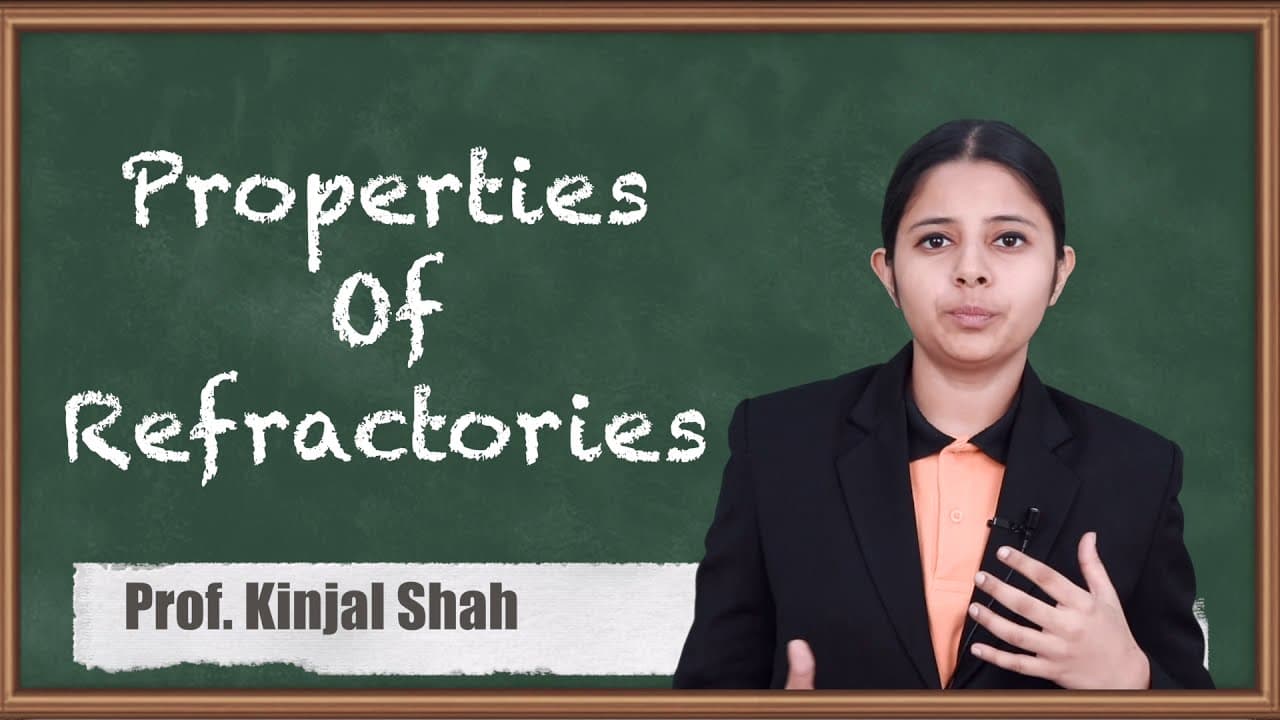
Properties Of Refractories
TL;DR
This video provides a detailed explanation of the five most important properties of refractories - refractoriness, refractory under load, porosity, thermal expansion, and thermal conductivity.
Transcript
click the Bell icon to get latest videos from akira hello friends today we are going to study about different properties of refractories in this session we'll study the 5 most important properties so let's get started the 5 most important properties of any refractory is the first one is refractoriness the second one is ru and refractory under load ... Read More
Key Insights
- 🫠 Refractoriness is the cornerstone property of refractory materials, determining their ability to withstand high temperatures without melting.
- 🆘 Refractory under load (RUL) helps determine the maximum operating temperature for a refractory without deformation.
- 😘 Thermal expansion and contraction affect the longevity of refractories, and low values are desired to prevent fatigue.
- 💐 Low thermal conductivity is essential for refractories to prevent excessive heat flow.
- 💋 Porosity should be minimized to avoid foreign substances sticking to the refractory and weakening its properties.
Install to Summarize YouTube Videos and Get Transcripts
Explore YouTube Video Summarizer or Get YouTube Transcript Extractor
Questions & Answers
Q: What is the most important property of a refractory material?
The most important property of a refractory material is refractoriness, which refers to its ability to withstand high temperatures without melting or showing signs of fusion. This property determines the suitability of the material for specific applications.
Q: How is refractory under load (RUL) determined, and why is it important?
Refractory under load (RUL) is determined by measuring the temperature at which a refractory material undergoes ten percent deformation under a specified load. It is important because it helps determine the maximum temperature at which the refractory can be used without deformation, ensuring its suitability for particular industrial processes.
Q: Why is low thermal expansion and contraction desirable in refractories?
Low thermal expansion and contraction in refractories are desired to prevent continuous expansion and contraction cycles that can lead to fatigue. Fatigue weakens the refractory over time, affecting its ability to withstand heat and pressure.
Q: Why is porosity a negative attribute for refractory materials?
Porosity allows foreign substances such as acids, gases, or liquid slag formed during metal extraction processes to penetrate and stick to the refractory. This weakens the refractory and alters its original properties, making it unsuitable for its intended purpose.
Summary & Key Takeaways
-
Refractoriness is the ability of a refractory material to withstand high temperatures without melting.
-
Refractory under load (RUL) is the temperature at which a refractory will deform by ten percent.
-
Thermal expansion and contraction are important properties for refractories to ensure they can withstand temperature changes.
-
Low thermal conductivity is desired in refractories to prevent excessive heat flow.
-
Porosity should be minimized in refractories to avoid weakening and alteration of their properties.
Read in Other Languages (beta)
Share This Summary 📚
Summarize YouTube Videos and Get Video Transcripts with 1-Click
Try YouTube Summary with ChatGPT & Claude or YouTube Transcript Generator
Explore More Summaries from Ekeeda 📚




Summarize YouTube Videos and Get Video Transcripts with 1-Click
Try YouTube Summary with ChatGPT & Claude or YouTube Transcript Generator