Numerical of CBR Method - Design of Highway Pavements - Transportation Engineering - I
TL;DR
This content provides a step-by-step numerical analysis for designing a pavement using the CBR (California Bearing Ratio) method.
Transcript
hello students today we are going to solve numerical of cbr method question is given is cbi test was conducted over soils upgrade and following results were obtained assume curve throughout convex following materials are required to be used over the soils upgrade that is the compact soil whose cbr value is six percent poorly graded gravel whose cbr... Read More
Key Insights
- 🎨 CBR values are essential for designing pavements, and they can be determined using specific penetration loads and calculations.
- ⚾ The thickness of each layer in a pavement design is calculated based on the CBR values and specified formulas.
- 🎨 Different materials have different CBR values, and their thicknesses in the pavement design are determined according to their characteristics.
- 🚥 The CBR method helps ensure the stability and durability of the pavement under load and traffic conditions.
Install to Summarize YouTube Videos and Get Transcripts
Explore YouTube Video Summarizer or Get YouTube Transcript Extractor
Questions & Answers
Q: What is the CBR value for the subgrade?
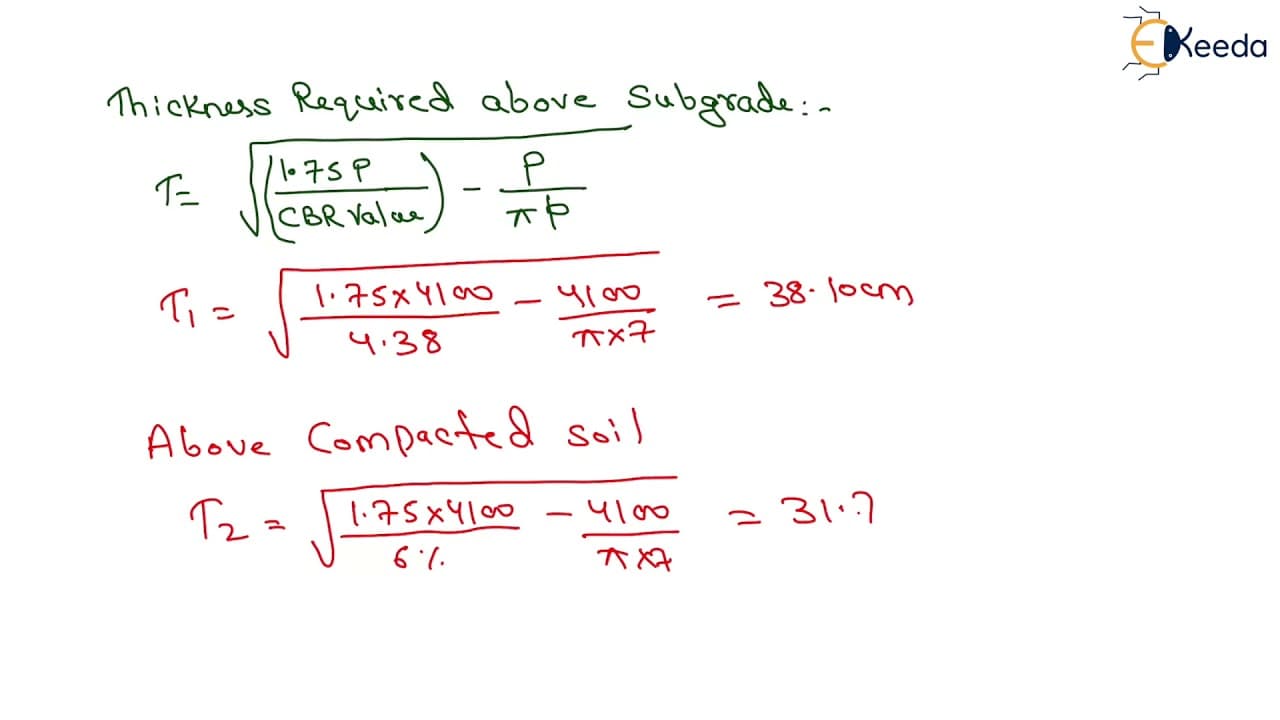
The CBR value for the subgrade is determined using the load at 2.5 mm penetration divided by 1370 times 100. In this case, the CBR value is calculated to be 4.38 percent.
Q: How do we calculate the thickness above the subgrade?
The thickness above the subgrade can be calculated using the formula square root of (1.75 * P / (CBR - P / PI * P)), where P is the wheel load and CBR is the CBR value. In this case, the thickness above the subgrade is determined to be 38.10 centimeters.
Q: How do we determine the thickness above the compacted soil?
The thickness above the compacted soil can be calculated using the formula square root of (1.75 * P / CBR - P / PI * P), where P is the wheel load and CBR is the CBR value. In this case, the thickness above the compacted soil is found to be 31.77 centimeters.
Q: What is the thickness above the poorly graded gravel?
The thickness above the poorly graded gravel is calculated using the formula square root of (1.75 * P / CBR - P / PI * P), where P is the wheel load and CBR is the CBR value. In this case, the thickness above the poorly graded gravel is determined to be 20.28 centimeters.
Q: How do we calculate the thickness of the compacted soil layer?
The thickness of the compacted soil layer is obtained by subtracting the thickness above the compacted soil from the thickness above the subgrade. In this case, the thickness of the compacted soil layer is 6.33 centimeters.
Q: What is the thickness of the poorly graded gravel layer?
The thickness of the poorly graded gravel layer is calculated by subtracting the thickness above the poorly graded gravel from the thickness above the compacted soil. In this case, the thickness of the poorly graded gravel layer is 11.49 centimeters.
Q: How do we determine the thickness of the well-graded gravel layer?
The thickness of the well-graded gravel layer is obtained by subtracting the thickness of the bituminous layer from the thickness above the poorly graded gravel. In this case, the thickness of the well-graded gravel layer is 16.28 centimeters.
Q: How thick is the bituminous layer?
The thickness of the bituminous layer is given in the question as 4 centimeters.
Summary & Key Takeaways
-
The content provides the necessary information to design a pavement using the CBR method.
-
It includes calculations for determining the CBR value and thickness of each layer.
-
The calculations consider various materials and their corresponding CBR values.
Read in Other Languages (beta)
Share This Summary 📚
Summarize YouTube Videos and Get Video Transcripts with 1-Click
Try YouTube Summary with ChatGPT & Claude or YouTube Transcript Generator
Explore More Summaries from Ekeeda 📚



Summarize YouTube Videos and Get Video Transcripts with 1-Click
Try YouTube Summary with ChatGPT & Claude or YouTube Transcript Generator