Spring Stiffness Numerical - Basic Concepts of Vibration - Dynamics of Machinery
TL;DR
This video discusses the concept of spring stiffness and provides numerical examples to calculate equivalent spring stiffness for different systems.
Transcript
hello everyone in this video we'll discuss a numerical on spring stiffness so we already know that the stiffness of the spring is actually the resistance offered by this elastic body the spring to any sort of deformation right and we are denoting spring stiffness by a small s in certain boost you will find that it is denoted by k both the notations... Read More
Key Insights
- 🌸 Spring stiffness is the resistance offered by an elastic body to deformation.
- 🌸 Equivalent spring stiffness can be calculated for different systems with various spring arrangements and suspended masses.
- 🌸 The formula for natural frequency, 1/2π√s/m, is used to calculate the equivalent spring stiffness.
- 🌸 Deflection of the mass is equal to the sum of deflections of individual springs in a system with multiple springs.
- 🌸 The equivalent spring stiffness can be determined by summing the individual spring stiffness values in some cases.
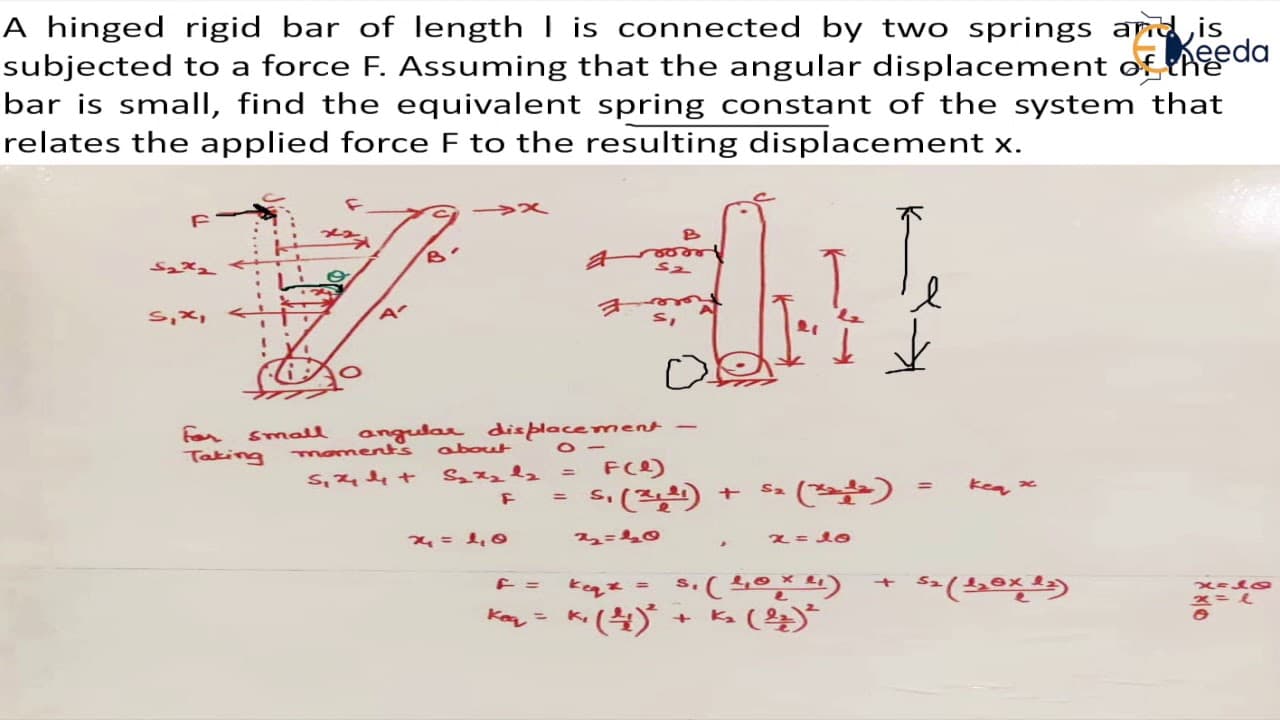
- 🌸 The moments about a hinged point can be used to derive the formula for calculating equivalent spring stiffness in a system with springs connected to a rigid bar.
Install to Summarize YouTube Videos and Get Transcripts
Explore YouTube Video Summarizer or Get YouTube Transcript Extractor
Questions & Answers
Q: What is spring stiffness and how is it denoted?
Spring stiffness refers to the resistance offered by an elastic body to deformation. It is denoted by "s" or "k" in different notations.
Q: How is the equivalent spring stiffness calculated for a system with a single suspended mass?
In this case, the spring constant remains the same as there is only one spring. The formula for the natural frequency, 1/2π√s/m, is used to calculate the equivalent spring stiffness.
Q: How is the equivalent spring stiffness calculated for a system with two springs in series?
When two springs are connected in series and a mass is attached, the deflection of the mass is equal to the sum of deflections of the two springs. The formula mg/s1 + mg/s2 is used to calculate the equivalent spring stiffness.
Q: How is the equivalent spring stiffness calculated for a system with a fixed mass between two springs?
In this case, the deflection of the mass is the same for both springs. Therefore, the equivalent spring stiffness is equal to the sum of the individual spring stiffnesses, s1 + s2.
Summary & Key Takeaways
-
The video explains that spring stiffness is the resistance offered by an elastic body to deformation and is denoted by "s" or "k".
-
It presents four questions that require finding the equivalent spring stiffness for different systems with multiple springs and suspended masses.
-
The formulas for natural frequency and deflection are used to calculate the equivalent spring stiffness in each case.
Read in Other Languages (beta)
Share This Summary 📚
Summarize YouTube Videos and Get Video Transcripts with 1-Click
Try YouTube Summary with ChatGPT & Claude or YouTube Transcript Generator
Explore More Summaries from Ekeeda 📚




Summarize YouTube Videos and Get Video Transcripts with 1-Click
Try YouTube Summary with ChatGPT & Claude or YouTube Transcript Generator