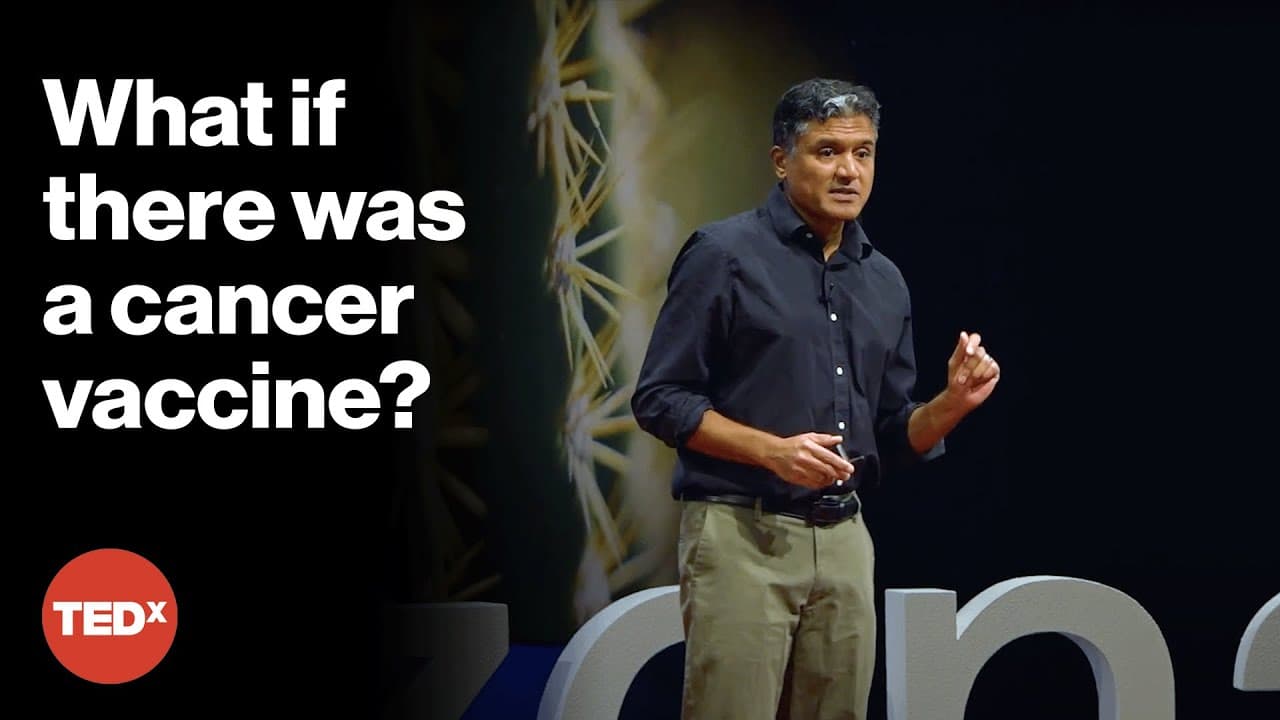
How immunotherapy could help us beat cancer | Deepta Bhattacharya | TEDxUArizona
TL;DR
The immune system's response to infections and vaccines, including the use of mRNA vaccines, is complex but fascinating, and understanding it can lead to advancements in immunotherapy for diseases like cancer.
Transcript
[Applause] I'm an immunologist and for the past 15 years or so my research group has been studying how the immune system responds to infections and vaccines I'd say up until about four years or so ago um even when I tried to explain the research to my own family the response was a bit like oh that's nice dear right but with the onset of the covid-1... Read More
Key Insights
- 💖 The COVID-19 pandemic has sparked public interest in understanding the immune system's response to viruses and vaccines.
- ❓ The Adaptive immune system generates diverse cells to recognize and combat various threats to the body.
- 🥺 mRNA vaccines instruct cells to produce a spike protein, triggering an immune response and leading to immunity against the virus.
- ♋ Understanding the Adaptive immune system's principles can help develop immunotherapies for diseases like cancer.
- 🛀 Customized mRNA vaccines have shown promising results in targeting cancer-specific mutations.
- 💦 Further research is needed to understand why immunotherapy works well for some cancers and not others.
- 👨🔬 Basic research and translational innovations are essential for advancing immunology and immunotherapy.
Install to Summarize YouTube Videos and Get Transcripts
Explore YouTube Video Summarizer or Get YouTube Transcript Extractor
Questions & Answers
Q: How has the COVID-19 pandemic changed the public's interest in understanding the immune system?
The pandemic has made people more curious about the immune system, its response to viruses, and the effectiveness of vaccines. This increased interest has led to a need for scientists to communicate complex concepts to the general public.
Q: How do mRNA vaccines work and how do they interact with the Adaptive immune system?
mRNA vaccines instruct cells to produce a spike protein found in the virus. This spike protein becomes a target for the Adaptive immune system. B cells recognize the spike protein and produce antibodies to prevent viral replication outside of cells. T cells identify infected cells and shut down the virus's life cycle.
Q: Can the understanding of the Adaptive immune system be applied to diseases like cancer?
Yes, mutations in cancer cells can turn self-proteins into non-self proteins, making them potential targets for the Adaptive immune system. Researchers have shown promising results by customizing mRNA vaccines to target cancer mutations, leading to te- cell responses against the cancerous cells.
Q: Why do some immunotherapies work well for certain cancers but not others?
The response to immunotherapies differs among individuals and cancer types. More research is needed to understand the underlying mechanisms and identify factors that determine the success or failure of immunotherapy treatments.
Summary & Key Takeaways
-
The COVID-19 pandemic has sparked global interest in understanding the immune system and its response to viruses, vaccines, and immunotherapies.
-
The Adaptive immune system generates a vast array of cells, each with a slightly different shape, to recognize and combat various threats to the body.
-
mRNA vaccines work by instructing cells to produce a spike protein, which triggers a response from the Adaptive immune system, leading to immunity against the virus.
Read in Other Languages (beta)
Share This Summary 📚
Summarize YouTube Videos and Get Video Transcripts with 1-Click
Try YouTube Summary with ChatGPT & Claude or YouTube Transcript Generator
Explore More Summaries from TEDx Talks 📚






Summarize YouTube Videos and Get Video Transcripts with 1-Click
Try YouTube Summary with ChatGPT & Claude or YouTube Transcript Generator