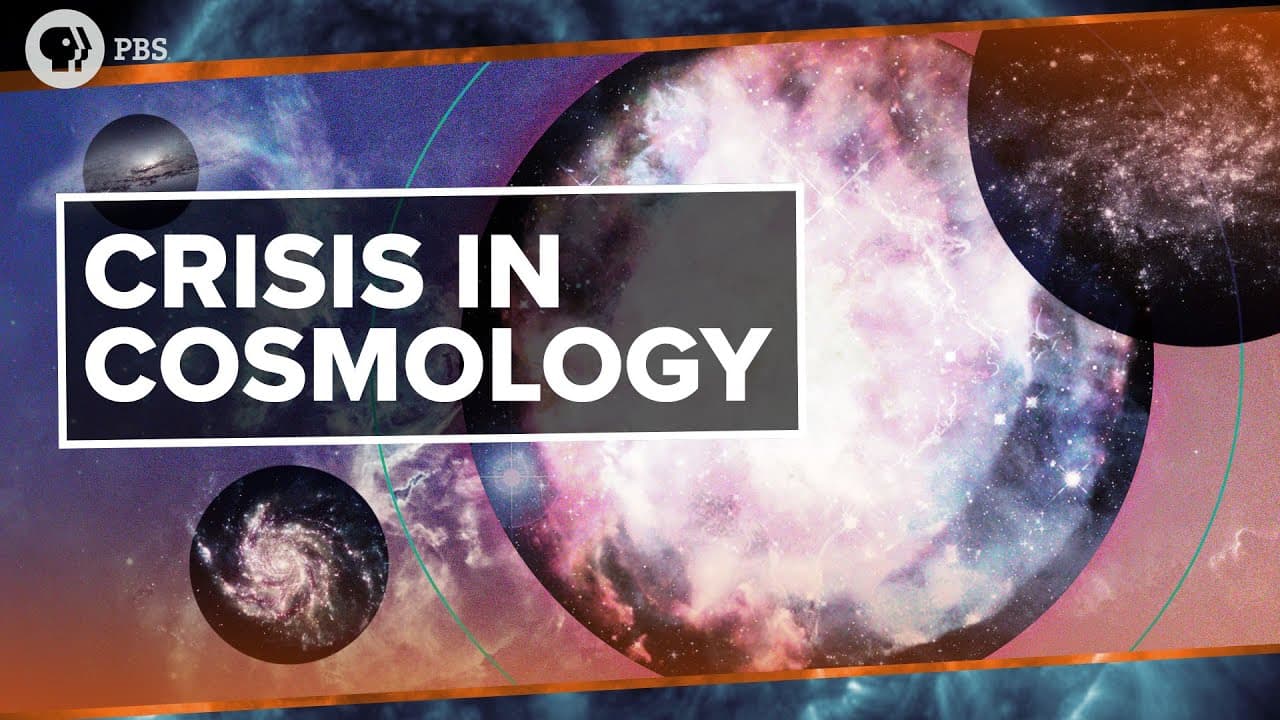
The Crisis in Cosmology
TL;DR
The Hubble constant's measurement discrepancy challenges our universe's understanding.
Transcript
The search for a single number, the Hubble constant,... ...the rate of expansion of our universe,... ...has consumed astronomers for generations. Finally, two powerful and independent methods... ...have refined its measurement to unprecedented precision. The only problem... is that they don't agree,... ...and it's causing to question... ...some... Read More
Key Insights
- The Hubble constant, denoting the universe's expansion rate, is measured by two methods yielding conflicting results.
- Edwin Hubble's 1929 discovery of galaxies beyond the Milky Way revealed the universe's expansion.
- Cepheid variables and supernovae are key tools for measuring cosmic distances and refining the Hubble constant.
- The Cosmic Microwave Background (CMB) provides an independent method for measuring the early universe's expansion rate.
- Discrepancy between SHOES project and Planck satellite results suggests potential unknown physics or measurement errors.
- Potential explanations for the discrepancy include unknown particles, different dark matter behavior, or variable dark energy.
- New observations and methods, like gravitational lensing, may resolve or further highlight the Hubble constant discrepancy.
- The ongoing quest for H0 could lead to breakthroughs in understanding dark energy, dark matter, and the universe's evolution.
Install to Summarize YouTube Videos and Get Transcripts
Explore YouTube Video Summarizer or Get YouTube Transcript Extractor
Questions & Answers
Q: What is the Hubble constant and why is it important?
The Hubble constant is a measure of the universe's current expansion rate, expressed in kilometers per second per megaparsec. It is crucial for understanding the universe's expansion history and future, as well as for interpreting observations of distant galaxies whose light has traveled billions of years through expanding space.
Q: How did Edwin Hubble contribute to our understanding of the universe?
In 1929, Edwin Hubble provided the first incontrovertible proof of galaxies beyond the Milky Way by measuring distances to spiral nebulae. This discovery revealed that galaxies are receding from us at a rate proportional to their distance, indicating the universe's expansion, encapsulated by the Hubble constant.
Q: What are Cepheid variables and how do they help measure cosmic distances?
Cepheid variables are giant stars that pulsate with a period related to their true brightness. By measuring these periods in other galaxies, astronomers can determine their true brightness and use them as 'standard candles' to calculate distances, aiding in refining the Hubble constant measurement.
Q: What role does the Cosmic Microwave Background play in measuring the Hubble constant?
The Cosmic Microwave Background (CMB) is the remnant heat glow from the early universe. Its detailed power spectrum, as observed by the Planck satellite, provides a method for determining the early universe's expansion rate, which can be extrapolated to predict the current Hubble constant.
Q: What is the significance of the discrepancy between SHOES and Planck results?
The SHOES project and Planck satellite provide conflicting Hubble constant measurements, with a significant statistical difference. This discrepancy challenges our understanding of cosmology and suggests potential unknown physics, systematic errors, or new insights into dark matter and dark energy.
Q: What are some potential explanations for the Hubble constant discrepancy?
Potential explanations include the existence of a new type of fast-moving particle, altered behavior of dark matter, or a non-constant dark energy. These factors could affect the energy balance in the early universe, leading to differences in the Hubble constant derived from different methods.
Q: How might future observations help resolve the Hubble constant crisis?
Future observations using new telescopes and independent methods like gravitational lensing or gravitational waves could refine Hubble constant measurements. These advancements may either resolve the discrepancy or highlight new physics, potentially transforming our understanding of dark energy and matter.
Q: Why is resolving the Hubble constant discrepancy important for cosmology?
Resolving the Hubble constant discrepancy is crucial for verifying our cosmological models and understanding the universe's expansion. It could lead to breakthroughs in physics, including insights into dark energy, dark matter, and the universe's evolution, ultimately shaping our comprehension of the cosmos.
Summary & Key Takeaways
-
The Hubble constant measures the universe's expansion rate, but conflicting results from different methods challenge our understanding. Edwin Hubble's 1929 discovery highlighted the universe's expansion, with Cepheid variables and supernovae aiding in refining this measurement.
-
The Cosmic Microwave Background offers an alternative method for determining the universe's expansion rate, leading to a discrepancy with supernova-based results. This inconsistency raises questions about potential unknown physics or systematic measurement errors.
-
Possible explanations for the Hubble constant discrepancy include new particles, altered dark matter behavior, or variable dark energy. Future observations and methods like gravitational lensing may help resolve this issue, potentially revolutionizing our understanding of cosmology.
Read in Other Languages (beta)
Share This Summary 📚
Summarize YouTube Videos and Get Video Transcripts with 1-Click
Try YouTube Summary with ChatGPT & Claude or YouTube Transcript Generator
Explore More Summaries from PBS Space Time 📚


Summarize YouTube Videos and Get Video Transcripts with 1-Click
Try YouTube Summary with ChatGPT & Claude or YouTube Transcript Generator