We Are Star Stuff
TL;DR
The universe's complexity and elemental origins are explained through cosmic nucleosynthesis.
Transcript
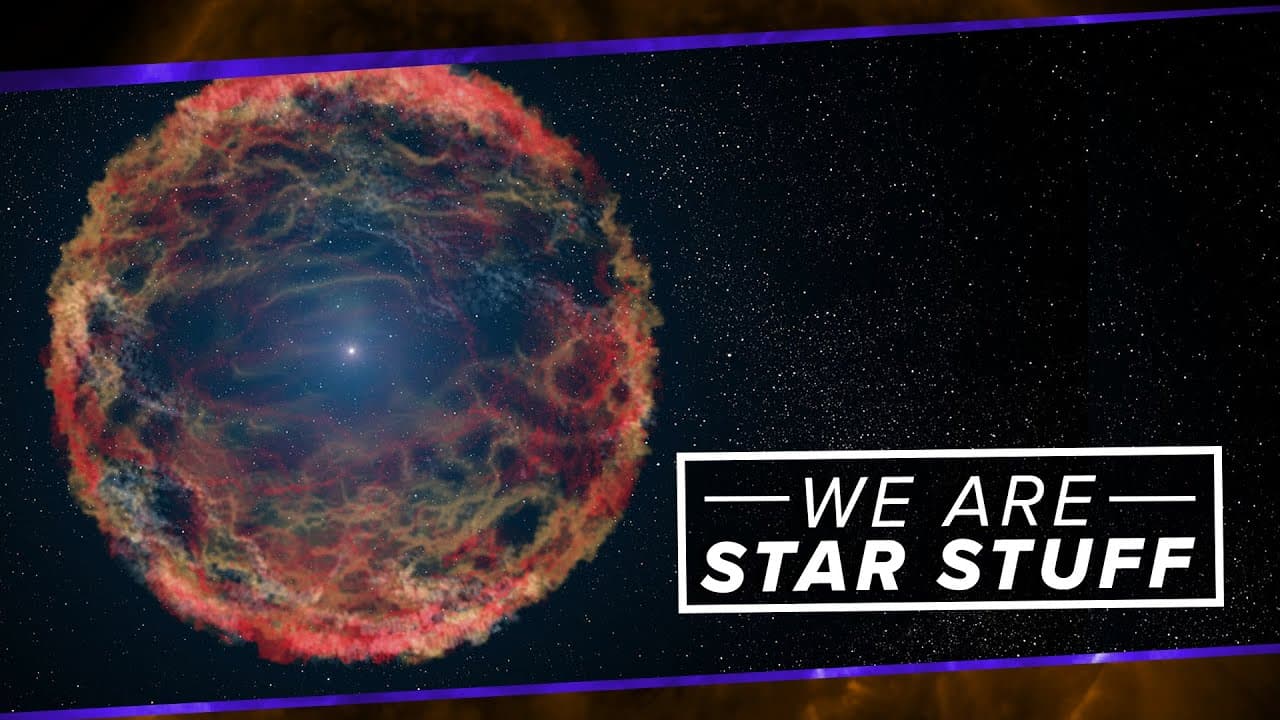
[MUSIC PLAYING] Carl Sagan said that we are "starstuff." Most of the atoms in our body were forged in violent stellar alchemy and spread through the galaxy in past supernovae. But the details of cosmic nucleosynthesis are even more mind blowing than you imagine. [MUSIC PLAYING] We live in a complex universe. Its raw gradients may seem simple. Space... Read More
Key Insights
- Most atoms in our body were created in stellar events like supernovae, highlighting our cosmic origins.
- The universe's complexity arises from the interactions of elementary particles forming atoms and molecules.
- Chemistry is the result of atomic interactions, with each element having unique properties based on its electron configuration.
- Hydrogen, the simplest element, formed shortly after the Big Bang and is a major component of the human body.
- Stars act as element factories, converting hydrogen into heavier elements through nuclear fusion over millions of years.
- Supernovae are crucial for spreading elements into space, which later form new stars and planetary systems.
- Elements heavier than iron were thought to form in supernovae, but new research suggests neutron star collisions also play a role.
- The universe's expansion can exceed the speed of light, a concept explained by general relativity and cosmic inflation.
Install to Summarize YouTube Videos and Get Transcripts
Explore YouTube Video Summarizer or Get YouTube Transcript Extractor
Questions & Answers
Q: What did Carl Sagan mean by 'we are starstuff'?
Carl Sagan's phrase 'we are starstuff' refers to the idea that most atoms in our bodies were forged in the violent alchemy of stars. These atoms were spread throughout the galaxy by events like supernovae, making the elements that compose us the products of cosmic processes.
Q: How do stars act as element factories?
Stars act as element factories by converting hydrogen into helium and then into heavier elements through nuclear fusion. This process occurs over millions to billions of years, with stars in their prime shining by forging hydrogen into helium. Larger stars can continue this process to create even heavier elements.
Q: What role do supernovae play in the universe?
Supernovae play a crucial role in spreading elements into interstellar space, providing the raw materials for the formation of new stars, planetary systems, and life. When a star explodes as a supernova, it releases the products of stellar nucleosynthesis, enriching the cosmos with heavy elements.
Q: How are elements heavier than iron formed?
Elements heavier than iron are formed in extreme cosmic events. Initially, it was thought they were created in supernova explosions. However, recent research indicates that neutron star collisions also contribute significantly to the formation of these heavy elements, including gold and uranium.
Q: What is cosmic inflation, and how does it affect the universe's expansion?
Cosmic inflation is a theory describing a rapid expansion of the universe shortly after the Big Bang. It allows regions of space to move apart faster than the speed of light, explaining the uniformity and large-scale structure of the universe. This expansion continues today beyond the observable universe.
Q: How does the universe's expansion exceed the speed of light?
The universe's expansion can exceed the speed of light because the speed limit applies to objects traveling through space, not to space itself. General relativity permits regions of space to expand faster than light, a phenomenon observed during cosmic inflation and beyond the Hubble Horizon.
Q: What is the significance of hydrogen in the universe?
Hydrogen is the simplest and most abundant element in the universe, formed shortly after the Big Bang. It is a major component of water and the human body. Hydrogen serves as the primary fuel for stars, initiating nuclear fusion processes that create heavier elements essential for life and planetary systems.
Q: What is the difference between spatial curvature and spacetime curvature?
Spatial curvature refers to the geometry of space at a constant moment in time, which can be flat, positively curved, or negatively curved. Spacetime curvature includes both space and time, leading to phenomena like the expansion of space. Flat spatial curvature means the geometry behaves like a flat sheet, while spacetime curvature involves gravitational effects.
Summary & Key Takeaways
-
Carl Sagan's idea that we are 'starstuff' is explored, explaining how atoms in our body originate from cosmic events like supernovae. The universe's complexity is due to the interactions of elementary particles forming atoms and molecules, with chemistry being the result of these atomic interactions.
-
Stars act as element factories, converting hydrogen into heavier elements over millions of years. Supernovae are crucial in spreading these elements into space, forming new stars and planetary systems. Recent research suggests that neutron star collisions also contribute to the formation of heavy elements.
-
The universe's expansion can exceed the speed of light, a concept explained by general relativity and cosmic inflation. This expansion is currently happening beyond the Hubble Horizon and within black holes, illustrating the dynamic nature of the cosmos.
Read in Other Languages (beta)
Share This Summary 📚
Summarize YouTube Videos and Get Video Transcripts with 1-Click
Try YouTube Summary with ChatGPT & Claude or YouTube Transcript Generator
Explore More Summaries from PBS Space Time 📚




Summarize YouTube Videos and Get Video Transcripts with 1-Click
Try YouTube Summary with ChatGPT & Claude or YouTube Transcript Generator