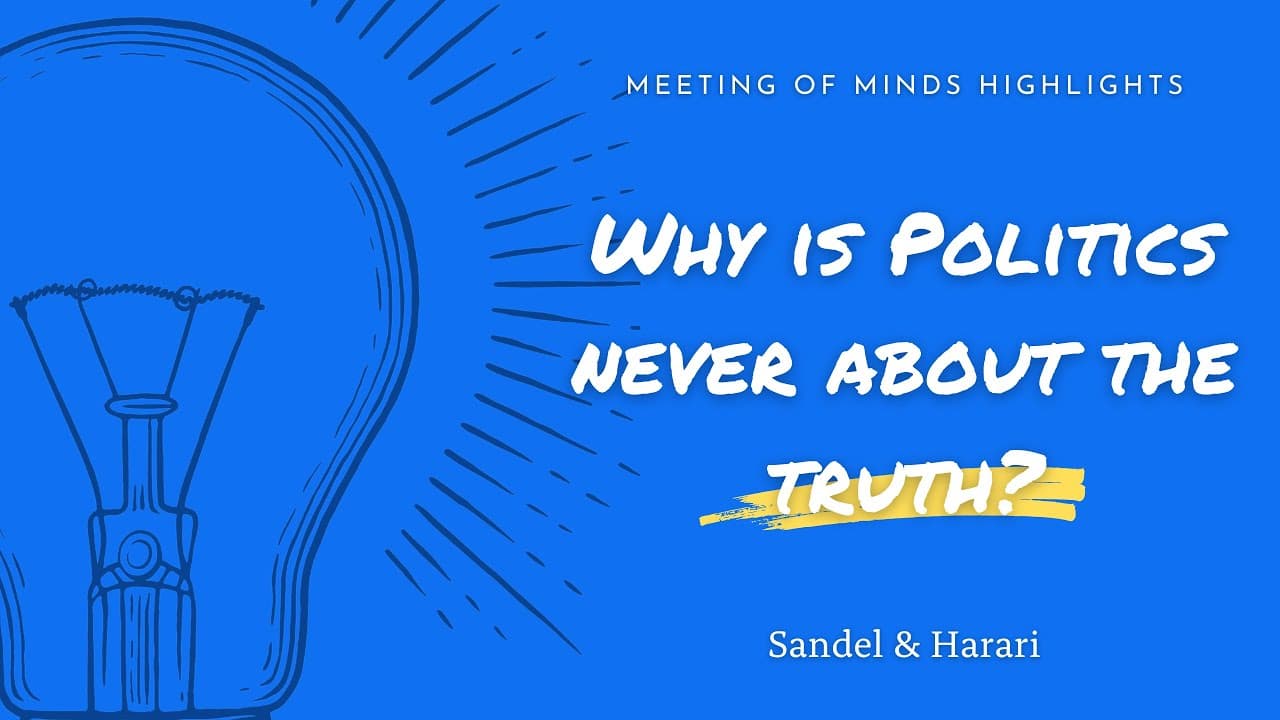
Michael Sandel & Yuval Noah Harari: Why is politics never about the truth?
TL;DR
Despite expectations that more education would lead to convergence on climate change beliefs, the opposite is true. The partisan divide on climate change exists at all levels of education, with greater education leading to a larger partisan divide.
Transcript
if the factual scientific explanation accounts for disagreements about climate change partisan disagreements one would expect that the more education people have the greater the tendency to converge on climate change whether it's human cause whether it's really a problem whether we should do something about it in fact it's just the opposite the par... Read More
Key Insights
- 🎓 The partisan divide on climate change exists at all education levels.
- 🥺 Greater education and scientific literacy lead to a larger partisan divide on climate change.
- 🖐️ Trust, authority, and political disagreements play a significant role in the climate change debate.
- 🧑🔬 Politicians often rely on scientists to solve political problems, but this approach is ineffective.
- 💱 Politicization and polarization of scientific disciplines is not exclusive to climate change.
- ❓ The profession of politics and the pursuit of scientific truth often clash.
- ✊ Politics is about power, while science is about truth, pulling in opposite directions.
Install to Summarize YouTube Videos and Get Transcripts
Explore YouTube Video Summarizer or Get YouTube Transcript Extractor
Questions & Answers
Q: Does more education lead to a greater agreement on climate change?
No, the opposite is true. The partisan divide on climate change exists at all education levels, and greater education actually leads to a larger divide.
Q: How does scientific literacy affect climate change beliefs?
Surprisingly, greater scientific literacy and knowledge also lead to a larger partisan divide on climate change. The more science people know, the more likely they are to disagree on a partisan basis.
Q: What is the key to addressing the partisan divide on climate change?
The key lies in understanding and addressing trust, authority, and political disagreements. Simply providing scientific facts is not enough to bridge the divide.
Q: Is the politicization and polarization of climate change unique to the United States?
While it is more prominent in the U.S., we are seeing increasing politicization in other countries as well. The involvement of politicians expecting scientists to solve political problems is not an effective approach.
Summary & Key Takeaways
-
The partisan divide on climate change exists regardless of education level, with Democrats and Republicans holding different beliefs.
-
Surveys have shown that greater education and scientific literacy actually lead to a larger partisan divide on climate change.
-
The key to addressing this issue lies in understanding and addressing trust and political disagreements, rather than solely focusing on providing scientific facts.
Read in Other Languages (beta)
Share This Summary 📚
Summarize YouTube Videos and Get Video Transcripts with 1-Click
Try YouTube Summary with ChatGPT & Claude or YouTube Transcript Generator
Explore More Summaries from Yuval Noah Harari 📚




Summarize YouTube Videos and Get Video Transcripts with 1-Click
Try YouTube Summary with ChatGPT & Claude or YouTube Transcript Generator