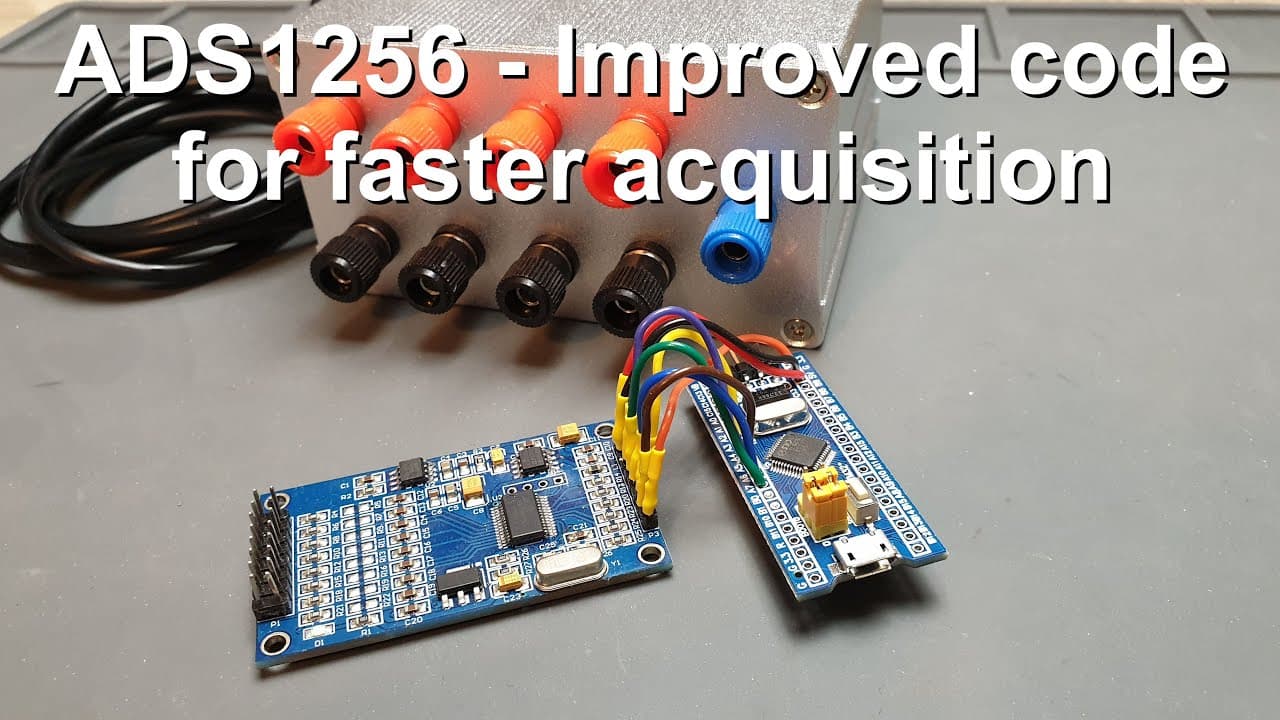
ADS1256 - Improved code for faster acquisition
TL;DR
This video discusses improvements made to the ADS 1256 ADC code for efficient data handling.
Transcript
welcome everyone in this video i'm going to talk about the ads 1256 24 bit 80 converter again i have several videos on this circuit and i even have a playlist so please check the description of the video but now i made some improvements uh in my code so i would like to share them uh with you so hopefully those improvements will help you to use this... Read More
Key Insights
- 🪛 Interrupt-driven programming can significantly improve data acquisition responsiveness in microcontroller applications.
- ☠️ Streamlining communication protocols such as SPI can enhance the performance of ADCs, increasing data transfer rates.
- 🚄 Buffer management facilitates the handling of high volumes of data, reducing the risk of data loss during high-speed transmission.
- ✋ The necessity of proper grounding for unused channels in ADC systems is essential for achieving the highest accuracy in measurements.
- 👤 Software interfaces can drastically improve user interaction with hardware, providing visual feedback and simplifying complex data management tasks.
- 🈸 It's critical to understand the specifications of devices like the ADS 1256 to effectively utilize their capabilities in practical applications.
- 🥺 Efficient coding practices, such as avoiding slower print functions, can lead to significant performance improvements in embedded systems.
Install to Summarize YouTube Videos and Get Transcripts
Explore YouTube Video Summarizer or Get YouTube Transcript Extractor
Questions & Answers
Q: What are the main advantages of using interrupts in the ADS 1256 ADC code?
Using interrupts allows for more efficient data handling as it enables the microcontroller to respond immediately to data ready signals without constantly polling the pin status. This leads to faster reaction times, minimizing the risk of missing data, particularly important at high sampling rates.
Q: How does the new code handle high-speed data acquisition?
The updated code leverages direct port access and low-level programming techniques to maximize data throughput while maintaining accurate data integrity. By incorporating buffer management with serial.write, it reduces the processing time normally associated with serial.print, enabling smoother high-speed data logging.
Q: Can you explain the functionality of the newly developed software for the ADS 1256?
The software provides a user-friendly interface for plotting real-time data, configuring parameters like sampling rates and voltage ranges, and saving measurement data to files. It features a clear chart for data visualization, improving the user experience by simplifying the analysis and storage of measurement results.
Q: What limitations are present when using the ADS 1256 in multiplexed mode?
When multiplexing channels, the maximum sampling frequency decreases significantly. Although the highest possible rate is 30 ksps for a single channel, it drops to approximately 4.3 kHz when cycling through multiple channels. This limitation is crucial to manage in applications requiring precise timing.
Q: What considerations should be made regarding floating channels during measurement?
Floating channels can introduce noise and unpredictable readings in a system. As advised in the video, it's best practice to tie unused channels to ground to prevent interference and ensure stable measurements. This minimizes erroneous data capture, leading to more accurate results.
Q: How is the reference voltage for the ADC handled in the new code?
The reference voltage is defined and stored within the code, which allows the system to compute actual voltages based on the raw ADC conversion results. This reference value is crucial for interpreting the output correctly, especially when outputting to user interfaces.
Summary & Key Takeaways
-
The video covers enhancements made in the ADS 1256 24-bit ADC code to improve data acquisition rates and functionality when interfaced with an STM32 microcontroller.
-
Key improvements include using interrupts for data readiness, optimizing communication via SPI, and employing buffers for faster data transfer, enabling higher sampling rates.
-
The presenter introduces a software interface designed for data visualization and logging, highlighting its features for monitoring and saving measurement data, enhancing user experience.
Read in Other Languages (beta)
Share This Summary 📚
Summarize YouTube Videos and Get Video Transcripts with 1-Click
Try YouTube Summary with ChatGPT & Claude or YouTube Transcript Generator
Explore More Summaries from Curious Scientist 📚

![Building a Peltier cooler-based cooling box - First iteration, improvements [Part 2/6] thumbnail](/_next/image?url=https%3A%2F%2Fi.ytimg.com%2Fvi%2F0YlNw0EGnzI%2Fhqdefault.jpg&w=750&q=75)
Summarize YouTube Videos and Get Video Transcripts with 1-Click
Try YouTube Summary with ChatGPT & Claude or YouTube Transcript Generator