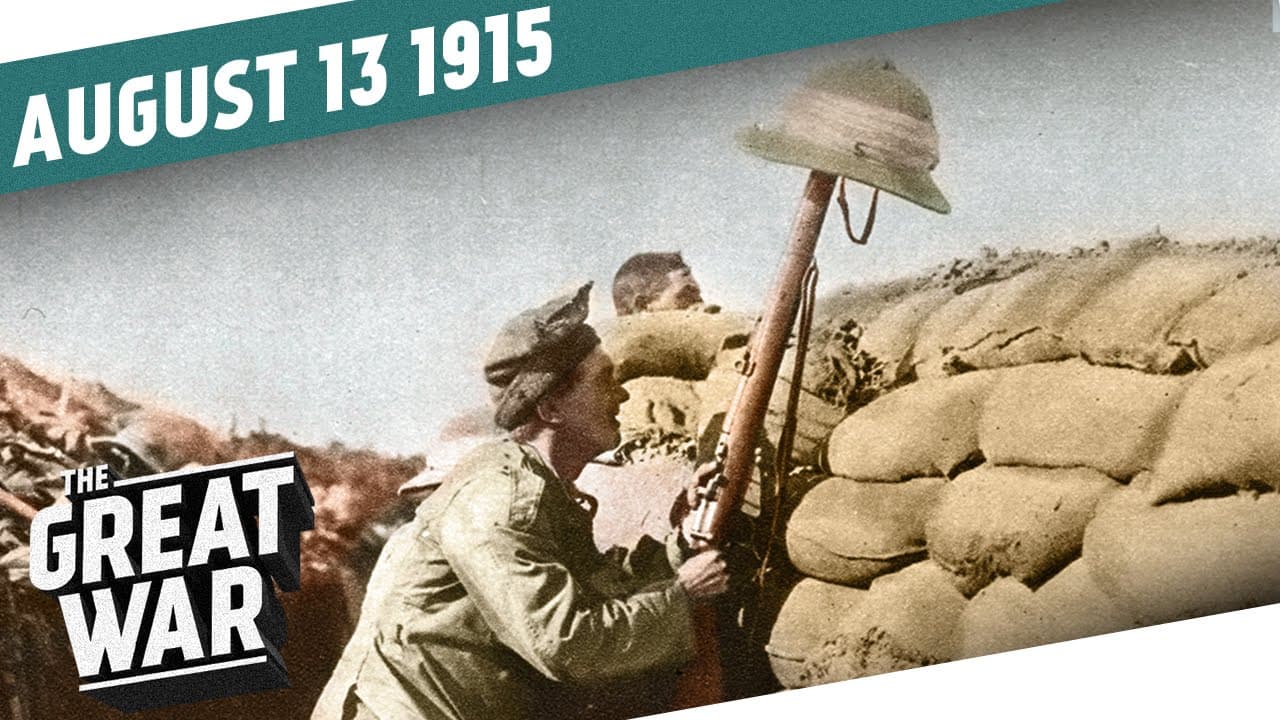
The Ruse at Gallipoli and the Siege of Kovno I THE GREAT WAR - Week 55
TL;DR
Allied forces struggle at Gallipoli; Germans lay siege to Kovno.
Transcript
The battle at Gallipoli had been a stalemate for months, but the Allies had landed tens of thousands of troops last week in a fresh attempt to gain the high ground, but what happens when new recruits who’ve never seen battle take on a battle hardened enemy? You’ll find out in just a minute. I’m Indy Neidell; welcome to the Great War. Last week Wars... Read More
Key Insights
- The battle at Gallipoli remains a stalemate despite fresh Allied reinforcements, highlighting the challenges faced by inexperienced troops against seasoned enemies.
- The successful landing at Suvla Bay by British forces did not result in significant territorial gains, demonstrating the difficulty of overcoming entrenched positions.
- German forces have captured Warsaw and are now besieging the Russian fortress of Kovno, indicating a strategic shift in the Eastern Front.
- The introduction of Anthony Fokker's synchronization gear has given the Germans air superiority on the Western Front, impacting the dynamics of aerial combat.
- Civilians in Eastern Europe are experiencing severe hardships as they flee advancing German forces, showcasing the war's toll on non-combatants.
- Mustafa Kemal's leadership at Gallipoli demonstrates effective Ottoman resistance, utilizing tactical ruses and timing to counter Allied advances.
- The encirclement of Russian armies near Brest-Litovsk by German and Austro-Hungarian forces suggests a potential disaster for the Russians.
- The failure to capitalize on initial successes at Gallipoli and Kovno illustrates the difficulties of maintaining momentum in large-scale military operations.
Install to Summarize YouTube Videos and Get Transcripts
Explore YouTube Video Summarizer or Get YouTube Transcript Extractor
Questions & Answers
Q: What challenges did the Allies face at Gallipoli?
The Allies faced significant challenges at Gallipoli due to the entrenched positions of the Ottoman forces and the inexperience of their own troops. Despite landing tens of thousands of fresh recruits, the Allies struggled to gain and hold the high ground, leading to a prolonged stalemate. The failure to advance beyond initial positions and the effective counterattacks by Mustafa Kemal's forces further compounded their difficulties.
Q: How did the Germans achieve air superiority on the Western Front?
The Germans achieved air superiority on the Western Front through the development of synchronization gear by Anthony Fokker. This technological advancement allowed machine guns to fire through the propeller blades of aircraft, significantly enhancing the effectiveness of German fighter planes. As a result, the Germans gained mastery of the skies, impacting the dynamics of aerial combat and providing strategic advantages over the Allies.
Q: What was the significance of the siege of Kovno?
The siege of Kovno was significant as it marked a strategic advance for the Germans on the Eastern Front. Following the capture of Warsaw, the Germans laid siege to the Russian fortress of Kovno, aiming to further weaken Russian defenses. The siege demonstrated the Germans' ability to conduct large-scale operations and put additional pressure on Russian forces, potentially leading to their encirclement near Brest-Litovsk.
Q: What impact did the war have on civilians in Eastern Europe?
Civilians in Eastern Europe faced severe hardships due to the war, particularly as German forces advanced into their territories. Many were forced to flee their homes, destroying property and burning farms to prevent them from falling into enemy hands. The displacement and destruction caused by the war led to significant suffering and highlighted the broader impact of military conflicts on non-combatant populations.
Q: How did Mustafa Kemal's tactics influence the Gallipoli campaign?
Mustafa Kemal's tactics played a crucial role in the Ottoman resistance during the Gallipoli campaign. He effectively used tactical ruses and precise timing to launch counterattacks against Allied forces, often catching them off guard. His leadership and decision-making, such as the bayonet charge against inexperienced British troops, helped maintain Ottoman control over key positions and thwart Allied advances, demonstrating his strategic acumen.
Q: What was the outcome of the British landing at Suvla Bay?
The British landing at Suvla Bay initially appeared successful, with the Allies securing a foothold on the Gallipoli Peninsula. However, the failure to capitalize on this advantage led to a lack of significant territorial gains. Hesitation and delays allowed Ottoman forces to regroup and fortify their positions, resulting in a prolonged stalemate. The inability to advance beyond the coastal plain highlighted the challenges faced by the Allies in overcoming entrenched defenses.
Q: What were the consequences of the failed German attacks in the Argonne?
The failed German attacks in the Argonne resulted in significant casualties and demonstrated the challenges of breaking through well-defended positions on the Western Front. Despite multiple attempts, the Germans were unable to achieve their objectives, suffering around 4,000 casualties in the process. These failures highlighted the difficulties of offensive operations in the heavily fortified trench warfare environment and underscored the stalemate on the Western Front.
Q: How did the encirclement near Brest-Litovsk affect the Russian forces?
The encirclement near Brest-Litovsk posed a significant threat to Russian forces, as German and Austro-Hungarian armies formed an unbroken line around three Russian armies. This strategic maneuver increased the pressure on Russian defenses and foreshadowed potential disasters, such as the capture or destruction of encircled troops. The situation highlighted the challenges faced by the Russians in maintaining their positions and the effectiveness of Central Powers' strategies in the Eastern Front.
Summary & Key Takeaways
-
The Gallipoli campaign continues to be a challenging endeavor for the Allies, with fresh troops failing to secure significant gains against entrenched Ottoman forces. The strategic importance of the high ground remains unachieved, and the stalemate persists.
-
On the Eastern Front, the German capture of Warsaw and subsequent siege of Kovno represents a significant shift in momentum. The Russians are under pressure, with their forces potentially facing encirclement near Brest-Litovsk.
-
Technological advancements like Fokker's synchronization gear have given the Germans air superiority, affecting the Western Front dynamics. Meanwhile, civilian populations in Eastern Europe endure severe hardships due to the advancing German military.
Read in Other Languages (beta)
Share This Summary 📚
Summarize YouTube Videos and Get Video Transcripts with 1-Click
Try YouTube Summary with ChatGPT & Claude or YouTube Transcript Generator
Explore More Summaries from The Great War 📚

Summarize YouTube Videos and Get Video Transcripts with 1-Click
Try YouTube Summary with ChatGPT & Claude or YouTube Transcript Generator