Can We Break the Universe?
TL;DR
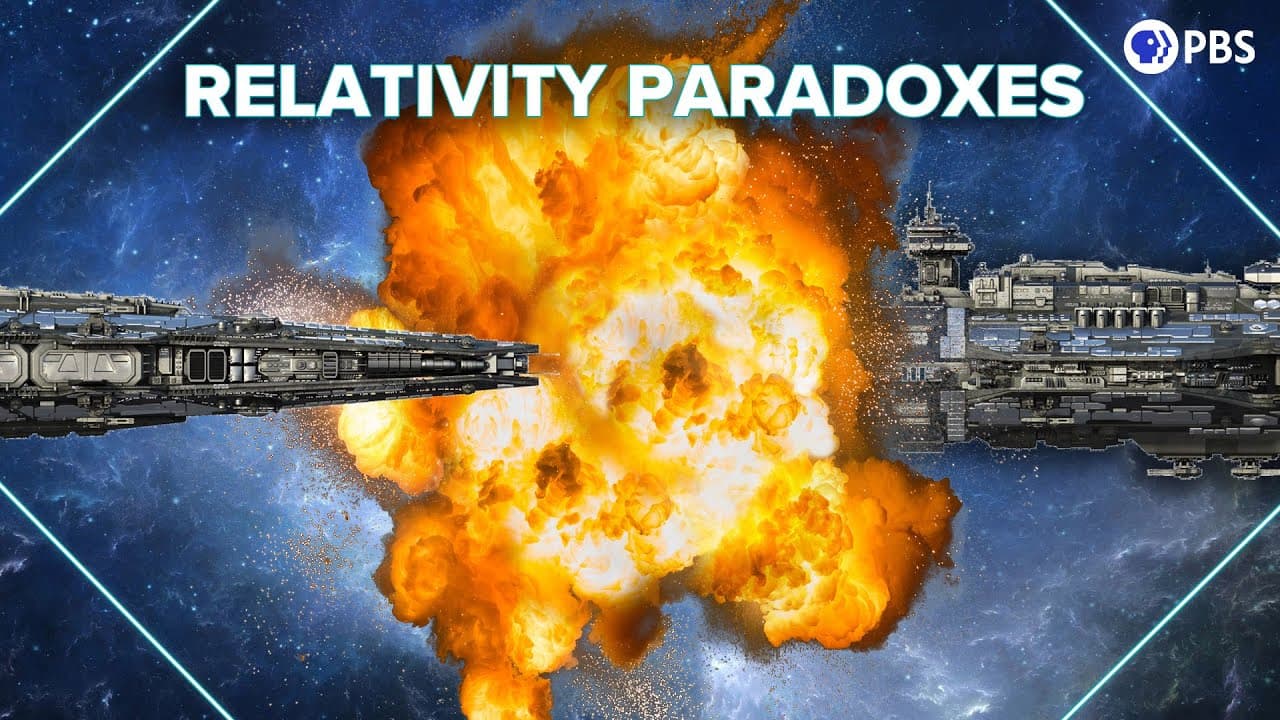
The universe's paradoxes can be resolved through Einstein's relativity.
Transcript
That Einstein guy had some pretty wacky ideas. Black holes, gravitational waves, he was even the first to realize that friggin lasers could be a thing. But that all came later. Way back in 1905, when Einstein was just getting started - he was already rocking our understanding of the universe with his special theory of relativity. The theory started... Read More
Key Insights
- Einstein's special theory of relativity revolutionized our understanding of space and time, proposing that their perception changes with the observer's velocity.
- Time dilation and length contraction are fundamental concepts, where moving objects experience time slower and appear shorter to stationary observers.
- The twin paradox illustrates how a traveling twin ages slower than a stationary one due to different frames of reference.
- In a closed universe, a spaceship traveling at near-light speed could theoretically wrap around without colliding with itself due to spacetime dynamics.
- The ladder paradox shows how moving objects can appear to fit into smaller spaces due to length contraction.
- Relativity of simultaneity explains how different observers perceive events in different orders, resolving many apparent paradoxes.
- Special relativity maintains that no local frame of reference is preferred, though the universe can have a special frame.
- Paradoxes in relativity often arise from intuitive misunderstandings but can be resolved by following logical principles of spacetime.
Install to Summarize YouTube Videos and Get Transcripts
Explore YouTube Video Summarizer or Get YouTube Transcript Extractor
Questions & Answers
Q: What is the twin paradox in special relativity?
The twin paradox involves one twin traveling at a high speed to a distant star and returning, while the other twin remains on Earth. Due to time dilation, the traveling twin ages slower than the stationary twin. The paradox arises from different perceptions of time, but is resolved by acknowledging the traveler's change in frames of reference.
Q: How does the ladder paradox demonstrate relativity?
The ladder paradox involves a ladder moving at high speed through a barn shorter than the ladder. Due to length contraction, the ladder appears to fit inside the barn from the barn's perspective. However, from the ladder's perspective, the barn is shorter. The paradox is resolved by understanding the relativity of simultaneity, where different observers perceive events differently.
Q: Can a spaceship collide with itself in a closed universe?
In a closed universe, a spaceship traveling at near-light speed could theoretically wrap around the universe. However, it won't collide with itself due to the helical nature of spacetime, where different parts of the spaceship exist at different times, avoiding collision. This demonstrates the consistency of relativity in resolving paradoxes.
Q: How does relativity of simultaneity resolve paradoxes?
Relativity of simultaneity means that different observers can perceive the timing of events differently based on their relative motion. This concept resolves paradoxes by showing that events are not universally simultaneous, allowing for differing perceptions that align with the principles of relativity, maintaining consistency across frames of reference.
Q: What role does length contraction play in relativity?
Length contraction is a phenomenon where objects moving at high speeds appear shorter in the direction of motion to stationary observers. It plays a crucial role in relativity by explaining how objects can fit into smaller spaces from certain perspectives, resolving paradoxes like the ladder paradox, and aligning with the theory's principles.
Q: Why is there no preferred frame of reference in relativity?
Special relativity posits that no local frame of reference is preferred, meaning all non-accelerating frames are equivalent. This principle ensures that the laws of physics are consistent across different perspectives. However, the universe itself can have a special frame, such as the one where the cosmic microwave background appears unshifted.
Q: What is the significance of Einstein's special theory of relativity?
Einstein's special theory of relativity revolutionized physics by introducing the idea that space and time are relative, dependent on the observer's velocity. This theory led to groundbreaking concepts like time dilation and length contraction, challenging intuitive notions and providing a consistent framework for understanding the universe's behavior.
Q: How do paradoxes in relativity get resolved?
Paradoxes in relativity often arise from intuitive misunderstandings of how space and time behave at high speeds. They are resolved by applying the logical principles of relativity, such as time dilation, length contraction, and relativity of simultaneity, which offer consistent explanations and align with the theory's framework, maintaining its self-consistency.
Summary & Key Takeaways
-
Einstein's special theory of relativity introduced concepts like time dilation and length contraction, fundamentally changing our understanding of space and time. Despite seeming paradoxical, these principles are consistent and logical, offering a new perspective on the universe.
-
The twin paradox and ladder paradox are famous examples illustrating the counterintuitive nature of relativity, where different observers perceive time and space differently based on their relative motion.
-
In a closed universe, a near-light-speed spaceship won't collide with itself due to the helical nature of spacetime, demonstrating how relativity resolves paradoxes and maintains consistency in its framework.
Read in Other Languages (beta)
Share This Summary 📚
Summarize YouTube Videos and Get Video Transcripts with 1-Click
Try YouTube Summary with ChatGPT & Claude or YouTube Transcript Generator
Explore More Summaries from PBS Space Time 📚

Summarize YouTube Videos and Get Video Transcripts with 1-Click
Try YouTube Summary with ChatGPT & Claude or YouTube Transcript Generator