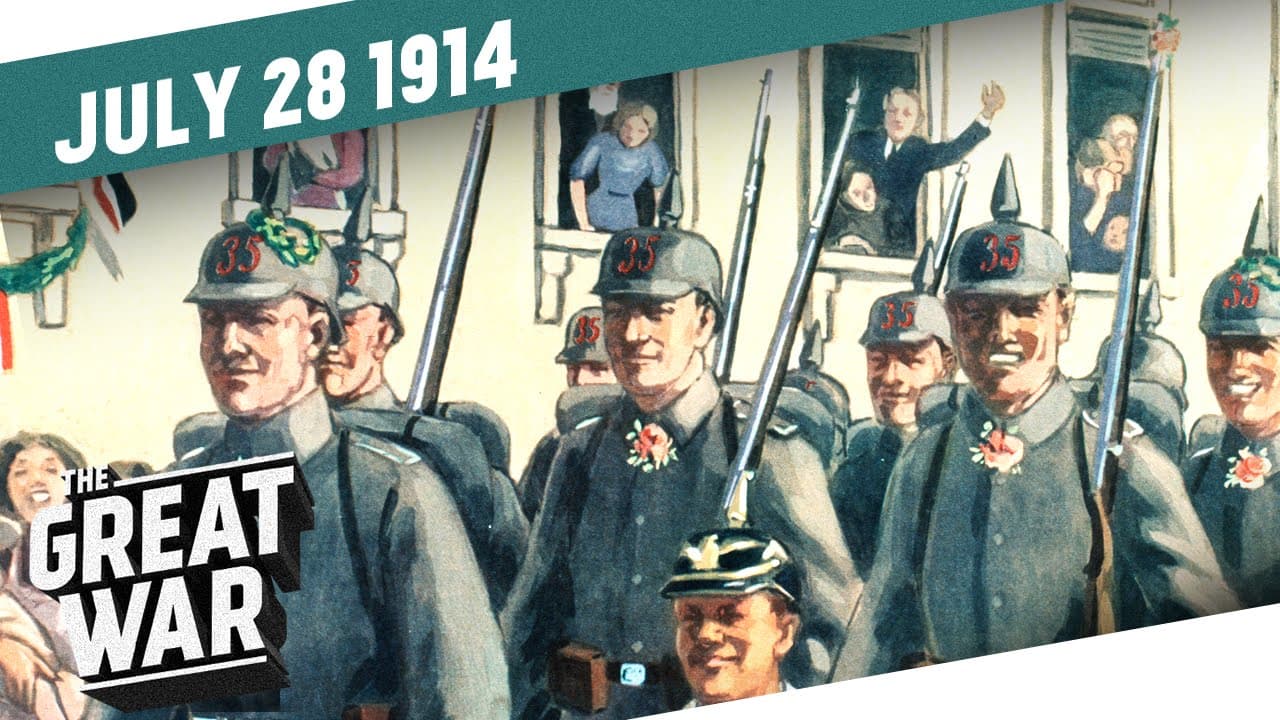
The Outbreak of WWI - From Local Conflict to World War in 1914 I THE GREAT WAR Week 1
TL;DR
Austria-Hungary's war on Serbia escalates into WWI.
Transcript
My name is Indy Neidell and this channel – The Great War – is going to cover the first world war, week by week, as it unfolded 100 years later. From today until November 2018, so you can really get a sense of just what happened as it happened. The active weeks, the passive weeks, the weeks of carnage and the weeks of hope – we'll follow them all on... Read More
Key Insights
- The series will chronicle WWI week by week, providing a detailed account of the war's progression, including active and passive weeks.
- Austria-Hungary declared war on Serbia on July 28, 1914, marking the beginning of WWI, influenced by the assassination of Archduke Franz Ferdinand.
- Germany's 'blank check' to Austria is often cited as a key factor in the war's escalation, though this oversimplifies the situation.
- Conrad von Hötzendorf, Austria's Army Chief of Staff, was a strong advocate for war, seeking to curb Serbian power following the archduke's assassination.
- Germany feared Russia's growing military capabilities, prompting German leaders to support a preemptive war before Russia became too strong.
- Austria's ultimatum to Serbia was designed to be rejected, with demands such as Austrian involvement in Serbia's judicial process.
- Despite Serbia's conciliatory response to the ultimatum, Austria was determined to go to war, rejecting diplomatic efforts from Russia and Britain.
- Kaiser Wilhelm of Germany did not initially believe war was imminent, even taking a vacation, indicating a lack of immediate war intent.
Install to Summarize YouTube Videos and Get Transcripts
Explore YouTube Video Summarizer or Get YouTube Transcript Extractor
Questions & Answers
Q: What was the significance of the 'blank check' in the lead-up to WWI?
The 'blank check' refers to Germany's unconditional support for Austria-Hungary's actions against Serbia. It is often cited as a crucial factor in the escalation of tensions leading to WWI, as it emboldened Austria-Hungary to take a hardline stance, knowing Germany would back them. However, this view simplifies the complex interplay of alliances and national interests at the time.
Q: How did Conrad von Hötzendorf influence Austria's decision to go to war?
Conrad von Hötzendorf, Austria's Army Chief of Staff, was a fervent advocate for war. He viewed the assassination of Archduke Franz Ferdinand as an opportunity to curb Serbian power and influence. His repeated calls for military action against Serbia, despite opposition from figures like Franz Ferdinand, played a significant role in Austria's aggressive stance and decision to issue an ultimatum designed to provoke conflict.
Q: Why did Germany fear Russia's growing power before WWI?
Germany was concerned about Russia's rapid economic and military growth, particularly its expanding railway network, which would enable faster mobilization of troops. German military leaders believed that if war was inevitable, it was better to engage Russia sooner rather than later, before it could fully leverage its manpower and logistical advantages. This fear influenced Germany's support for Austria against Serbia, hoping to preemptively weaken Russia.
Q: What were the key demands in Austria's ultimatum to Serbia?
Austria's ultimatum to Serbia included several demands, such as the suppression of anti-Austrian propaganda and punishment of those involved. The most contentious demand was allowing Austrian officials to participate in Serbia's judicial proceedings, effectively undermining Serbian sovereignty. This ultimatum was crafted to be unacceptable, providing Austria with a pretext to declare war when Serbia inevitably failed to comply fully.
Q: How did Serbia respond to Austria's ultimatum?
Serbia responded to Austria's ultimatum by agreeing to most demands, including punishing anti-Austrian propagandists and suppressing subversive movements. However, Serbia requested that the demand for Austrian involvement in its judicial process be referred to the Hague Tribunal. Despite Serbia's conciliatory response, Austria rejected it, determined to pursue war, as the ultimatum was intended to be unacceptable.
Q: What diplomatic efforts were made to prevent the outbreak of WWI?
In the days leading up to WWI, Russia suggested negotiations with Austria to resolve tensions, and Britain proposed a four-power conference to mediate the conflict. Both efforts were rejected by Austria and Germany, who were set on war. Despite these diplomatic initiatives, the rigid alliance systems and national interests of the involved powers made peaceful resolution difficult, leading to the war's outbreak.
Q: Why did Kaiser Wilhelm not anticipate an imminent war?
Kaiser Wilhelm did not initially believe a major war was imminent, as evidenced by his decision to embark on a three-week vacation. Despite supporting Austria's actions, he underestimated the likelihood of a broader conflict, believing Russia was not yet ready for war. His lack of immediate concern suggests a misjudgment of the escalating tensions and the determination of Austria-Hungary to pursue military action.
Q: How did the assassination of Archduke Franz Ferdinand contribute to the start of WWI?
The assassination of Archduke Franz Ferdinand by Gavrilo Princip in Sarajevo was a catalyst for WWI, as it provided Austria-Hungary with a pretext to act against Serbia. The event intensified existing tensions between the Austro-Hungarian Empire and Serbia. It also set off a chain reaction of alliances and military mobilizations, ultimately leading to the broader conflict known as World War I.
Summary & Key Takeaways
-
The Great War series aims to provide a comprehensive week-by-week account of World War I, starting with Austria-Hungary's declaration of war on Serbia on July 28, 1914. This conflict quickly escalated into a global war, influenced by complex political dynamics and alliances.
-
Germany's support for Austria, known as the 'blank check,' is often blamed for the war's escalation, though the situation was more nuanced. Austria's aggressive stance, driven by figures like Conrad von Hötzendorf, sought to suppress Serbian influence following Franz Ferdinand's assassination.
-
Despite Serbia's efforts to meet Austria's demands, the ultimatum was designed to be rejected, leading to war. Diplomatic efforts by Russia and Britain to prevent conflict were ignored, and Kaiser Wilhelm's initial disbelief in an imminent war highlights the complex pre-war political landscape.
Read in Other Languages (beta)
Share This Summary 📚
Summarize YouTube Videos and Get Video Transcripts with 1-Click
Try YouTube Summary with ChatGPT & Claude or YouTube Transcript Generator
Explore More Summaries from The Great War 📚
Summarize YouTube Videos and Get Video Transcripts with 1-Click
Try YouTube Summary with ChatGPT & Claude or YouTube Transcript Generator