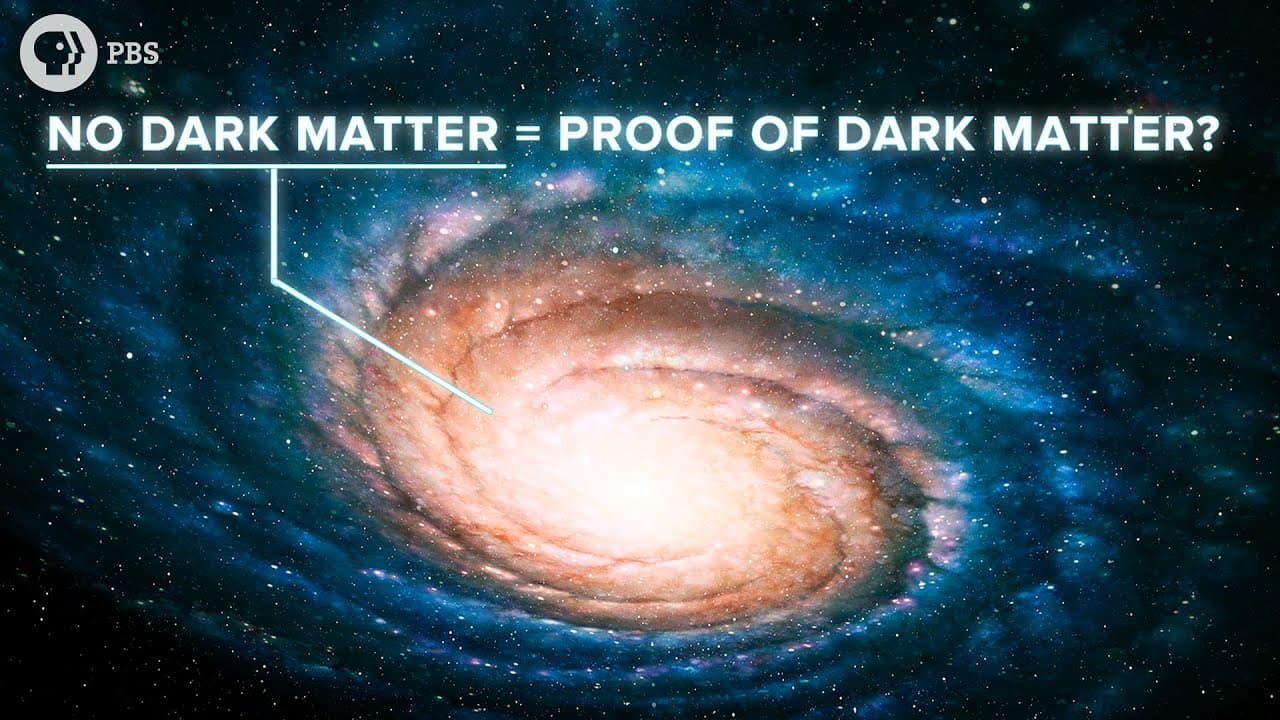
No Dark Matter = Proof of Dark Matter?
TL;DR
Galaxies without dark matter might confirm its existence.
Transcript
Thanks to curiosity stream for supporting PBS Digital Studios. We've been failing to detect dark matter for decades but finally the latest failure to detect Dark Matter may have actually proved its existence one of these is true either most of the matter in the universe is invisible and formed by something not explained by modern particle physics o... Read More
Key Insights
- Dark matter has eluded direct detection for decades, sparking debates between its existence and potential flaws in gravity theory.
- Two galaxies found with no dark matter challenge modified gravity theories, supporting dark matter as a separate entity.
- The discovery of these galaxies indicates dark matter might be a unique substance not tied to baryonic matter.
- Historical context: Fritz Zwicky and Vera Rubin's observations laid groundwork for dark matter's gravitational effects.
- Modified gravity theories, like MOND, struggle to explain observations such as the Bullet Cluster's mass distribution.
- Gravitational lensing and cosmic microwave background data support dark matter's existence as a physical substance.
- The peculiar ultra diffuse galaxies (UDGs) suggest dark matter can be absent, contradicting modified gravity models.
- Understanding galaxies without dark matter could unravel dark matter's nature, crucial since it composes 80% of the universe's matter.
Install to Summarize YouTube Videos and Get Transcripts
Explore YouTube Video Summarizer or Get YouTube Transcript Extractor
Questions & Answers
Q: What recent discovery supports the existence of dark matter?
The recent discovery of two galaxies that appear to have no dark matter at all supports the existence of dark matter. These galaxies challenge modified gravity theories, which suggest that dark matter is not a separate entity but rather a modification of gravitational laws. The absence of dark matter in these galaxies indicates that dark matter might be a unique, exotic substance.
Q: How do modified gravity theories explain dark matter?
Modified gravity theories, such as MOND, propose that the discrepancies in gravitational effects observed in galaxies and clusters are due to changes in gravitational laws at different scales, rather than the presence of dark matter. These theories suggest that baryonic matter, like stars and gas, is responsible for gravity, which behaves differently over large distances, giving the illusion of additional mass.
Q: What historical observations laid the groundwork for dark matter research?
Fritz Zwicky's observation in 1933 of galaxies in the Coma Cluster moving too quickly to remain gravitationally bound suggested the presence of unseen mass, which he termed 'dunkle materie.' Later, in the 1970s, Vera Rubin's discovery of spiral galaxies rotating too fast for their visible mass alone reinforced the idea of dark matter, leading to extensive research into its existence.
Q: What role does gravitational lensing play in dark matter research?
Gravitational lensing, the warping of light from distant objects by massive bodies, provides independent measures of mass in galaxies and clusters. Observations of lensing effects have shown mass distributions consistent with the presence of dark matter, supporting its existence as a separate entity rather than a modification of gravity. This evidence challenges modified gravity theories, which struggle to account for such observations.
Q: Why are ultra diffuse galaxies (UDGs) significant in dark matter research?
Ultra diffuse galaxies (UDGs) are significant because they exhibit properties that challenge existing theories about dark matter. The discovery of UDGs lacking dark matter suggests that dark matter can be absent in certain galaxies, contradicting modified gravity models. This discovery supports the idea that dark matter is a unique substance and provides new avenues for understanding its nature and role in the universe.
Q: How do cosmic microwave background fluctuations relate to dark matter?
Cosmic microwave background (CMB) fluctuations provide measurements of the universe's early conditions, including the relative amounts of dark matter and baryonic matter. These measurements are consistent with other methods indicating dark matter's presence, supporting the idea that dark matter is a physical substance. The consistency of CMB data with dark matter models challenges modified gravity theories, which struggle to explain these observations.
Q: What challenges do modified gravity theories face?
Modified gravity theories face challenges in explaining observations like the Bullet Cluster's mass distribution and gravitational lensing effects. These theories propose changes in gravitational laws to account for discrepancies without dark matter. However, the discovery of galaxies without dark matter and consistent data from cosmic microwave background fluctuations support dark matter's existence as a separate entity, challenging these theories' validity.
Q: What potential explanations exist for galaxies without dark matter?
Potential explanations for galaxies without dark matter include scenarios where gas and stars ejected from past collisions with nearby galaxies form new galaxies without dark matter. Alternatively, quasar winds from elliptical galaxies might have expelled gas, leading to star formation without dark matter. These hypotheses are speculative, and further research is needed to understand how such galaxies form and what they reveal about dark matter's nature.
Summary & Key Takeaways
-
The video discusses the long-standing challenge of detecting dark matter, highlighting recent discoveries of galaxies lacking dark matter, which paradoxically supports its existence. These findings challenge modified gravity theories, suggesting dark matter is a separate, exotic substance. The discussion includes historical context and implications for future research in understanding dark matter's nature.
-
The discovery of two ultra diffuse galaxies (UDGs) without dark matter suggests dark matter's existence as a separate entity, challenging modified gravity theories. This finding, alongside historical observations by Fritz Zwicky and Vera Rubin, supports the notion that dark matter is a unique substance, crucial for explaining the universe's gravitational phenomena.
-
Gravitational lensing and cosmic microwave background data support the existence of dark matter as a physical substance. The peculiar absence of dark matter in certain galaxies contradicts modified gravity models, suggesting dark matter is a unique entity. Understanding these galaxies could provide insights into dark matter, which constitutes the majority of the universe's matter.
Read in Other Languages (beta)
Share This Summary 📚
Summarize YouTube Videos and Get Video Transcripts with 1-Click
Try YouTube Summary with ChatGPT & Claude or YouTube Transcript Generator
Explore More Summaries from PBS Space Time 📚

Summarize YouTube Videos and Get Video Transcripts with 1-Click
Try YouTube Summary with ChatGPT & Claude or YouTube Transcript Generator