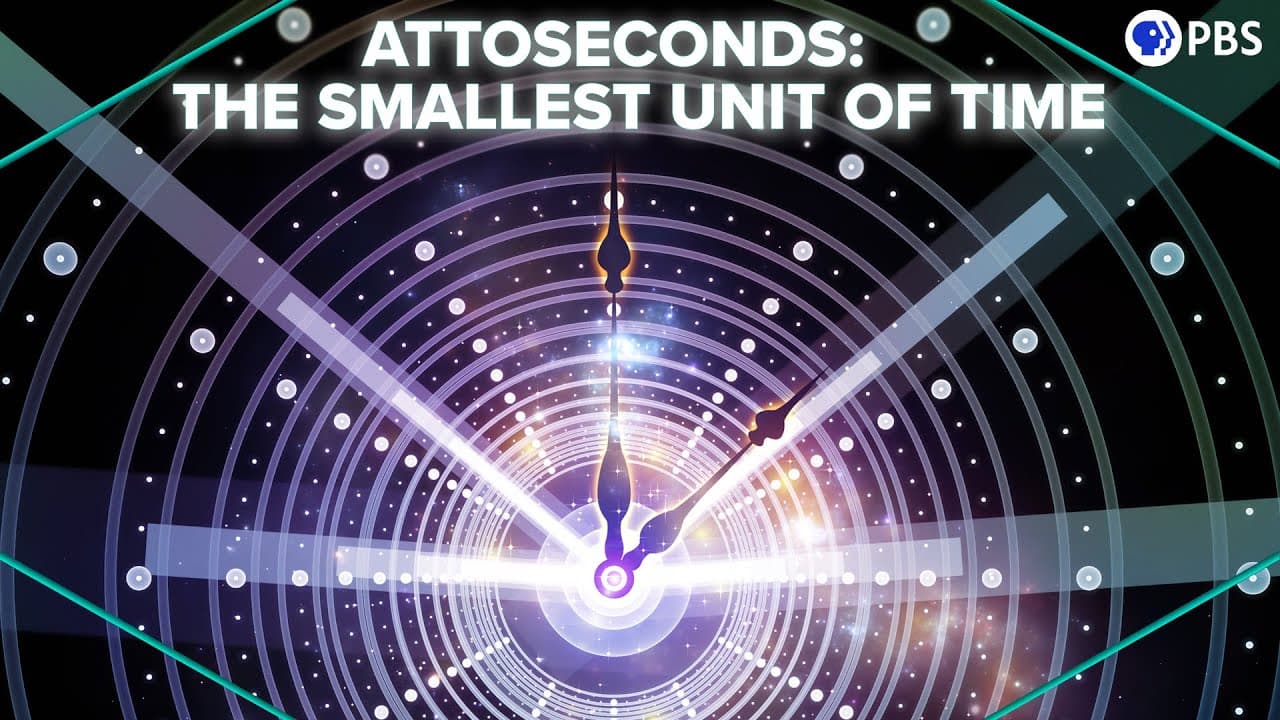
Why Did Attosecond Physics Win the NOBEL PRIZE?
TL;DR
2023 Nobel Prize awarded for breakthroughs in attosecond physics.
Transcript
Whenever we open a new window on the universe we discover something new. Whether it's figuring out how to see to greater distances like with telescopes, or down to smaller size-scales like with microscopes, or perhaps expanding our vision to new wavelengths of light or via exotic means such as in neutrinos or gravitational waves. Well, the 2023... Read More
Key Insights
- The 2023 Nobel Prize in Physics was awarded for advancements in attosecond physics, which opens a new window in time to study phenomena at the atomic level.
- Attosecond physics allows scientists to observe the motion of electrons and atoms, which occur on timescales as short as billionths of a billionth of a second.
- Anne L'Huillier, Pierre Agostini, and Ferenc Krausz were recognized for their pioneering work in creating attosecond pulses and enabling the study of fast processes.
- The creation of attosecond pulses involves high harmonic generation, where laser light interacts with gas atoms to produce higher frequency overtones.
- Attosecond pulses can be used to study and manipulate electron dynamics, offering potential applications in molecular fingerprinting for medical diagnostics.
- The technology can also lead to the development of ultrafast electronics, potentially increasing computer power significantly by using light-controlled transistors.
- The discovery of attosecond physics represents a significant leap in our ability to measure and manipulate processes at atomic and subatomic scales.
- As with past scientific advancements, the opening of this new temporal window is expected to lead to new discoveries and applications across various fields.
Install to Summarize YouTube Videos and Get Transcripts
Explore YouTube Video Summarizer or Get YouTube Transcript Extractor
Questions & Answers
Q: What is the significance of attosecond physics?
Attosecond physics is significant because it allows scientists to observe and manipulate processes that occur on an incredibly short timescale, specifically at the atomic and subatomic levels. This new capability opens a window in time, enabling the study of phenomena that were previously inaccessible, such as the motion of electrons and atoms during chemical reactions.
Q: Who were the Nobel laureates recognized for attosecond physics?
The 2023 Nobel Prize in Physics was awarded to Anne L'Huillier, Pierre Agostini, and Ferenc Krausz. These physicists were recognized for their pioneering work in developing the technology and methods necessary to create attosecond pulses, which have opened new avenues for studying fast processes at the atomic level.
Q: How are attosecond pulses created?
Attosecond pulses are created through a process called high harmonic generation. This involves using laser light to interact with gas atoms, such as argon, causing the emission of higher frequency overtones. These overtones produce pulses with durations in the attosecond range, allowing scientists to observe and study rapid atomic and electronic phenomena.
Q: What are some potential applications of attosecond physics?
Attosecond physics has potential applications in various fields, including medicine and electronics. In medicine, it can be used for molecular fingerprinting, helping to identify the detailed composition of samples for diagnostics. In electronics, attosecond pulses can enable the development of ultrafast transistors, potentially increasing computer processing power significantly.
Q: Why is attosecond physics considered a breakthrough?
Attosecond physics is considered a breakthrough because it provides a new way to observe and manipulate processes at the atomic level on incredibly short timescales. This advancement opens up new possibilities for scientific exploration and technological innovation, as it allows for the study of phenomena that were previously beyond our reach.
Q: What challenges were overcome to achieve attosecond resolution?
Achieving attosecond resolution required overcoming challenges related to the generation and measurement of extremely short light pulses. These challenges included creating pulses with precise temporal locality and separation, as well as calibrating them accurately. The work of the Nobel laureates involved ingenious methods to generate and measure these pulses, enabling the study of fast atomic processes.
Q: How does attosecond physics impact our understanding of chemical reactions?
Attosecond physics impacts our understanding of chemical reactions by allowing scientists to observe the motion of electrons and atoms as they interact and change during reactions. This insight into the dynamics of chemical processes at the atomic level provides a deeper understanding of how reactions occur, potentially leading to new discoveries and innovations in chemistry.
Q: What future discoveries might attosecond physics enable?
Attosecond physics might enable future discoveries in various fields by providing a new tool to study fast processes at the atomic level. As with past advancements in scientific observation, this new capability is expected to lead to new applications and insights, potentially revolutionizing areas such as materials science, quantum computing, and molecular biology.
Summary & Key Takeaways
-
The 2023 Nobel Prize in Physics was awarded to Anne L'Huillier, Pierre Agostini, and Ferenc Krausz for their work in attosecond physics. This field allows scientists to observe and manipulate processes at the atomic level, with timescales as short as billionths of a billionth of a second.
-
Attosecond physics opens a new window in time, enabling the study of fast processes such as electron motion in atoms. The award recognizes the creation of attosecond pulses, which are crucial for observing these rapid phenomena.
-
The advancements in attosecond physics have potential applications in various fields, including medicine and electronics. The technology could lead to new diagnostic tools and significantly faster computers, showcasing the transformative impact of this scientific breakthrough.
Read in Other Languages (beta)
Share This Summary 📚
Summarize YouTube Videos and Get Video Transcripts with 1-Click
Try YouTube Summary with ChatGPT & Claude or YouTube Transcript Generator
Explore More Summaries from PBS Space Time 📚
Summarize YouTube Videos and Get Video Transcripts with 1-Click
Try YouTube Summary with ChatGPT & Claude or YouTube Transcript Generator