What Are Context-Free Languages and Grammars?
TL;DR
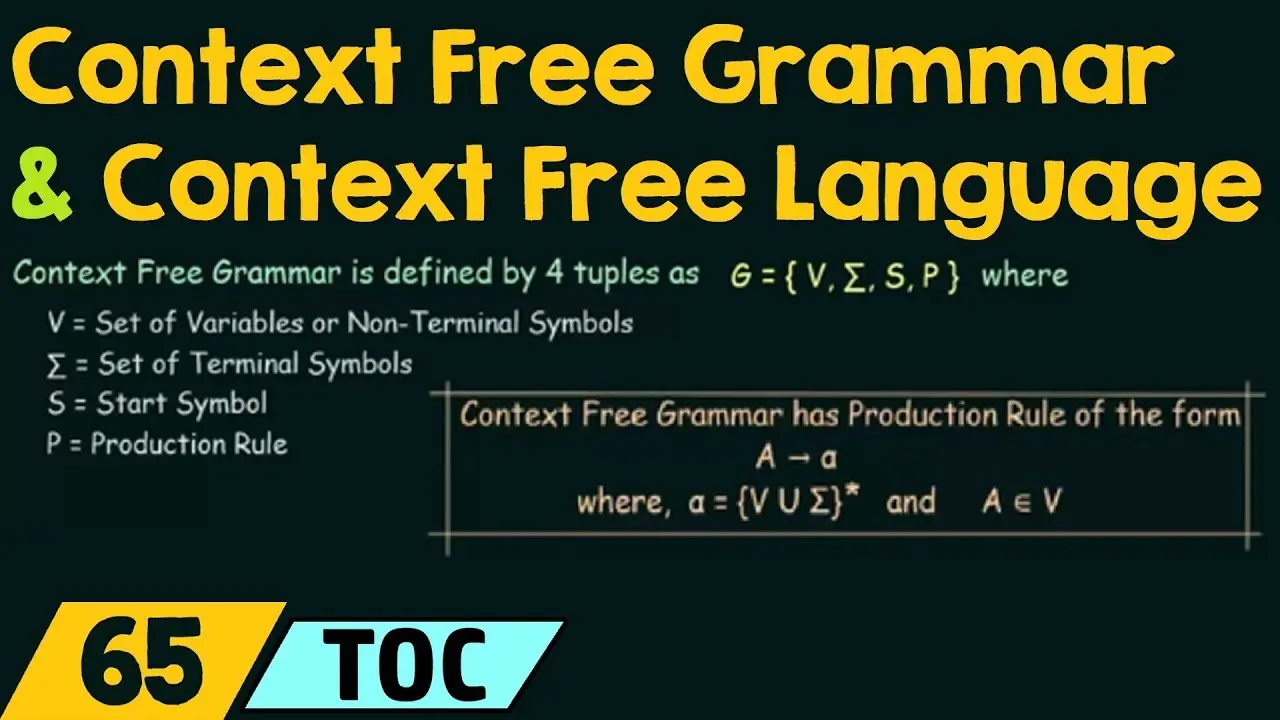
Context-free languages are generated by context-free grammars, which use production rules allowing a single non-terminal to be replaced by a sequence of terminals and non-terminals. These languages can express more complex structures than regular languages, exemplified by generating strings where the number of A's equals the number of B's.
Transcript
in this lecture we will be studying about context-free languages so tilde we have studied about regular languages and we also studied about regular grammars and we saw what they can be used for and we also saw their limitations now we come to the next level of languages which are context-free languages so let's first see what are context-free langu... Read More
Key Insights
- 🔑 Context-free languages are a higher-level language compared to regular languages, and they are generated using context-free grammars distinct from regular grammars.
- 🤔 Context-free languages are accepted by pushdown automata, which are more powerful than finite state automata used for regular languages, as per Chomsky's classification of grammars.
- ✨ Context-free grammars are defined by four tuples: V (variables/non-terminal symbols), Sigma (terminals), s (start symbol), and P (production rules).
- 📚 Production rules in context-free grammars have the form "a → alpha" or "a → epsilon," where alpha can be a combination of variables and terminals, and epsilon represents the empty symbol.
- 🌐 An example of a language generated by a context-free grammar is the one that generates strings of the form "a^n b^n," where the number of a's is equal to the number of b's.
- ⚡️ The context-free grammar for "a^n b^n" is defined as G = (s, {a, b}, s, {s → a a B, a → a a B, a → epsilon}), where s is the start symbol.
- 💡 By expanding the production rules, we can generate strings of the form "a^n b^n" where n is any positive integer.
- 🎯 Context-free languages allow for more complex language structures, making them suitable for representing and generating a wide range of languages beyond regular languages.
Install to Summarize YouTube Videos and Get Transcripts
Explore YouTube Video Summarizer or Get YouTube Transcript Extractor
Questions & Answers
Q: What is the difference between regular grammars and context-free grammars?
The main difference lies in the production rules. Regular grammars have production rules of the form "a → α," where α can only be a terminal symbol or empty, while context-free grammars have production rules of the form "a → α" or "a → αβ," where α and β can be both non-terminal symbols and terminal symbols.
Q: What is the role of pushdown automata in context-free languages?
Pushdown automata are used to recognize or accept languages generated by context-free grammars. They are more powerful than finite state automata, which are used for regular languages.
Q: How are context-free grammars formally defined?
Context-free grammars are formally defined by four tuples: V (set of variables/non-terminal symbols), Sigma (set of terminals), s (start symbol), and P (production rules). The production rules have the form "a → α" or "a → αβ," where α and β can be both non-terminal symbols and terminal symbols, including the possibility of being empty.
Q: Can context-free grammars generate languages that regular grammars cannot?
Yes, context-free grammars can generate languages that regular grammars cannot. For example, the language of equal number of A's and B's (a^n b^n) cannot be generated by a regular grammar, but it can be generated by a context-free grammar.
Summary & Key Takeaways
-
Context-free languages are a higher-level language compared to regular languages, and they are generated using context-free grammars.
-
Context-free grammars are defined by four tuples: V (set of variables/non-terminal symbols), Sigma (set of terminals), s (start symbol), and P (production rules).
-
Context-free grammars have production rules of the form "a → α" or "a → αβ," where α and β can be both non-terminal symbols and terminal symbols, including the possibility of being empty.
Read in Other Languages (beta)
Share This Summary 📚
Summarize YouTube Videos and Get Video Transcripts with 1-Click
Try YouTube Summary with ChatGPT & Claude or YouTube Transcript Generator
Explore More Summaries from Neso Academy 📚
Summarize YouTube Videos and Get Video Transcripts with 1-Click
Try YouTube Summary with ChatGPT & Claude or YouTube Transcript Generator