2015 AP Chemistry free response 5 | Kinetics | Chemistry | Khan Academy
TL;DR
The experiment analyzes the reaction order and absorbance of blue food coloring with bleach using a spectrophotometer.
Transcript
- [Voiceover] Blue food coloring can be oxidized by household bleach, which contains hypochlorite, household bleach will usually use sodium hypochlorite, to form colorless products, as represented by the equation above. So this is the food coloring, reacts with the hypochlorite, produces colorless a product. A student uses a spectrophotometer set a... Read More
Key Insights
- 😋 Blue food coloring can be oxidized by household bleach, resulting in colorless products.
- 🥘 Absorbance measurements can be used as a proxy for concentration of food coloring, allowing for analysis of the reaction over time.
- ⌛ Graphs of absorbance versus time can provide insights into the order of the reaction.
- 😋 Increasing the concentration of food coloring can slow down the reaction, leading to a longer time for the solution to reach near zero absorbance.
Install to Summarize YouTube Videos and Get Transcripts
Explore YouTube Video Summarizer or Get YouTube Transcript Extractor
Questions & Answers
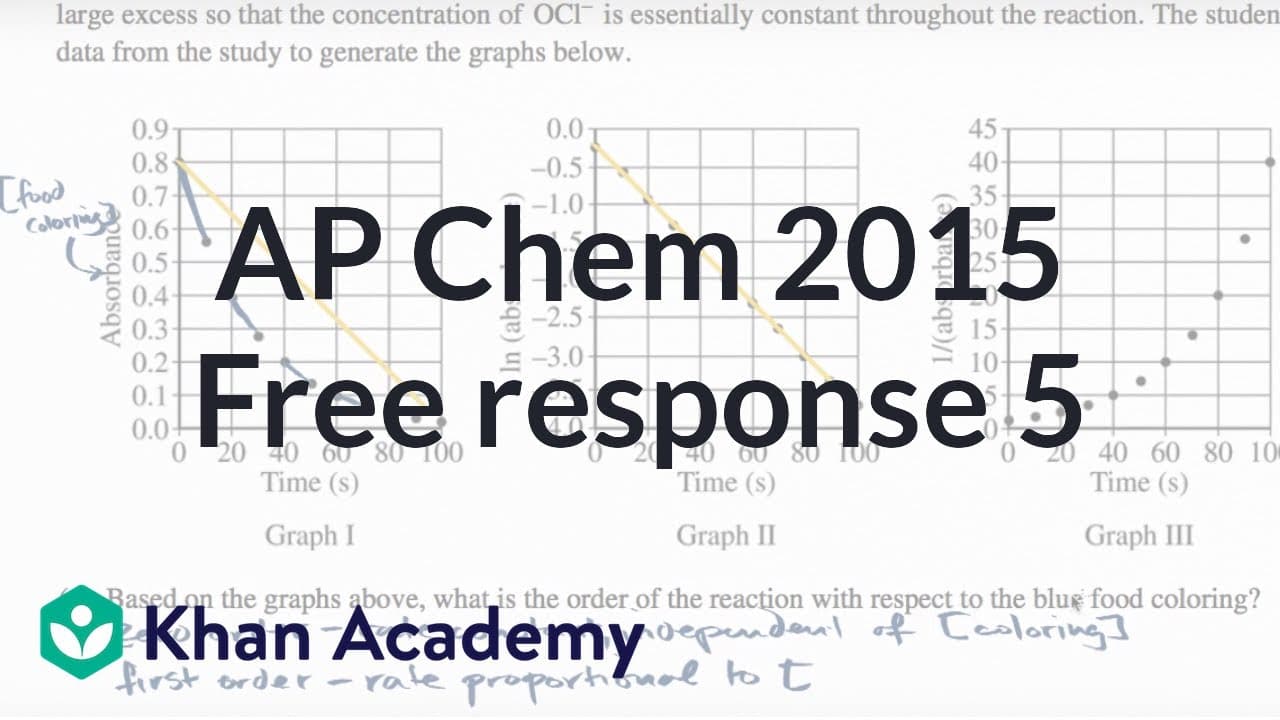
Q: What is the order of the reaction with respect to the blue food coloring?
The reaction is a first-order reaction with respect to blue food coloring. This can be determined by analyzing the graph of the natural log of absorbance versus time, which shows a straight line, indicating a first-order reaction.
Q: Why is increasing the concentration of blue food coloring a suitable modification to slow down the reaction?
Increasing the concentration of blue food coloring results in a higher initial absorbance. This means it will take more time for the reaction mixture to reach near zero absorbance, effectively slowing down the reaction.
Q: Why is increasing the temperature not a suitable modification to slow down the reaction?
Increasing the temperature would speed up the reaction as molecules would have more energy and collide more frequently. This would result in a faster reaction and a quicker transition to a colorless solution.
Q: How would the student need to modify the experiment to determine the order of the reaction with respect to red food coloring?
The student would need to change the wavelength of light used in the spectrophotometer to a red wavelength of light. This would match the absorbance properties of the red food coloring and allow for accurate analysis of the reaction order.
Summary & Key Takeaways
-
The experiment studies the reaction between blue food coloring and bleach using a spectrophotometer.
-
Graphs of absorbance over time show that the reaction is a first-order reaction with respect to blue food coloring.
-
The student proposes modifying the experiment by increasing the concentration of blue food coloring to slow down the reaction.
-
To study the oxidation of red food coloring with bleach, the student would need to modify the experiment by using a wavelength of light suitable for absorption by red coloring.
Read in Other Languages (beta)
Share This Summary 📚
Summarize YouTube Videos and Get Video Transcripts with 1-Click
Try YouTube Summary with ChatGPT & Claude or YouTube Transcript Generator
Explore More Summaries from Khan Academy 📚





Summarize YouTube Videos and Get Video Transcripts with 1-Click
Try YouTube Summary with ChatGPT & Claude or YouTube Transcript Generator