How Will We (Most Likely) Discover Alien Life?
TL;DR
K2-18b may hint at alien life but likely isn't aliens.
Transcript
The first discovery of extraterrestrial life will almost certainly NOT be when it visits us, nor when we visit it. It won’t be when we intercept it’s stray embarassing TV signals. It’ll be in the excruciatingly faint changes in the color of alien sunsets glimpsed hundreds of light years away. Today we’re going to talk about the first such hint,... Read More
Key Insights
- The discovery of extraterrestrial life is more likely to occur through subtle changes in starlight rather than direct contact or signals from aliens.
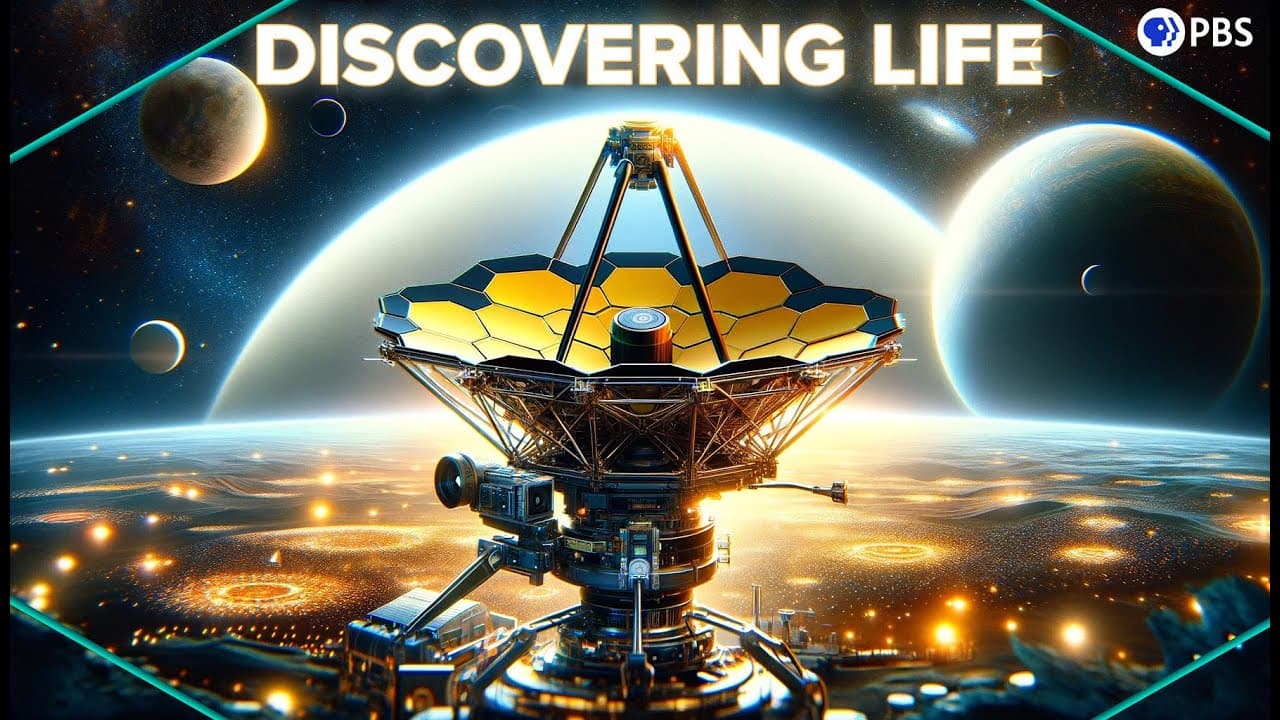
- K2-18b, a mini-Neptune exoplanet, has sparked interest due to potential biosignatures in its atmosphere, detected by the James Webb Space Telescope.
- Despite initial excitement, the presence of dimethyl sulfide, a potential biosignature, remains uncertain due to low detection confidence.
- K2-18b's atmosphere is rich in methane and carbon dioxide, but lacks water in its upper layers, challenging previous assumptions.
- The concept of Hycean planets, with vast oceans beneath hydrogen atmospheres, emerges as a new category in exoplanet studies.
- Extreme pressures in K2-18b's atmosphere may prevent traditional life-supporting processes like carbon cycling and plate tectonics.
- Future James Webb Space Telescope observations aim to confirm or refute the presence of dimethyl sulfide and other potential biosignatures.
- The study of K2-18b exemplifies the ongoing quest to understand planetary atmospheres and the potential for life beyond Earth.
Install to Summarize YouTube Videos and Get Transcripts
Explore YouTube Video Summarizer or Get YouTube Transcript Extractor
Questions & Answers
Q: How is the discovery of extraterrestrial life expected to occur?
The discovery of extraterrestrial life is anticipated to occur through subtle changes in starlight, observed as planets pass across their stars. These changes are detected by telescopes like the James Webb Space Telescope, which analyze the light spectrum for biosignatures in the atmospheres of distant planets.
Q: What makes K2-18b a significant exoplanet in the search for alien life?
K2-18b is significant due to its potential biosignatures detected in its atmosphere, such as dimethyl sulfide. Its status as a Hycean planet, with a vast ocean beneath a hydrogen atmosphere, adds intrigue, as this type of planet is a new category in exoplanet studies, potentially offering conditions for life.
Q: What challenges are there in confirming the presence of dimethyl sulfide on K2-18b?
The confirmation of dimethyl sulfide on K2-18b is challenging due to the low confidence level of the detection, currently at 1-sigma, which implies a high chance of the signal being a false positive. Further observations with the James Webb Space Telescope are needed to strengthen or refute this potential biosignature.
Q: Why is there no water detected in K2-18b's upper atmosphere?
Water is not detected in K2-18b's upper atmosphere likely because it condenses and rains out in deeper layers, leaving the upper atmosphere dry. This is similar to Earth's stratosphere, where water vapor is minimal, and is consistent with the planet's atmospheric model suggesting a vast ocean beneath a hydrogen atmosphere.
Q: What are Hycean planets and why are they important?
Hycean planets are a newly proposed category of exoplanets characterized by vast oceans beneath hydrogen-rich atmospheres. They are important because they expand our understanding of planetary types and environments that might support life, despite the challenges posed by extreme pressures and lack of traditional life-supporting processes.
Q: What role does the James Webb Space Telescope play in studying exoplanets like K2-18b?
The James Webb Space Telescope plays a crucial role in studying exoplanets like K2-18b by providing detailed observations of their atmospheres. Its advanced infrared capabilities allow for the detection of molecular signatures, such as methane and carbon dioxide, and potential biosignatures like dimethyl sulfide, offering insights into the planet's composition and potential habitability.
Q: What are the limitations of current atmospheric models for K2-18b?
Current atmospheric models for K2-18b are limited by the range of possible atmospheres that could fit the observations. While some models suggest a water world beneath a hydrogen atmosphere, alternative models could also explain the data. The challenge lies in accurately modeling the complex interactions and processes within the planet's atmosphere to determine its true nature.
Q: What future observations are planned for K2-18b?
Future observations for K2-18b involve further monitoring with the James Webb Space Telescope, specifically using the Mid-Infrared Interferometer (MIRI) to explore the mid-infrared spectrum. These observations aim to confirm or refute the presence of dimethyl sulfide and other potential biosignatures, enhancing our understanding of the planet's atmosphere and potential for life.
Summary & Key Takeaways
-
The first discovery of extraterrestrial life is expected to be indirect, through faint changes in starlight from planets like K2-18b. This exoplanet has drawn attention due to potential biosignatures in its atmosphere, although the presence of life remains unlikely.
-
K2-18b's atmosphere, studied by the James Webb Space Telescope, shows methane and carbon dioxide but lacks water, challenging previous hypotheses. The potential detection of dimethyl sulfide, a biosignature, is uncertain and requires further investigation.
-
Hycean planets, like K2-18b, with vast oceans beneath hydrogen atmospheres, represent a new category in exoplanet studies. These planets face challenges for life development due to extreme pressures and lack of traditional life-supporting processes.
Read in Other Languages (beta)
Share This Summary 📚
Summarize YouTube Videos and Get Video Transcripts with 1-Click
Try YouTube Summary with ChatGPT & Claude or YouTube Transcript Generator
Explore More Summaries from PBS Space Time 📚
Summarize YouTube Videos and Get Video Transcripts with 1-Click
Try YouTube Summary with ChatGPT & Claude or YouTube Transcript Generator