How to Calculate Equilibrium Constants in Chemistry
TL;DR
To calculate an equilibrium constant, use the concentrations or partial pressures of products and reactants at equilibrium, forming a ratio based on the balanced equation. This ratio allows predictions about reaction behavior under specific conditions, and it's essential to note that equilibrium constants vary with temperature.
Transcript
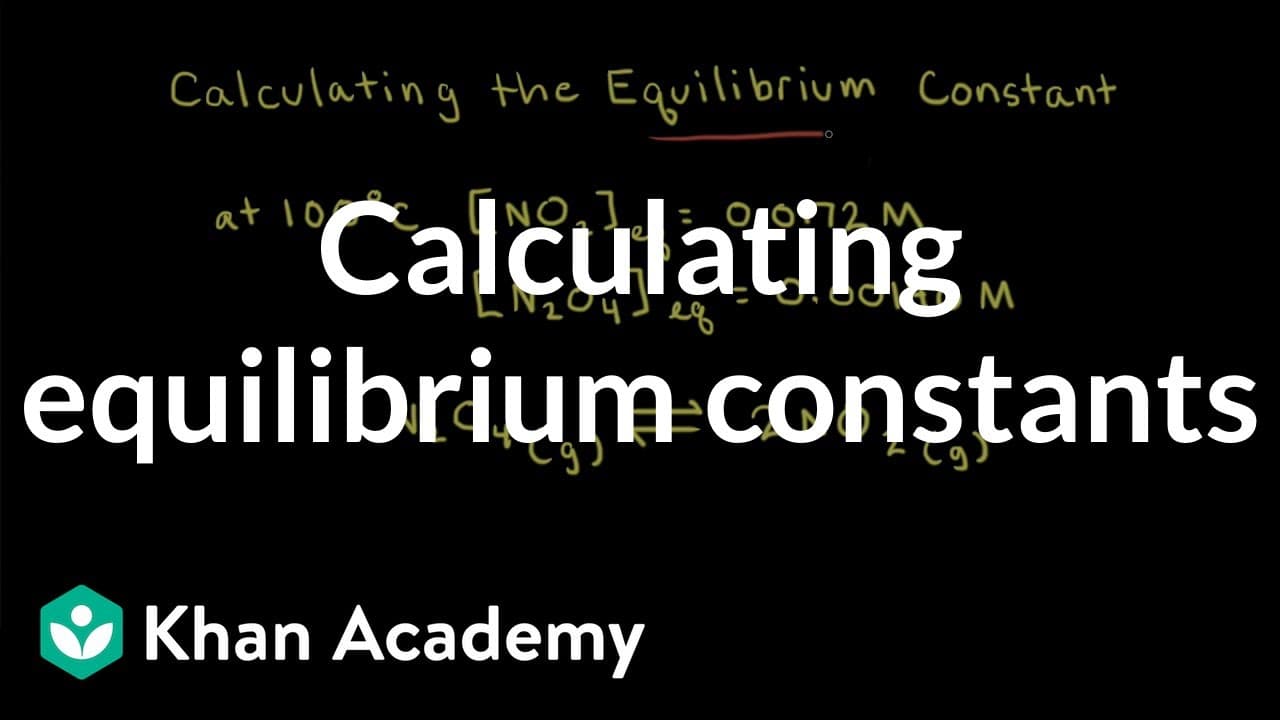
- [Instructor] An equilibrium constant can be calculated from experimentally measured concentrations or partial pressures of reactants and products at equilibrium. As an example, let's look at the reaction where N2O4 in the gaseous state turns into 2NO2 also in the gaseous state. And let's say we do an experiment and we allow this reaction to come ... Read More
Key Insights
- ❓ Equilibrium constants can be calculated using concentrations or partial pressures of reactants and products.
- 😑 The equilibrium constant expression is written by dividing the concentrations or partial pressures of the products by the concentrations or partial pressures of the reactants.
- 🇦🇪 Equilibrium constants are specific to a particular reaction at a particular temperature and do not have any units.
- 💪 An ICE table can be used to determine changes in partial pressures and calculate equilibrium constants when working with partial pressures.
- 💁 Equilibrium constants provide information about the extent of a reaction and whether it favors the products or reactants.
- ❓ Equilibrium constants can be used to predict the direction of a reaction under different conditions.
- ❓ The numerical value of the equilibrium constant can indicate the relative concentrations of reactants and products at equilibrium.
Install to Summarize YouTube Videos and Get Transcripts
Explore YouTube Video Summarizer or Get YouTube Transcript Extractor
Questions & Answers
Q: How is the equilibrium constant expression written?
The equilibrium constant expression is written by dividing the concentrations or partial pressures of the products by the concentrations or partial pressures of the reactants, as determined by the coefficients in the balanced equation.
Q: What is the significance of giving the temperature when providing a value for an equilibrium constant?
The equilibrium constant is specific to a particular reaction at a particular temperature. Therefore, it is important to provide the temperature when giving a value for an equilibrium constant.
Q: How is the equilibrium constant calculated when working with partial pressures instead of concentrations?
When working with partial pressures, the equilibrium constant expression is still written using the balanced equation. The equilibrium partial pressures are then substituted into the expression to calculate the equilibrium constant.
Q: Why is it necessary to use an ICE table when calculating the equilibrium constant for a reaction using partial pressures?
An ICE table helps determine the changes in partial pressures for each species involved in the reaction. This information is crucial for calculating the equilibrium partial pressures and eventually the equilibrium constant.
Summary & Key Takeaways
-
Equilibrium constants can be calculated from experimentally measured concentrations or partial pressures of reactants and products at equilibrium.
-
The equilibrium constant expression is written by using the balanced equation and involves the concentrations or partial pressures of the products divided by the concentrations or partial pressures of the reactants.
-
The equilibrium constant is only constant for a particular reaction at a particular temperature and does not have any units.
Read in Other Languages (beta)
Share This Summary 📚
Summarize YouTube Videos and Get Video Transcripts with 1-Click
Try YouTube Summary with ChatGPT & Claude or YouTube Transcript Generator
Explore More Summaries from Khan Academy 📚




Summarize YouTube Videos and Get Video Transcripts with 1-Click
Try YouTube Summary with ChatGPT & Claude or YouTube Transcript Generator