How Do Amplitude and Reflection Affect Sine Graphs?
TL;DR
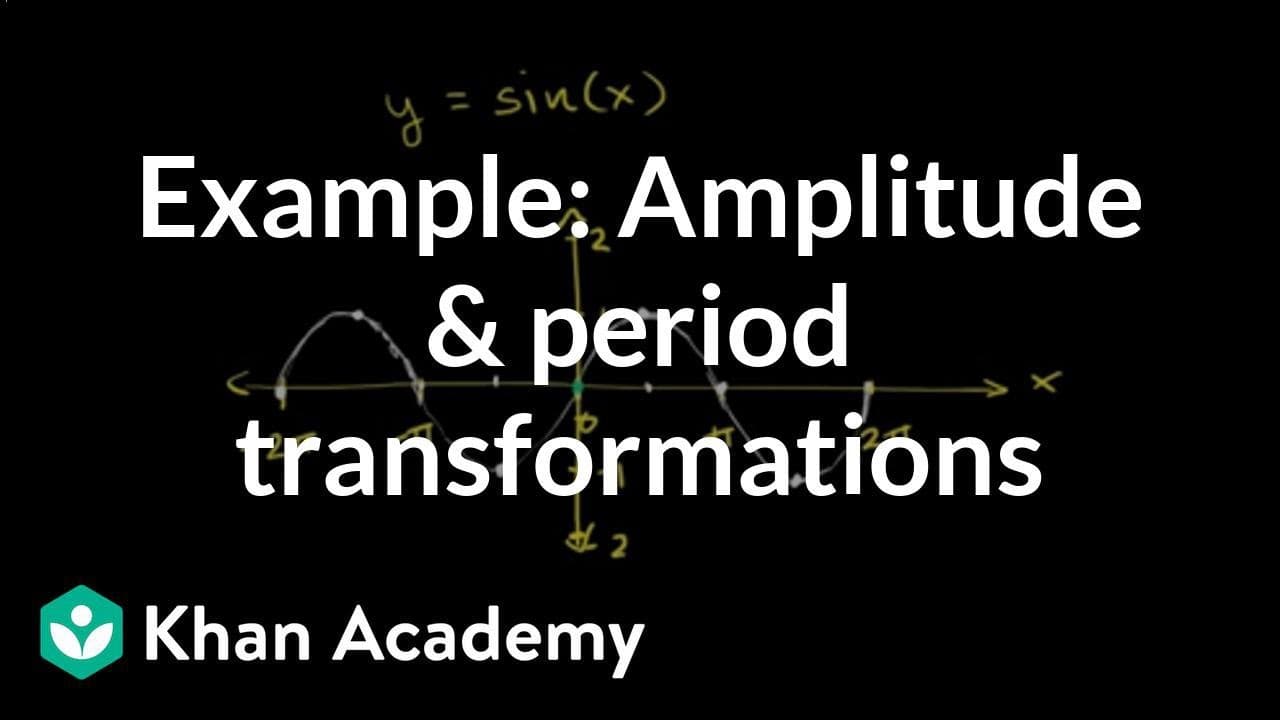
The function y = 2sin(-x) doubles the amplitude of the sine wave and reflects it over the y-axis. The amplitude becomes 2, while the period remains unchanged at 2π. Understanding these transformations is essential for graphing sine functions accurately.
Transcript
We're asked to graph the function y = 2sin(-x) on the interval the closed interval so it includes the endpoints -2π to 2π So to do this I'm going to graph the function y = sin(x) and then think about how it's changed by the 2 and the negative in front of the x over here So let's look at the sine of x first So let me draw our x-axis let me draw the ... Read More
Key Insights
- 📈 Multiplying the function by a constant affects the amplitude of the graph.
- 👋 Graphing sin(x) on the interval -2π to 2π creates a typical sine wave pattern.
- 🚫 Reflecting the graph over the y-axis changes the sign of the function values.
- 😀 The period of y = 2sin(-x) remains the same as sin(x) at 2π.
- ✖️ The amplitude of y = 2sin(-x) is twice that of sin(x) due to the multiplication by 2.
- ⭕ Understanding the unit circle helps determine the values of trigonometric functions.
- 📈 Graph transformations involve changing the amplitude and reflecting the graph over the y-axis.
Install to Summarize YouTube Videos and Get Transcripts
Explore YouTube Video Summarizer or Get YouTube Transcript Extractor
Questions & Answers
Q: How does multiplying the function by 2 affect the graph of y = 2sin(x)?
Multiplying the function by 2 doubles the amplitude of the graph, making it oscillate between 2 and -2 instead of 1 and -1.
Q: What happens when sin(x) is graphed on the interval -2π to 2π?
The graph of sin(x) follows a typical sine wave pattern, starting at 0, reaching a maximum amplitude of 1, returning to 0, and then reaching a minimum amplitude of -1.
Q: How does graphing sin(-x) differ from graphing sin(x)?
Graphing sin(-x) reflects the graph over the y-axis, resulting in a mirrored image of the original graph. The function values remain the same, but in a different order.
Q: What is the period of the function y = 2sin(-x)?
The period of y = 2sin(-x) is the same as the period of sin(x), which is 2π. The negative in front of x does not affect the period.
Summary & Key Takeaways
-
Graphing y = sin(x) on the interval -2π to 2π shows a typical sine wave pattern.
-
Multiplying the function by 2 results in doubling the amplitude of the graph.
-
Graphing y = sin(-x) reflects the graph over the y-axis.
Read in Other Languages (beta)
Share This Summary 📚
Summarize YouTube Videos and Get Video Transcripts with 1-Click
Try YouTube Summary with ChatGPT & Claude or YouTube Transcript Generator
Explore More Summaries from Khan Academy 📚




Summarize YouTube Videos and Get Video Transcripts with 1-Click
Try YouTube Summary with ChatGPT & Claude or YouTube Transcript Generator