Various Types of Chips - Metal Cutting Theory and Dynamometry - Machining Sciences and Tool Design
TL;DR
Different types of metal chips are formed during machining, including continuous chips, discontinuous chips, and chips with a built-up edge, which can be influenced by various parameters.
Transcript
hello students this is santosh kumarichvi i am your course instructor for machining sciences and tool design we were discussing module number one that is metal cutting theory and dynamometry and today we will discuss about topic types of metal chips three types of chips formation which will happen that is continuous chip discontinuous chip and chip... Read More
Key Insights
- 💁 Different types of metal chips are formed during machining, and their formation depends on the workpiece material, tool geometry, and cutting conditions.
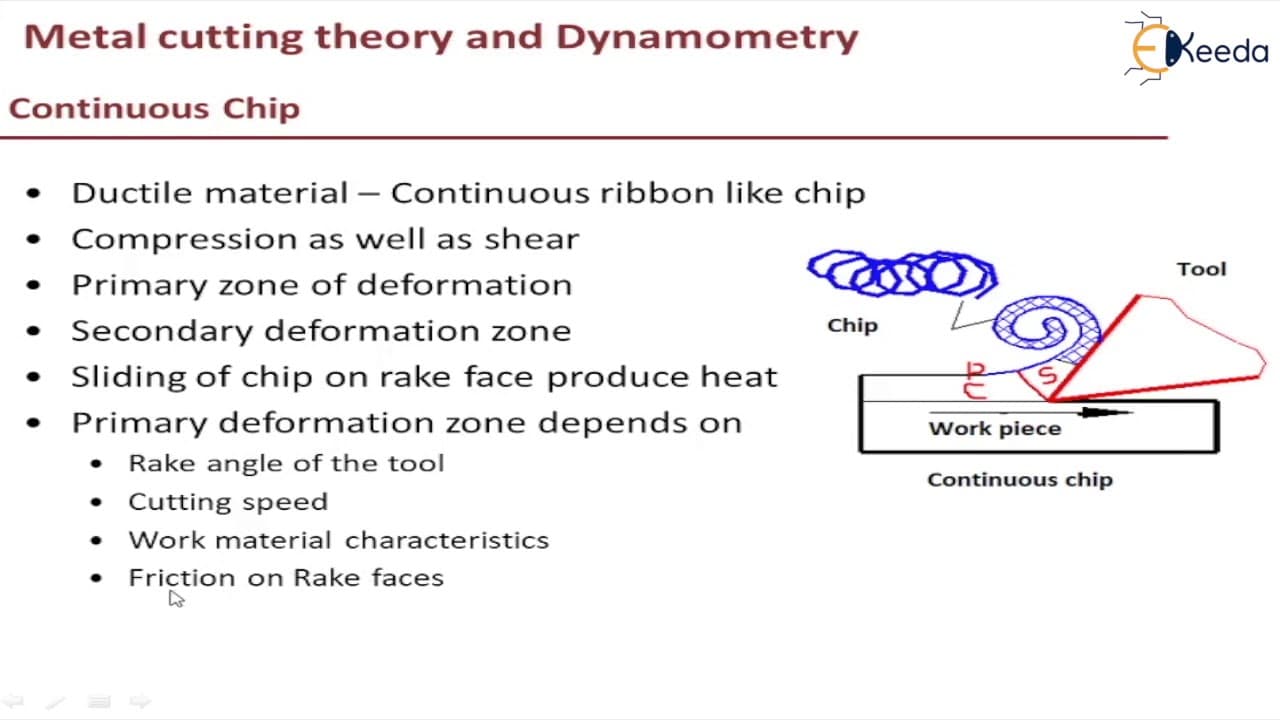
- 💝 Continuous chips are formed when machining ductile materials and are characterized by a ribbon-like shape.
- 💁 Discontinuous chips are formed when machining brittle materials and consist of small, segmented pieces.
- 🐿️ Chips with a built-up edge occur due to friction between the chip and the tool, resulting in periodic breaking and forming of the built-up edge.
- 🧑🏭 The size and characteristics of the deformation zones and the built-up edge can be influenced by factors such as rake angle, cutting speed, and work material characteristics.
- 💇 Increasing cutting speed can affect the built-up edge, making it soften or even disappear.
- 💁 Machining brittle materials can also result in continuous chip formation by adjusting the cutting conditions.
Install to Summarize YouTube Videos and Get Transcripts
Explore YouTube Video Summarizer or Get YouTube Transcript Extractor
Questions & Answers
Q: What are the three types of metal chips formed during machining?
The three types of metal chips formed during machining are continuous chips, discontinuous chips, and chips with a built-up edge.
Q: What influences the type of chip formation during machining?
The type of chip formation is influenced by parameters such as workpiece material, tool geometry, and cutting conditions.
Q: How are continuous chips formed?
Continuous chips are formed when machining ductile materials. The tool's pressure plastically deforms the material ahead of the cutting edge in compression and shear, resulting in a continuous, ribbon-like chip.
Q: What causes a built-up edge to form on the tool's cutting edge?
The built-up edge is formed due to friction between the chip and the tool. Some of the chip material sticks to the tool's rake face, discharging heat and becoming stronger, attracting more work material and increasing in size until it breaks periodically.
Summary & Key Takeaways
-
Metal chips formed during machining can be classified into three types: continuous, discontinuous, and chips with a built-up edge.
-
Continuous chips are formed when machining ductile materials, such as low carbon steel, copper, brass, and aluminum alloys, and are characterized by a ribbon-like shape.
-
Discontinuous chips are formed when machining brittle materials, like cast iron and brasses with a high percentage of zinc, and are characterized by small, segmented pieces.
-
Chips with a built-up edge occur when there is friction between the chip and the tool, causing some of the chip material to stick to the tool's cutting edge, leading to a periodically breaking and forming of the built-up edge.
Read in Other Languages (beta)
Share This Summary 📚
Summarize YouTube Videos and Get Video Transcripts with 1-Click
Try YouTube Summary with ChatGPT & Claude or YouTube Transcript Generator
Explore More Summaries from Ekeeda 📚






Summarize YouTube Videos and Get Video Transcripts with 1-Click
Try YouTube Summary with ChatGPT & Claude or YouTube Transcript Generator