The REAL Possibility of Mapping Alien Planets!
TL;DR
A mission to map exoplanets using solar gravitational lensing is proposed.
Transcript
Thank you to Squarespace for Supporting PBS. I’m going to tell you about the craziest proposal for an astrophysics mission that has a good chance of actually happening. A train of spacecraft sailing the sun’s light to a magical point out there in space where the Sun’s own gravity turns it into a gigantic lens. What could such a solar-system-siz... Read More
Key Insights
- The mission involves using a solar gravitational lens to map exoplanets, utilizing the Sun's gravity as a massive lens.
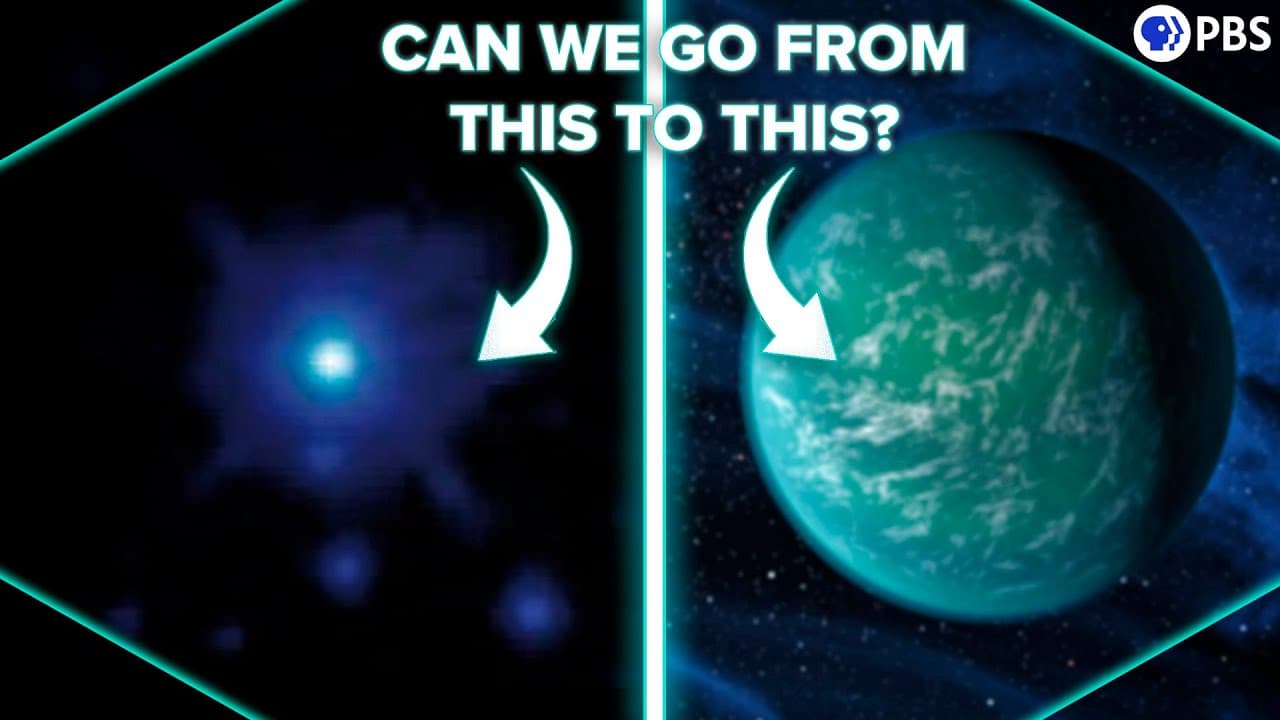
- There are billions of exoplanets in our galaxy, with many Earth-like in size and mass, but detailed surface mapping is needed for further study.
- Current telescopes, like the James Webb Space Telescope, can detect atmospheric molecules but cannot resolve detailed surface features.
- A telescope the size of New York City would be needed to resolve exoplanet features from 100 light years away using traditional methods.
- The proposed mission involves sending spacecraft in the opposite direction of the exoplanet to reach the solar gravitational lens focal region.
- Two mission models are proposed: a single large craft or a 'string of pearls' model using multiple small-sats with solar sails.
- Solar sails harness the momentum of sunlight for propulsion, allowing for long-range missions without carrying fuel.
- The mission aims to achieve detailed mapping of exoplanet surfaces, potentially revealing features like coastlines and even signs of civilization.
Install to Summarize YouTube Videos and Get Transcripts
Explore YouTube Video Summarizer or Get YouTube Transcript Extractor
Questions & Answers
Q: What is the main goal of the proposed mission?
The main goal of the proposed mission is to map the surfaces of exoplanets using a solar gravitational lens. By sending spacecraft to a specific point in space where the Sun's gravity acts as a massive lens, the mission aims to achieve detailed imaging of exoplanet surfaces, potentially revealing features such as coastlines, vegetation, and signs of civilization.
Q: How does the solar gravitational lens work?
The solar gravitational lens works by using the Sun's gravitational field to bend and focus light from distant exoplanets. This creates a magnified and amplified image of the exoplanet, allowing for detailed observation of its surface features. The mission involves sending spacecraft to the focal region of this lens to capture the enhanced images.
Q: What are the two proposed models for the mission?
The two proposed models for the mission are the 'flagship' model and the 'string of pearls' model. The flagship model involves sending a single large spacecraft equipped with a telescope, while the string of pearls model involves deploying multiple small-sats in a train formation, each using solar sails for propulsion. The latter is preferred due to its scalability and efficiency.
Q: What are solar sails and how do they work?
Solar sails are propulsion systems that use the momentum of sunlight to accelerate spacecraft. By catching photons from the Sun, solar sails provide thrust without the need for onboard fuel. This makes them ideal for long-range missions, as they can continuously accelerate and reach high speeds, enabling the spacecraft to travel vast distances in space.
Q: What challenges does the mission face?
The mission faces several challenges, including the need for precise navigation to reach the solar gravitational lens focal region, the requirement for advanced materials for the solar sails, and the difficulty of unfurling and controlling large sails. Additionally, the mission must achieve high speeds to reach the target within a reasonable timeframe, and the spacecraft must operate autonomously due to communication delays.
Q: What potential discoveries could the mission lead to?
The mission could lead to groundbreaking discoveries about exoplanets, including detailed mapping of their surfaces. This could reveal geographical features like coastlines, mountains, and lakes, as well as potential signs of life or civilization, such as vegetation or artificial lights. The data could also provide insights into the planets' climates, weather patterns, and geological activity.
Q: How does this mission compare to current telescopes like the James Webb Space Telescope?
While the James Webb Space Telescope can detect atmospheric molecules and capture images of exoplanets, it cannot resolve detailed surface features. The proposed mission aims to overcome this limitation by using the solar gravitational lens to achieve much higher resolution imaging, allowing for detailed observation of exoplanet surfaces that current telescopes cannot provide.
Q: What is the current status of the mission proposal?
The mission proposal is currently in the advanced stages of development, having reached phase 3 in the NAIA program. While it is not yet funded, the involved scientists are hopeful that it will be picked up by NASA. The mission relies on existing or developing technologies, and if successful, it could lead to detailed mapping of distant worlds within our lifetimes.
Summary & Key Takeaways
-
The proposed mission involves using a solar gravitational lens to map the surfaces of exoplanets, leveraging the Sun's gravity as a massive lens to amplify and magnify the light from distant worlds.
-
Two mission models are considered: a single large spacecraft or a 'string of pearls' approach with multiple small-sats using solar sails for propulsion, which allows for a fuel-free journey.
-
The mission aims to achieve unprecedented resolution in exoplanet imaging, potentially revealing detailed surface features and even signs of life or civilization on distant planets.
Read in Other Languages (beta)
Share This Summary 📚
Summarize YouTube Videos and Get Video Transcripts with 1-Click
Try YouTube Summary with ChatGPT & Claude or YouTube Transcript Generator
Explore More Summaries from PBS Space Time 📚
Summarize YouTube Videos and Get Video Transcripts with 1-Click
Try YouTube Summary with ChatGPT & Claude or YouTube Transcript Generator