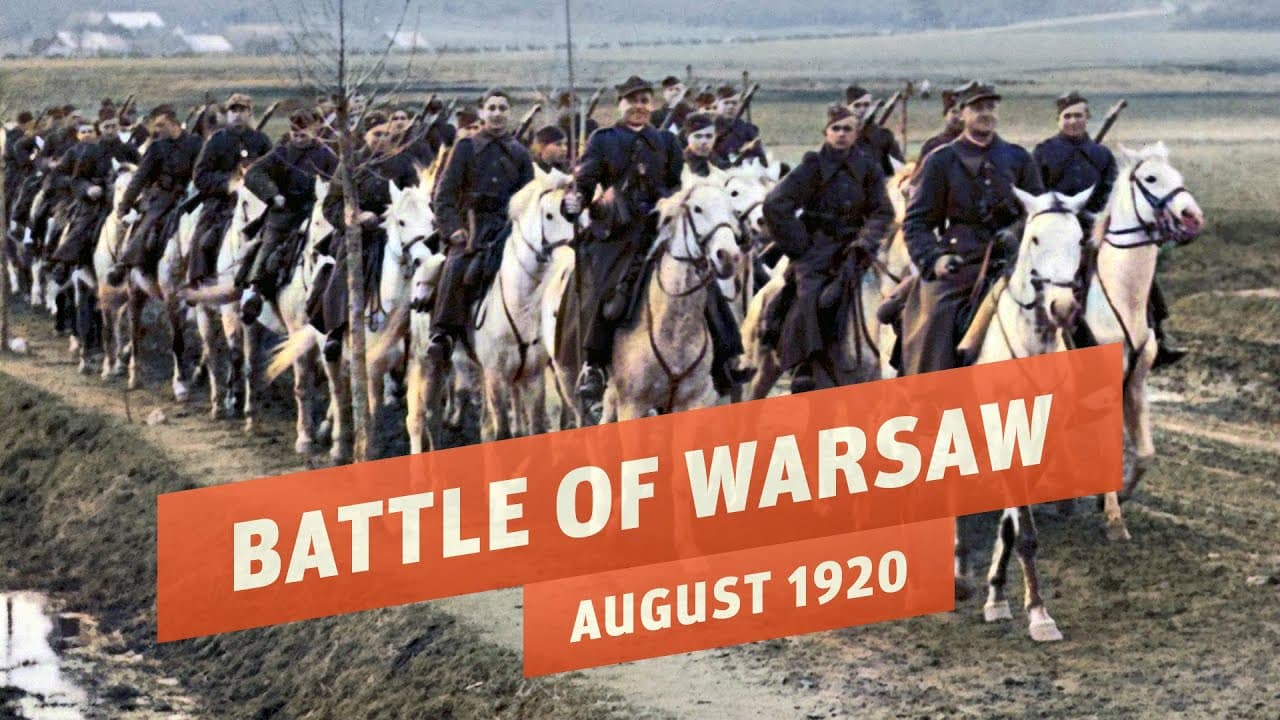
Battle of Warsaw - Turning Point of Polish-Soviet War (Documentary)
TL;DR
The Battle of Warsaw was a turning point in the Polish-Soviet War.
Transcript
By August 1920, the Polish-Soviet War had been raging for over a year. What had started as a guerilla border war had turned into a full-on conventional conflict in the spring of 1920, as Polish forces advanced east into Belarus and Ukraine, capturing Kiev in May. But the Red Army recovered and launched a major counterattack, which would reach a dra... Read More
Key Insights
- The Polish-Soviet War escalated from a border conflict to a conventional war, reaching a climax at the Battle of Warsaw in August 1920.
- The Red Army's advance into Poland was initially successful but faced stiff resistance from Polish forces, leading to a drawn-out siege at Lwow.
- Internal political divisions and low morale plagued Poland, with leaders like Pilsudski doubting the army's and civilians' resolve.
- Anti-Semitic tensions rose in Poland, with Jews being unfairly associated with the Bolshevik enemy, leading to discriminatory measures.
- The Polish government faced a crisis, with changes in leadership and the creation of the Council of National Defence to manage the situation.
- The Battle of Warsaw saw a successful Polish counterattack, exploiting weaknesses in the overextended Red Army, leading to a significant Polish victory.
- Allied nations, particularly Britain and France, were involved diplomatically but were constrained by domestic politics from direct military intervention.
- The Bolshevik leadership was divided on the extent of their ambitions in Europe, with some seeing Poland as a strategic threat to Russia.
Install to Summarize YouTube Videos and Get Transcripts
Explore YouTube Video Summarizer or Get YouTube Transcript Extractor
Questions & Answers
Q: What were the main challenges faced by Poland during the Battle of Warsaw?
Poland faced several challenges, including a crisis of morale within its army and society, political divisions within its government, and anti-Semitic tensions. The country's leadership was uncertain, with Pilsudski offering his resignation twice, and there were significant concerns about the army's ability to withstand the Bolshevik advance.
Q: How did the Red Army manage to advance so far into Poland?
The Red Army's advance into Poland was facilitated by their numerical superiority, especially in artillery, and the effective use of cavalry to outflank Polish forces. The Bolsheviks also capitalized on internal divisions and low morale within Poland, which initially allowed them to make significant territorial gains.
Q: What role did international allies play in the Polish-Soviet War?
International allies, particularly Britain and France, played a diplomatic role in the Polish-Soviet War. They attempted to mediate negotiations and pressured the Bolsheviks to halt their advance at the Curzon Line. However, their involvement was limited by domestic politics, which prevented direct military intervention.
Q: How did internal divisions within the Bolshevik leadership affect their campaign in Poland?
Internal divisions within the Bolshevik leadership, including rivalries between Tukhachevsky, Stalin, and other commanders, led to a lack of coordination between different fronts. This disunity, combined with logistical challenges and a lack of local support, weakened the Red Army's campaign in Poland.
Q: What was the significance of the Polish victory at the Battle of Warsaw?
The Polish victory at the Battle of Warsaw was significant because it halted the Bolshevik advance into Europe, preserved Polish independence, and prevented the spread of Bolshevism. It was seen as a turning point in the Polish-Soviet War and had lasting geopolitical implications for the region.
Q: How did the Polish forces manage to achieve victory at Warsaw?
Polish forces achieved victory at Warsaw through a well-executed counteroffensive that exploited the Red Army's overextension and logistical weaknesses. The Polish military's strategic repositioning and use of old German trenches helped stabilize their defenses, allowing them to repel the Bolshevik assault and launch a successful counterattack.
Q: What impact did the Battle of Warsaw have on Polish society?
The Battle of Warsaw had a unifying effect on certain segments of Polish society, particularly the urban middle class, who rallied to defend the nation. However, it also highlighted existing social tensions, such as anti-Semitic sentiments and the divide between urban and rural populations, which persisted despite the military victory.
Q: What were the Bolsheviks' strategic goals in the Polish-Soviet War?
The Bolsheviks' strategic goals included securing Poland as a buffer state and potentially using it as a springboard to spread the revolution into Western Europe. However, internal disagreements and logistical challenges limited their ability to achieve these objectives, and the defeat at Warsaw forced them to reconsider their ambitions.
Summary & Key Takeaways
-
The Battle of Warsaw marked a pivotal moment in the Polish-Soviet War, with Poland managing to repel the advancing Red Army despite internal strife and low morale. This victory was crucial in preserving Polish independence and preventing the spread of Bolshevism into Western Europe.
-
Poland faced significant internal challenges, including political divisions, anti-Semitic tensions, and a crisis of morale within the army and society. Despite these issues, a national mobilization effort helped to rally the country in defense of Warsaw against the Bolshevik threat.
-
The Red Army's initial success in Poland was undermined by logistical difficulties, lack of local support, and internal political rivalries. The Polish victory at Warsaw was a strategic and symbolic triumph, altering the course of the war and impacting the broader geopolitical landscape.
Read in Other Languages (beta)
Share This Summary 📚
Summarize YouTube Videos and Get Video Transcripts with 1-Click
Try YouTube Summary with ChatGPT & Claude or YouTube Transcript Generator
Explore More Summaries from The Great War 📚
Summarize YouTube Videos and Get Video Transcripts with 1-Click
Try YouTube Summary with ChatGPT & Claude or YouTube Transcript Generator