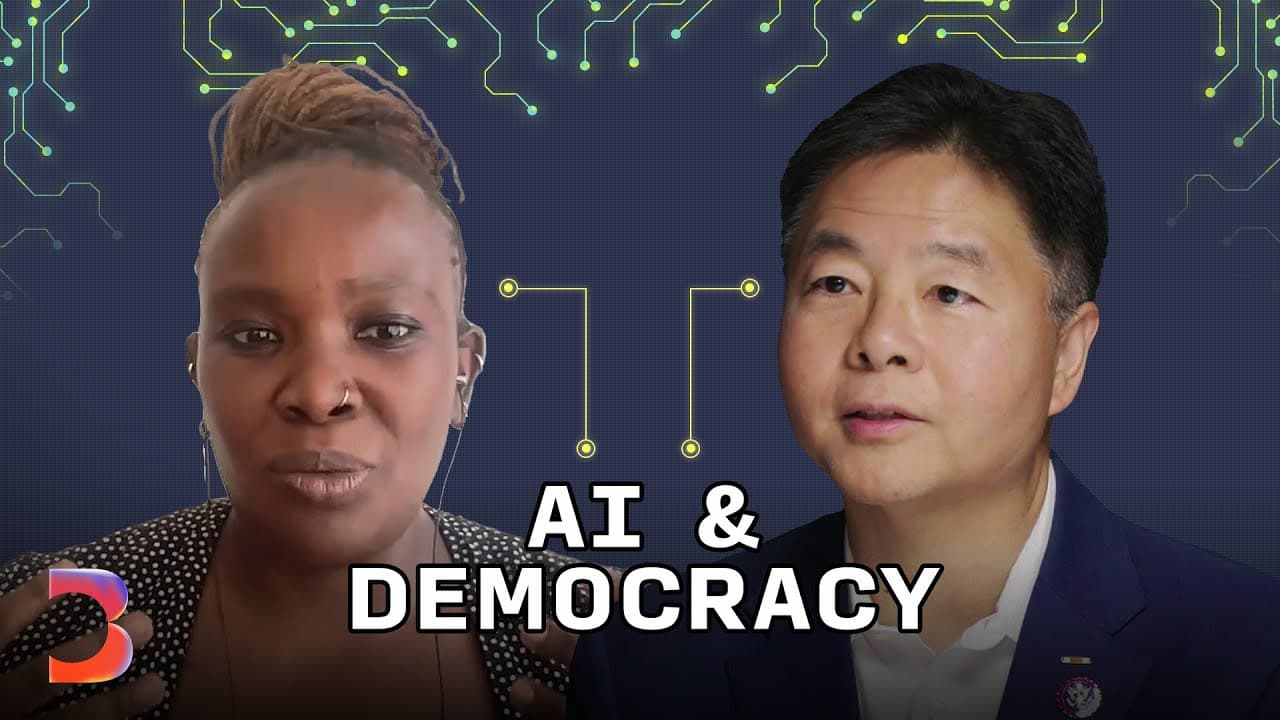
Will 2024 Elections Be Safe From AI? | AI IRL
TL;DR
AI could disrupt elections, testing democratic resilience globally.
Transcript
The rise of artificial intelligence, is raising fresh fears about technology's role in distorting the truth. It's setting up a test of the strength and resilience of democratic institutions across the globe. And it comes at a time when many governments are grappling with the power of social media, and its ability to stoke division. So in an effort ... Read More
Key Insights
- Artificial intelligence is raising concerns about its potential to distort truth and impact democratic processes globally. Lawmakers are attempting to establish regulations despite not fully understanding the technology.
- AI's ability to create convincing fake videos and voices poses significant risks to democracy, similar to how social media eroded public trust in institutions.
- AI's rapid advancement might outpace legislative efforts, potentially leading to significant societal disruptions, particularly in the labor market and information dissemination.
- A national bipartisan commission has been proposed to recommend AI regulations, aiming for a swift process to avoid delaying necessary legislative actions.
- AI's potential to influence elections is significant, though experts believe it might not be the deciding factor in the 2024 U.S. elections, where issues like abortion may play a larger role.
- The use of AI in political campaigns is expected to grow, raising questions about intellectual property rights and the monetization of AI-generated content.
- In Africa, AI is being used both positively, like in service provision in local languages, and negatively, such as in spreading misinformation during elections.
- AI's role in geopolitical dynamics is complex, with Africa being a frontier for digital transformation influenced by both U.S. and Chinese technologies.
Install to Summarize YouTube Videos and Get Transcripts
Explore YouTube Video Summarizer or Get YouTube Transcript Extractor
Questions & Answers
Q: What risks does AI pose to democracy?
AI poses risks to democracy by enabling the creation of fake videos and voices, which can mislead the public and erode trust in institutions. This capability mirrors the impact of social media, which has already contributed to public skepticism towards information and authorities.
Q: How are lawmakers addressing AI regulation?
Lawmakers are attempting to address AI regulation by proposing a national bipartisan commission to make recommendations. The aim is to quickly establish guidelines to prevent AI from causing societal disruptions, though challenges remain due to the rapid pace of AI advancement and lawmakers' limited understanding of the technology.
Q: Can AI decide the 2024 U.S. election?
Experts believe AI will not be the deciding factor in the 2024 U.S. election. While AI can influence public perception through fake content, the election is expected to hinge on key issues like abortion. However, AI's role in shaping political narratives and campaigns is anticipated to grow.
Q: What role does AI play in Africa's digital transformation?
In Africa, AI plays a dual role in digital transformation. Positively, it aids in service provision by incorporating local languages. Negatively, it accelerates misinformation spread during elections. The continent's digital policies are influenced by both U.S. and Chinese technologies, making it a geopolitical frontier for AI.
Q: How might AI affect the labor market?
AI is expected to significantly impact the labor market by automating jobs and increasing efficiency. This could lead to job displacement or necessitate new work models, like a four-day workweek. Policymakers are challenged to prepare for these changes while maximizing AI's benefits and minimizing disruptions.
Q: Is AI regulation a bipartisan issue?
AI regulation is largely seen as a bipartisan issue, focusing on maximizing benefits and minimizing harms. Unlike other political issues, AI is viewed as a tool rather than a partisan subject, allowing lawmakers from both parties to collaborate on establishing guidelines for its use.
Q: What challenges exist in regulating AI in Africa?
Regulating AI in Africa involves addressing the balance between leveraging digital technologies for development and managing geopolitical influences from the U.S. and China. Equitable AI deployment is crucial, requiring transparent and accountable systems to ensure fair service provision and prevent exploitation.
Q: How does AI's potential for bias impact society?
AI's potential for bias can harm society by reinforcing stereotypes and inequalities, particularly in areas like hiring and credit risk assessments. Addressing these biases requires ongoing scrutiny and regulation to ensure AI systems are fair and do not perpetuate existing social injustices.
Summary & Key Takeaways
-
The rise of AI is causing concern about its potential to distort truth and impact democratic processes worldwide. Lawmakers are working to establish regulations, though they face challenges due to a lack of understanding of the technology.
-
AI's ability to create fake videos and voices poses risks to democracy similar to those posed by social media. A national bipartisan commission has been proposed to recommend AI regulations, aiming for swift action to avoid delaying necessary legislation.
-
AI's influence on elections is significant, but experts believe it may not be the deciding factor in the 2024 U.S. elections. In Africa, AI is used both positively and negatively, impacting service provision and spreading misinformation.
Read in Other Languages (beta)
Share This Summary 📚
Summarize YouTube Videos and Get Video Transcripts with 1-Click
Try YouTube Summary with ChatGPT & Claude or YouTube Transcript Generator
Explore More Summaries from Bloomberg Originals 📚




Summarize YouTube Videos and Get Video Transcripts with 1-Click
Try YouTube Summary with ChatGPT & Claude or YouTube Transcript Generator