How Does the James Webb Telescope Explore the Universe?
TL;DR
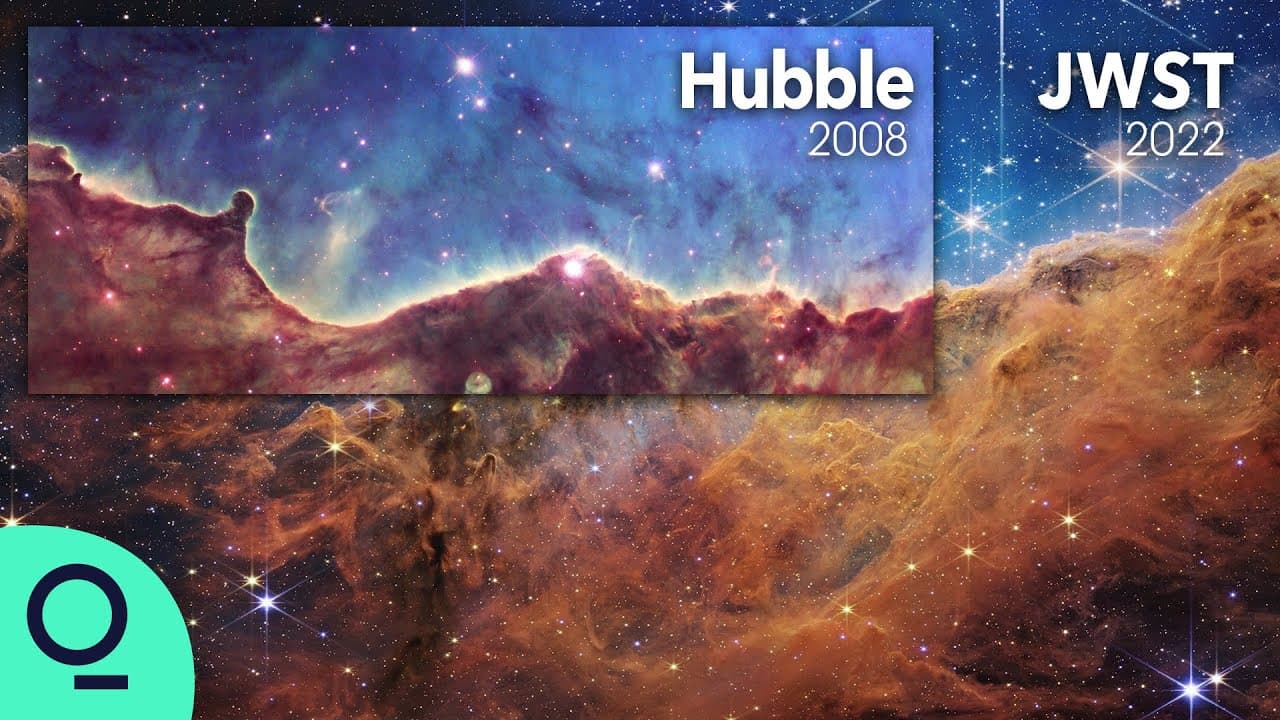
The James Webb Space Telescope (JWST) is a groundbreaking instrument that allows scientists to observe the universe's earliest galaxies, star-forming regions, and exoplanets. It operates in the infrared spectrum, enabling it to see objects that are invisible to optical telescopes like Hubble. JWST's advanced capabilities promise to uncover new cosmic phenomena and deepen our understanding of the universe.
Transcript
Space Telescope is in a way a little like Galileo's first telescope. Wherever Galileo pointed his telescope, he made major new discoveries. Look at the Moon, you find mountains and craters, look at Saturn, you find rings, look at the Milky Way and you find that it is littered and composed of stars. If you could look back in time, when would you loo... Read More
Key Insights
- The James Webb Space Telescope (JWST) is 100 times more powerful than Hubble and operates in the infrared spectrum.
- JWST can see back to the beginning of the Universe, observing galaxies from 13.5 billion years ago.
- Infrared capabilities allow JWST to detect light from the earliest galaxies, which are redshifted beyond Hubble's optical range.
- JWST's COSMOS-Webb survey will explore a vast area of the sky, observing thousands of galaxies.
- The telescope's design includes a 6.5-meter mirror and a tennis court-sized sunshield to keep it cold.
- JWST's instruments can analyze star and galaxy compositions, offering insights into their formation and evolution.
- The Trappist-1 system, with multiple Earth-like planets, is a key target for studying exoplanet atmospheres.
- JWST's collaborative development involved NASA, the European Space Agency, and the Canadian Space Agency.
Install to Summarize YouTube Videos and Get Transcripts
Explore YouTube Video Summarizer or Get YouTube Transcript Extractor
Questions & Answers
Q: How does the James Webb Space Telescope differ from Hubble?
The James Webb Space Telescope (JWST) differs from Hubble in several key ways. It is 100 times more powerful and operates primarily in the infrared spectrum, allowing it to see objects that are invisible to Hubble's optical capabilities. JWST's design includes a larger mirror and a sunshield to keep it cold, enabling it to detect faint infrared light from distant galaxies and cosmic phenomena.
Q: What is the COSMOS-Webb survey?
The COSMOS-Webb survey is a major observational program of the James Webb Space Telescope (JWST) aimed at exploring a vast area of the sky. It seeks to observe thousands of galaxies, looking 13.5 billion years into the past. By doing so, the survey hopes to provide a deeper understanding of the universe's earliest structures and how galaxies have evolved over time.
Q: Why is infrared capability important for JWST?
Infrared capability is crucial for the James Webb Space Telescope (JWST) because it allows the telescope to detect light from the universe's earliest galaxies. As the universe expands, light from distant galaxies is redshifted into the infrared spectrum. JWST's ability to operate in this spectrum enables it to observe these galaxies, which are invisible to optical telescopes like Hubble.
Q: What are the key targets for JWST's first cycle of operations?
During its first cycle of operations, the James Webb Space Telescope (JWST) will focus on several key targets, including the earliest galaxies, red giant stars in the Andromeda Galaxy, star-forming regions in the Milky Way and nearby galaxies, the Trappist-1 exoplanet system, and trans-Neptunian objects beyond Neptune. These observations aim to deepen our understanding of cosmic phenomena and the universe's history.
Q: How does JWST study exoplanet atmospheres?
The James Webb Space Telescope (JWST) studies exoplanet atmospheres using its advanced infrared instruments. By observing the light filtered through an exoplanet's atmosphere as it transits its star, JWST can perform transit spectroscopy. This technique reveals the chemical composition of the atmosphere, including potential indicators of habitability like water vapor, carbon dioxide, and methane.
Q: What makes the Trappist-1 system significant for JWST?
The Trappist-1 system is significant for the James Webb Space Telescope (JWST) because it contains multiple Earth-sized planets in the habitable zone, where conditions might support liquid water and life. JWST's powerful instruments will focus on detecting and analyzing the atmospheres of these planets, searching for signs of habitability and potentially life-supporting conditions.
Q: How does JWST's design support its mission?
The design of the James Webb Space Telescope (JWST) supports its mission by incorporating a large 6.5-meter mirror and a tennis court-sized sunshield. These features keep the telescope extremely cold, allowing it to detect faint infrared light from distant cosmic objects. JWST's innovative design enables it to observe the universe's earliest galaxies and study the formation and evolution of stars and planets.
Q: What is the significance of JWST's collaborative development?
The collaborative development of the James Webb Space Telescope (JWST) is significant because it highlights international cooperation in space exploration. Involving NASA, the European Space Agency, and the Canadian Space Agency, this partnership pooled resources and expertise to build a more capable and sophisticated telescope. Such collaboration ensures that JWST can address a wide range of scientific goals and benefit astronomers worldwide.
Summary & Key Takeaways
-
The James Webb Space Telescope (JWST) is revolutionizing our understanding of the universe by observing the earliest galaxies and star-forming regions. Its infrared capabilities allow it to detect light from the universe's infancy, providing insights into galaxy formation and evolution. JWST's advanced design and instruments enable it to study exoplanet atmospheres, potentially identifying habitable conditions beyond our solar system.
-
JWST's COSMOS-Webb survey is set to explore a large area of the sky, observing thousands of galaxies and offering a deeper look into the universe's history. The telescope's innovative design, including a large mirror and sunshield, keeps it cold enough to detect faint infrared light, crucial for studying distant cosmic objects.
-
Collaboratively developed by NASA, the European Space Agency, and the Canadian Space Agency, JWST is a testament to international cooperation in space exploration. Its ability to analyze the composition of stars and galaxies promises to uncover new cosmic phenomena, making it a vital tool for astronomers worldwide.
Read in Other Languages (beta)
Share This Summary 📚
Summarize YouTube Videos and Get Video Transcripts with 1-Click
Try YouTube Summary with ChatGPT & Claude or YouTube Transcript Generator
Explore More Summaries from Bloomberg Originals 📚






Summarize YouTube Videos and Get Video Transcripts with 1-Click
Try YouTube Summary with ChatGPT & Claude or YouTube Transcript Generator