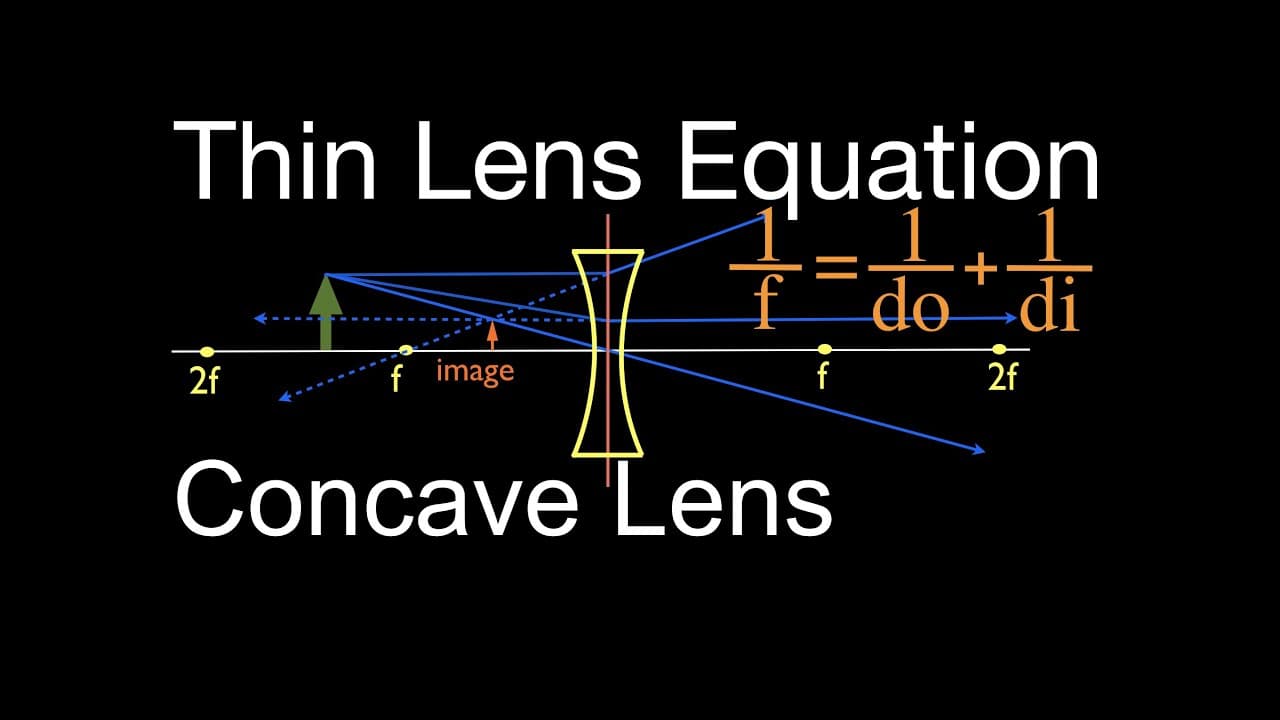
Thin Lens Equation (6 of 6) Concave Lens
TL;DR
Learn how to use the thin lens equation to calculate image height, distance, size, and orientation for a concave lens.
Transcript
okay in today's video I'm going to go over how to use the thin lens equation for calculations of image height image distance size and orientation for a concave lens this is our problem we have an object it's eight point five centimeters tall it's place 11 centimeters from our concave lens and this concave lens has a focal length of 6 centimeters an... Read More
Key Insights
- ❎ Concave lenses have negative focal lengths.
- 🛩️ The image distance for a concave lens is always smaller than the object distance.
- 🛩️ The image height for a concave lens is always smaller than the object height.
- ❓ The magnification for a concave lens can be positive.
- ❓ The image of a concave lens is virtual and appears on the same side as the object.
- ❓ The image distance for a concave lens is always less than the focal length.
- ❓ The orientation of the image for a concave lens is the same as the object.
Install to Summarize YouTube Videos and Get Transcripts
Explore YouTube Video Summarizer or Get YouTube Transcript Extractor
Questions & Answers
Q: How do you determine the image distance for a concave lens?
To determine the image distance for a concave lens, the thin lens equation (1/F = 1/do + 1/di) is used. By substituting the appropriate values, including the negative focal length, you can solve for the image distance.
Q: Is the image height for a concave lens always smaller than the object height?
Yes, according to the video, the image height for a concave lens will always be smaller than the object height. This is a characteristic of concave lenses and can be deduced from the magnification equation.
Q: Can the image distance for a concave lens be greater than the focal length?
No, the image distance for a concave lens must always be less than the focal length. This is because the image appears on the same side as the object and is closer to the lens.
Q: What does a positive magnification value indicate for a concave lens?
A positive magnification value for a concave lens indicates that the image is upright and has the same orientation as the object. This means the image is not inverted.
Summary & Key Takeaways
-
The video discusses how to use the thin lens equation to solve for image height and distance for a concave lens.
-
It emphasizes the importance of recognizing negative focal lengths for concave lenses and carrying the negative through calculations.
-
The video explains that the image distance for a concave lens will always be smaller than the object distance, and the image height will always be smaller than the object height.
Read in Other Languages (beta)
Share This Summary 📚
Summarize YouTube Videos and Get Video Transcripts with 1-Click
Try YouTube Summary with ChatGPT & Claude or YouTube Transcript Generator
Explore More Summaries from Step by Step Science 📚
Summarize YouTube Videos and Get Video Transcripts with 1-Click
Try YouTube Summary with ChatGPT & Claude or YouTube Transcript Generator