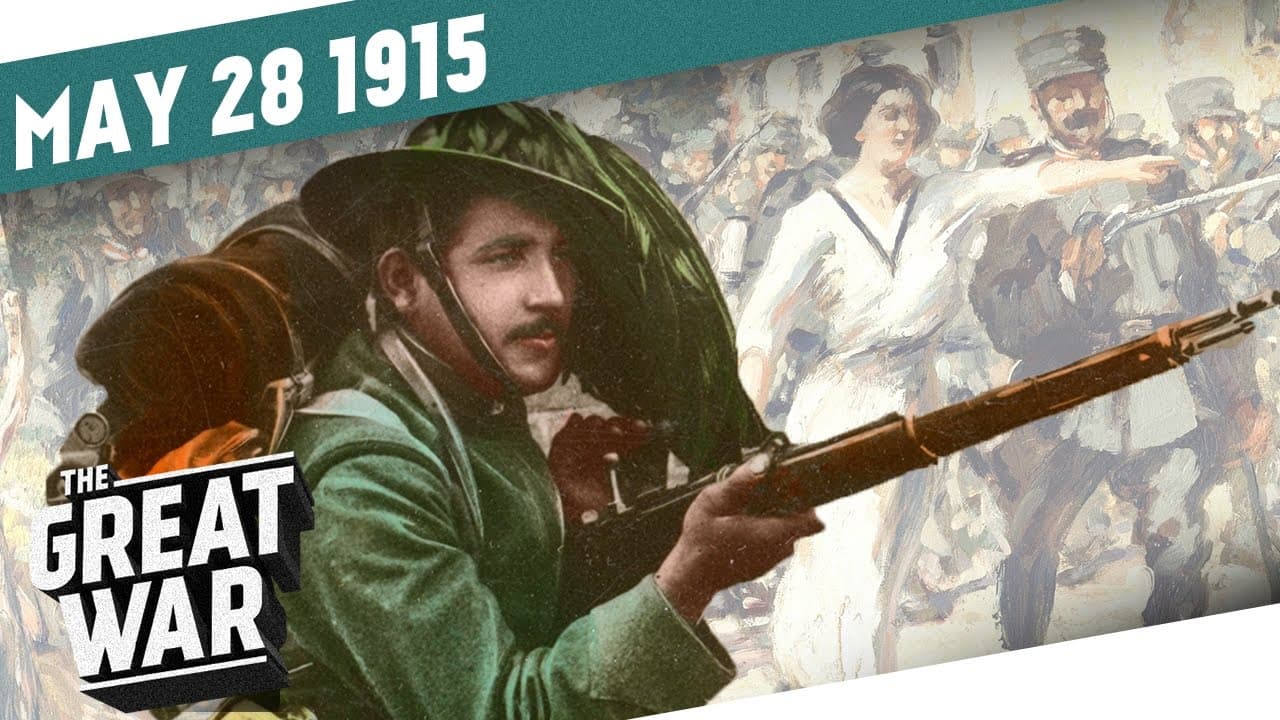
The New Alpine Front - Italy Joins World War 1 I THE GREAT WAR Week 44
TL;DR
Italy joins WWI for territorial gain, opening a new front.
Transcript
This month has been a blockbuster month in terms of actions and reactions all over the map, and this week is no exception. Remember last month when the Allies opened a new front at Gallipoli? Well, this week yet another front opens as Italy joins the war. I’m Indy Neidell; welcome to the Great War. Last week, the Germans and Austrians had knocked b... Read More
Key Insights
- Italy declared war on the Austro-Hungarian Empire on May 23, 1915, aiming for territorial gains despite being underprepared militarily and economically.
- The Italian army faced significant challenges, including insufficient equipment for its 1.2 million mobilized men and lack of heavy artillery, especially needed for the mountainous terrain.
- Italy's entry into the war opened a new front, characterized by harsh mountainous conditions, making it a challenging battleground for both offensive and defensive operations.
- The Gallipoli front remained at a standstill, with trench warfare dominating, but saw naval action as German U-boats sank British battleships, impacting Allied naval strategies.
- The Second Battle of Ypres ended with high casualties, highlighting the horrors of gas warfare and the continued stalemate on the Western Front.
- Russia experienced mixed fortunes, retreating in Galicia but making advances in Lithuania, Persia, and Eastern Anatolia, showcasing the dynamic nature of the Eastern Front.
- A treaty between China and Japan on May 25, 1915, expanded Japanese influence in China, reflecting broader geopolitical shifts during the war.
- Italy's decision to join the Allies was influenced by territorial disputes and a strategic opportunity to weaken Austria-Hungary, though it led to significant loss of life.
Install to Summarize YouTube Videos and Get Transcripts
Explore YouTube Video Summarizer or Get YouTube Transcript Extractor
Questions & Answers
Q: Why did Italy join World War I?
Italy joined World War I on May 23, 1915, primarily for territorial gains. The Italian government sought to reclaim disputed territories from Austria-Hungary, taking advantage of the latter's military setbacks against Russia. Italy's entry was also influenced by its strategic calculations to align with the Allies, despite its initial commitments to the Central Powers.
Q: What challenges did the Italian army face upon entering the war?
The Italian army faced significant challenges, including inadequate equipment for its 1.2 million mobilized soldiers, as they only had enough for 700,000. Additionally, Italy lacked heavy artillery and mountain guns, crucial for the mountainous terrain along the Austro-Hungarian border. These logistical and industrial shortcomings mirrored the issues faced by Russia at the war's outset.
Q: What was the significance of the Second Battle of Ypres?
The Second Battle of Ypres, which concluded during this week, was significant for its introduction of chemical warfare, as the Germans used poison gas against the Allies. Despite the horror and high casualties, the battle did not break the stalemate on the Western Front. The use of gas highlighted the brutal and evolving nature of warfare during World War I.
Q: How did the Gallipoli campaign progress during this period?
During this period, the Gallipoli campaign remained at a standstill, characterized by entrenched positions and limited movement. However, naval engagements became prominent as German U-boats sank British battleships, forcing the remaining ships to withdraw and providing Turkish forces relief from ongoing bombardment. This shift underscored the strategic importance of naval power in the campaign.
Q: What were the outcomes of Russia's military actions this week?
Russia experienced mixed outcomes this week. On the Eastern Front, Russian forces were pushed back in Galicia, with significant losses, as Austro-German forces advanced towards Przemysl. However, Russia achieved successes in other regions, capturing territories in Lithuania, Persia, and Eastern Anatolia, demonstrating the varied dynamics of the Eastern Front.
Q: What was the impact of the treaty between China and Japan?
The treaty signed on May 25, 1915, between China and Japan expanded Japanese influence in China, including the opening of new treaty ports and extended leases. This agreement reflected Japan's growing power in Asia and its strategic interests during World War I, highlighting the broader geopolitical shifts and colonial ambitions that accompanied the war.
Q: How did Italy's entry into the war affect Austria-Hungary?
Italy's entry into the war posed a new challenge for Austria-Hungary, opening a new front that stretched its military resources. Although initially seen as an opportunity for Italy to exploit Austria-Hungary's vulnerabilities, the renewed German support for Austria-Hungary and the challenging mountainous terrain made significant Italian advances difficult, complicating the strategic situation for both sides.
Q: What were the broader implications of Italy joining the Allies?
Italy joining the Allies added another front to the already complex World War I landscape, increasing the scale and scope of the conflict. While Italy hoped for territorial gains, the decision resulted in heavy casualties and prolonged the war. It also influenced diplomatic dynamics, as the Allies sought to leverage Italy's involvement to pressure Austria-Hungary and potentially force a separate peace.
Summary & Key Takeaways
-
Italy entered World War I on May 23, 1915, declaring war on Austria-Hungary to reclaim disputed territories. Despite mobilizing 1.2 million men, Italy faced equipment shortages and logistical challenges, especially in the mountainous battlefronts.
-
The Gallipoli campaign remained stagnant, with trench warfare prevailing, but saw significant naval action as German U-boats sank British battleships. This development provided relief to Turkish forces from constant bombardment.
-
On the Eastern Front, Russia faced setbacks in Galicia but made gains in other regions. Meanwhile, a treaty between China and Japan signaled changing power dynamics in Asia, showcasing the global impact of the war.
Read in Other Languages (beta)
Share This Summary 📚
Summarize YouTube Videos and Get Video Transcripts with 1-Click
Try YouTube Summary with ChatGPT & Claude or YouTube Transcript Generator
Explore More Summaries from The Great War 📚
Summarize YouTube Videos and Get Video Transcripts with 1-Click
Try YouTube Summary with ChatGPT & Claude or YouTube Transcript Generator